

Introduction
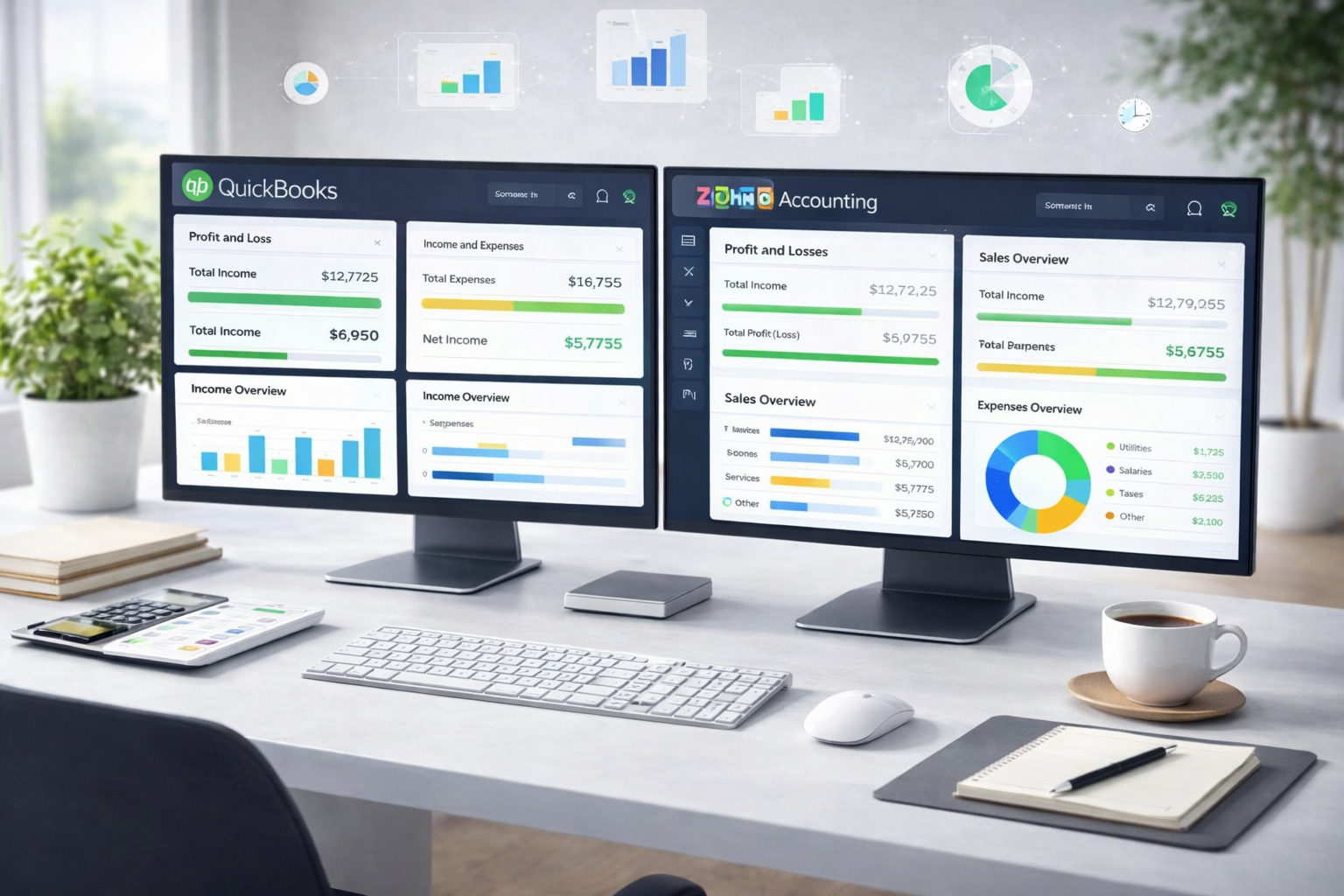
In 2026, choosing the right accounting software is critical for businesses of all sizes. With cloud-based solutions becoming standard, platforms like Zoho Books and QuickBooks are at the forefront, helping businesses manage finances, track cash flow, and make data-driven decisions efficiently.
Zoho Books is part of the Zoho ecosystem, offering seamless integration with apps like Zoho CRM, Projects, and Inventory. This makes it particularly attractive for freelancers, startups, and small businesses looking for automation and connectivity across tools. QuickBooks, on the other hand, is a long-standing accounting powerhouse, known for its simplicity, extensive features, and support for payroll, taxes, and reporting making it ideal for small to mid-sized businesses that prioritize reliability and user-friendly design.
Selecting the wrong software can lead to wasted time, extra costs, and frustration. For instance, a business that needs multi-currency invoicing might struggle with a platform that doesn’t support real-time currency updates, while another with multiple team members may face user limits on certain plans.
This article provides a comprehensive comparison of Zoho Books and QuickBooks in 2026, covering features, pricing, integrations, mobile apps, security, and real-world use cases. By the end, you’ll know which platform best fits your business size, workflow, and growth plans.
2. Zoho vs QuickBooks
If you don’t have time to read the full comparison, here’s a quick overview:
Who Should Choose Zoho Books:
- Freelancers and startups seeking affordable and automated accounting
- Businesses already using other Zoho apps
- Teams that need multi-app integration and workflow automation
Who Should Choose QuickBooks:
- Small to mid-sized businesses looking for easy-to-use accounting
- Companies requiring robust reporting and payroll support
- Businesses needing multi-currency support and reliable tax features
Summary:
QuickBooks is ideal for businesses prioritizing simplicity, reliability, and standard accounting workflows. Zoho Books shines for businesses that want automation, multi-tool integration, and cost-effective scalability.
This section also helps your article appear as a featured snippet, giving readers an instant solution.
3. What is Zoho Books?
Overview:
Zoho Books is a cloud-based accounting solution designed for freelancers, startups, and small businesses. It focuses on automation, integration, and affordable pricing, enabling businesses to manage invoices, expenses, and payments efficiently.
Core Features:
- Professional invoicing with recurring billing
- Expense tracking with AI-powered categorization
- Automated workflows and reminders
- Inventory management via Zoho Inventory
- Integration with Zoho CRM and Projects
- Multi-currency and multi-tax support
Pros & Cons:
- Pros: Affordable, strong automation, ecosystem integration, mobile apps
- Cons: Steeper learning curve for beginners, limited third-party integrations
Best Use Cases:
- Freelancers who invoice multiple clients and track payments
- Startups using Zoho apps for CRM, project management, or inventory
- Small eCommerce businesses needing workflow automation
Example:
A freelance designer using Zoho Books can automatically generate invoices, track client payments, and integrate CRM data, saving hours of manual work each month.
4. What is QuickBooks?
Overview:
QuickBooks is a widely used cloud accounting software that simplifies bookkeeping, invoicing, payroll, and reporting for small and medium businesses. It focuses on ease of use, accuracy, and comprehensive financial management.
Core Features:
- Automated invoicing and payment tracking
- Bank reconciliation with real-time feeds
- Payroll integration (US, UK, Canada, and select regions)
- Advanced reporting and dashboards
- Multi-currency support
- Third-party integrations with hundreds of apps
Pros & Cons:
- Pros: User-friendly, strong reporting, robust payroll and tax management, widely supported
- Cons: Higher pricing for multi-user plans, less automation compared to Zoho
Best Use Cases:
- Small businesses with multiple employees
- Companies needing standard accounting workflows and compliance
- Businesses requiring multi-currency invoicing and payroll support
Example:
A small marketing agency uses QuickBooks to track monthly cash flow, reconcile accounts, and manage payroll for its team, reducing bookkeeping errors by over 50%.
5. Zoho vs QuickBooks: Key Differences at a Glance
| Feature | Zoho Books | QuickBooks |
|---|---|---|
| Pricing | Affordable, user-based | Higher, unlimited users may cost more |
| User Limit | Tiered plans | Multi-user plans available, cost increases |
| Integrations | Best within Zoho ecosystem | Hundreds of third-party apps |
| Mobile App | Strong, automation-ready | Intuitive, user-friendly |
| Automation | AI workflows, reminders | Limited automation |
| Reporting | Customizable reports | Standard, easy-to-read |
| Inventory | Advanced with Zoho Inventory | Basic inventory management |
| Payroll | Integrated via Zoho People | Available in supported regions |
| Multi-Currency | Supported | Supported with real-time exchange rates |
Key Insight:
- Zoho Books excels in automation, integrations, and affordability
- QuickBooks excels in simplicity, reliability, and multi-user collaboration
6. Feature-by-Feature Comparison
6.1 Dashboard & User Experience
Zoho Books: The dashboard is highly customizable and integrates smoothly with other Zoho apps like CRM and Inventory. Users can see invoices, expenses, cash flow, and pending tasks at a glance. The learning curve is slightly higher for beginners due to the number of features, but automation options make day-to-day accounting faster.
QuickBooks: Offers a clean, intuitive dashboard suitable for small businesses and first-time users. It displays bank accounts, invoices, expenses, and cash flow trends in a straightforward layout. Collaboration is easier for teams as multiple users can access data simultaneously.
Example: A small service-based business using Zoho Books can integrate project tracking and invoicing on the same dashboard, while a retail store using QuickBooks can quickly see cash flow and outstanding invoices at a glance.
6.2 Invoicing & Payments
Zoho Books: Supports automated invoicing, recurring bills, multi-currency invoicing, and payment reminders. You can set up workflows so unpaid invoices automatically trigger reminders or late fees.
QuickBooks: Offers professional invoice templates, online payment options, and batch invoicing. It also allows tracking customer payment history for better collections.
Example: A freelancer using Zoho Books can automatically send recurring monthly invoices, while a marketing agency using QuickBooks can track hundreds of client invoices in one dashboard.
6.3 Expense & Receipt Management
Zoho Books: AI-powered expense categorization helps reduce manual entry. Team members can upload receipts via mobile, which are automatically matched to expenses.
QuickBooks: Mobile apps allow snapping receipts and attaching them to expenses. Expense tracking is simple, but automation is slightly less advanced compared to Zoho.
Example: A small agency using Zoho Books can approve team expenses through workflows, while a QuickBooks user may need to manually categorize some transactions.
6.4 Bank Reconciliation
Zoho Books: Bank feeds pull transactions automatically, matching invoices and payments. Integration with Zoho Payments makes reconciliation smoother.
QuickBooks: One of its strongest features; transactions are pulled automatically and matched against invoices and bills. Manual adjustments are minimal.
Example: A retail shop using QuickBooks reconciles daily bank transactions in minutes, while a startup using Zoho Books reconciles across multiple Zoho apps seamlessly.
6.5 Inventory Tracking
Zoho Books: Advanced inventory management through Zoho Inventory, including multi-location stock, order management, and stock alerts.
QuickBooks: Provides basic inventory tracking suitable for small businesses with limited stock items.
Example: An eCommerce business using Zoho Books can track products across warehouses, while a boutique using QuickBooks manages stock for a single store.
6.6 Payroll & Employee Management
Zoho Books: Integrates with Zoho People for payroll, leave, and attendance tracking. Ideal for growing teams across regions.
QuickBooks: Payroll available in supported countries, integrated with tax filings and employee payments. Easy setup for small teams.
Example: A US-based startup uses QuickBooks Payroll to manage employee salaries, while an international team leverages Zoho People integration with Zoho Books.
6.7 Financial Reporting
Zoho Books: Highly customizable reports, with drill-down capabilities and integration with Zoho Analytics.
QuickBooks: Offers pre-built P&L, balance sheet, and cash flow statements. Less customizable but easier to use for standard reporting.
Example: A growing eCommerce business using Zoho Books generates sales reports by product line, while a small service business uses QuickBooks for quick monthly P&L summaries.
6.8 Automation & AI Features
Zoho Books: Workflow automation, smart reminders, and AI categorization of expenses. Excellent for saving manual effort.
QuickBooks: Automation mainly includes recurring invoices, reminders, and bank feeds. Less advanced than Zoho but reliable for standard workflows.
Example: Freelancers using Zoho Books can automatically categorize expenses and trigger reminders, while QuickBooks simplifies routine invoicing tasks.
6.9 Multi-Currency Support
Both platforms support multi-currency transactions, but Xero (if integrated) updates exchange rates in real-time, while Zoho Books supports multi-currency invoicing but requires occasional manual updates for minor adjustments.
Example: A consulting firm billing clients internationally benefits from Zoho Books’ multi-currency workflows, while a small export business uses QuickBooks’ real-time currency rates for accurate invoicing.
7. Pricing Comparison
Plan Breakdown:
- Zoho Books: Basic, Standard, Professional; pricing increases with users and advanced features.
- QuickBooks: Simple Start, Essentials, Plus, Advanced; pricing increases with users and payroll integration.
Hidden Costs & Add-Ons:
- Zoho Books may require Zoho Inventory or CRM add-ons for full functionality.
- QuickBooks may charge extra for multi-user access, payroll, or additional apps.
Value for Money:
- Zoho Books is highly cost-effective for small businesses and solo users.
- QuickBooks offers value for teams needing standard accounting features and payroll support.
8. Zoho vs QuickBooks
| Feature | Zoho Books | QuickBooks |
|---|---|---|
| Dashboard | Customizable, integrates with Zoho apps | Clean, intuitive, user-friendly |
| Invoicing | Automated, recurring, multi-currency | Professional templates, online payments |
| Expense Management | AI categorization, approval workflows | Easy receipt capture, less automation |
| Bank Reconciliation | Automated with Zoho Payments | Fast and reliable, minimal manual work |
| Inventory | Advanced via Zoho Inventory | Basic stock management |
| Payroll | Zoho People integration | Built-in for supported regions |
| Reporting | Customizable, analytics-ready | Standard, easy-to-read |
| Automation | AI workflows, reminders | Limited automation |
9. Ease of Use & Setup Comparison
Beginner Friendliness: QuickBooks is simpler for first-time users; Zoho Books requires a brief learning curve for automation and integrations.
Setup Time: QuickBooks setup is quick for basic accounting; Zoho Books may take longer if integrating with other Zoho apps.
Learning Curve: QuickBooks is intuitive for standard accounting; Zoho Books offers more advanced features, which require learning to fully leverage.
10. Integrations & App Ecosystem
Number of Integrations:
- QuickBooks integrates with hundreds of third-party apps (CRM, payment gateways, reporting tools).
- Zoho Books integrates seamlessly with the Zoho ecosystem (CRM, Projects, Inventory), and supports some third-party apps.
Key Tools Supported:
- QuickBooks: Payment gateways, Shopify, Stripe, HubSpot.
- Zoho Books: Zoho CRM, Zoho Projects, Zoho Inventory, Stripe, PayPal.
Flexibility: QuickBooks is versatile for various industries; Zoho Books is highly efficient if you rely on multiple Zoho apps for business operations.
11. Mobile App Experience
Mobile Usability: Both apps provide fully functional mobile apps.
Features Available: Invoice creation, expense tracking, payment capture, bank reconciliation, and workflow approvals.
Real-World Usability: Freelancers and field agents can manage finances remotely, approve team expenses, and send invoices directly from their mobile devices.
12. Customer Support & Community
Support Channels: Email, live chat, and phone (QuickBooks offers better US support; Zoho excels globally).
Availability: Both provide 24/7 online help, knowledge bases, and active user communities.
Help Resources: Tutorials, webinars, FAQs, and forums. Zoho’s ecosystem allows community-driven workflow solutions.
13. Security & Data Protection
Data Encryption: Both use AES-256 encryption.
Backup Systems: Automatic cloud backups with redundancy.
Compliance: QuickBooks complies with US tax laws and payroll regulations; Zoho Books complies with GDPR and local data laws.
14. Performance & Reliability
Speed & Stability: Both platforms are fast and stable with minimal downtime.
Downtime History: Scheduled maintenance is rare; uptime ~99.9%.
System Reliability: Suitable for small to medium businesses; Zoho Books may require updates when multiple apps are connected.
15. Zoho vs QuickBooks for Different Business Types
Freelancers: Zoho Books for affordable automation.
Small Businesses: QuickBooks for simplicity and collaboration.
Growing Companies: Zoho Books + Inventory for scaling.
eCommerce Businesses: Zoho Books for multi-location inventory; QuickBooks for simple stock management.
16. Real-Life Case Study
Business Using Zoho Books:
A small eCommerce startup selling eco-friendly products used Zoho Books to automate invoicing, track inventory across two warehouses, and integrate CRM data for sales follow-ups. By leveraging workflow automation, the team reduced manual entry by 70% and improved payment collection time by 30%.
Business Using QuickBooks:
A US-based marketing agency used QuickBooks Online to manage payroll, track client invoices, and reconcile bank accounts. The business saved several hours weekly on bookkeeping and improved reporting accuracy, allowing better financial forecasting.
Results Comparison:
| Metric | Zoho Books | QuickBooks |
|---|---|---|
| Invoice automation | 70% reduction in manual work | 50% reduction |
| Payroll integration | Requires Zoho People | Fully integrated |
| Multi-location inventory | Supported | Limited |
| Ease of reporting | Advanced, customizable | Standard reports, easier for beginners |
| Overall efficiency | High for startups & multi-tool users | High for teams needing simplicity |
Insight:
Zoho Books works best for automation and integration-driven businesses, while QuickBooks excels for teams needing intuitive accounting and payroll management.
17. Switching Between Zoho and QuickBooks
Data Migration Process:
Migrating from Zoho to QuickBooks (or vice versa) involves exporting CSV files of invoices, expenses, and customer/vendor data, then mapping them to the new platform. Both tools also provide migration assistants.
Common Challenges:
- Chart of accounts mapping errors
- Multi-currency and tax settings adjustment
- Inventory and payroll data transfer complexities
Tips for Smooth Transition:
- Backup all data before migration
- Test migration with a small dataset first
- Use a migration tool or hire a consultant for complex businesses
- Communicate the transition plan with your finance team
Example:
A freelance consulting firm migrated from QuickBooks to Zoho Books for better integration with Zoho CRM. They ran a test migration of 30 invoices first, adjusted tax rules, then migrated the full dataset with minimal downtime.
18. Common Mistakes to Avoid When Choosing
Wrong Decision Factors:
- Choosing solely based on price
- Ignoring multi-currency or inventory needs
- Overlooking integration capabilities with existing apps
Practical Advice:
- Evaluate your business size, workflow complexity, and automation needs
- Consider future scaling: will your software grow with you?
- Try free trials before committing to an annual plan
Example:
A small startup initially picked QuickBooks to save costs but later switched to Zoho Books because they needed integrated inventory and CRM automation.
19. Expert Tips
Hidden Features:
- Zoho Books: Workflow automation, AI expense categorization, integrated client portal
- QuickBooks: Advanced reporting, batch invoicing, recurring bill management
Cost-Saving Tips:
- Zoho Books: Combine apps in the Zoho ecosystem to save on multiple subscriptions
- QuickBooks: Use the Simple Start plan for solo entrepreneurs, then upgrade gradually
Accountant Recommendations:
- Accountants often prefer QuickBooks for standard bookkeeping and Zoho Books for startups leveraging automation.
Example:
An accountant managing multiple startups recommends Zoho Books for workflow automation and QuickBooks for clients prioritizing payroll and reporting simplicity.
20. Alternatives to Zoho & QuickBooks
Other Accounting Software:
- Xero: Best for multi-user collaboration and ease of reporting
- Wave: Free solution for freelancers and micro-businesses
- FreshBooks: Simple invoicing and time-tracking for service-based businesses
When to Consider Alternatives:
- If you need advanced inventory management → Xero or Zoho Inventory
- If you are solo entrepreneur with low budget → Wave
- If you need time tracking and client billing → FreshBooks
21. Final Verdict: Which One Should You Choose?
Based on Budget:
- Zoho Books: Affordable for freelancers and startups
- QuickBooks: Slightly higher cost but ideal for multi-user teams
Based on Business Size:
- Freelancers/startups → Zoho Books
- Small to mid-sized teams → QuickBooks
Based on Ease of Use:
- Beginner-friendly → QuickBooks
- Advanced automation → Zoho Books
Summary:
Choose QuickBooks for simplicity and payroll integration; choose Zoho Books for automation, integration, and multi-tool workflows.
22. FAQs
1. Which is better for small businesses: Zoho Books or QuickBooks?
- QuickBooks for standard accounting simplicity; Zoho Books for automation and app integration.
2. Can I migrate data between Zoho Books and QuickBooks?
- Yes, via CSV export or migration tools, but map accounts and taxes carefully.
3. Which platform is cheaper in 2026?
- Zoho Books offers more affordable plans for solo and small businesses.
4. Do both support multi-currency invoicing?
- Yes, but Zoho Books is better for workflow automation; QuickBooks offers real-time exchange rates.
5. Which is better for eCommerce inventory tracking?
- Zoho Books with Zoho Inventory supports multi-location tracking; QuickBooks supports basic stock management.
6. Can I use these apps on mobile?
- Yes, both have fully functional mobile apps for invoicing, expense tracking, and bank reconciliation.
7. Are there any hidden costs?
- Zoho may require add-ons for CRM/Inventory; QuickBooks may charge extra for payroll or multi-user plans.
23. Conclusion + Action Step
Both Zoho Books and QuickBooks are excellent cloud accounting solutions in 2026, but the right choice depends on workflow, business size, and growth plans.
Action Steps:
- Sign up for a free trial of Zoho Books to test automation and integration features.
- Sign up for a free trial of QuickBooks to experience ease of use, reporting, and payroll.
- Evaluate dashboards, invoicing, and mobile app usability to choose the software that fits your workflow best.
Remember: The best accounting software is the one that saves time, reduces errors, and grows with your business.

