

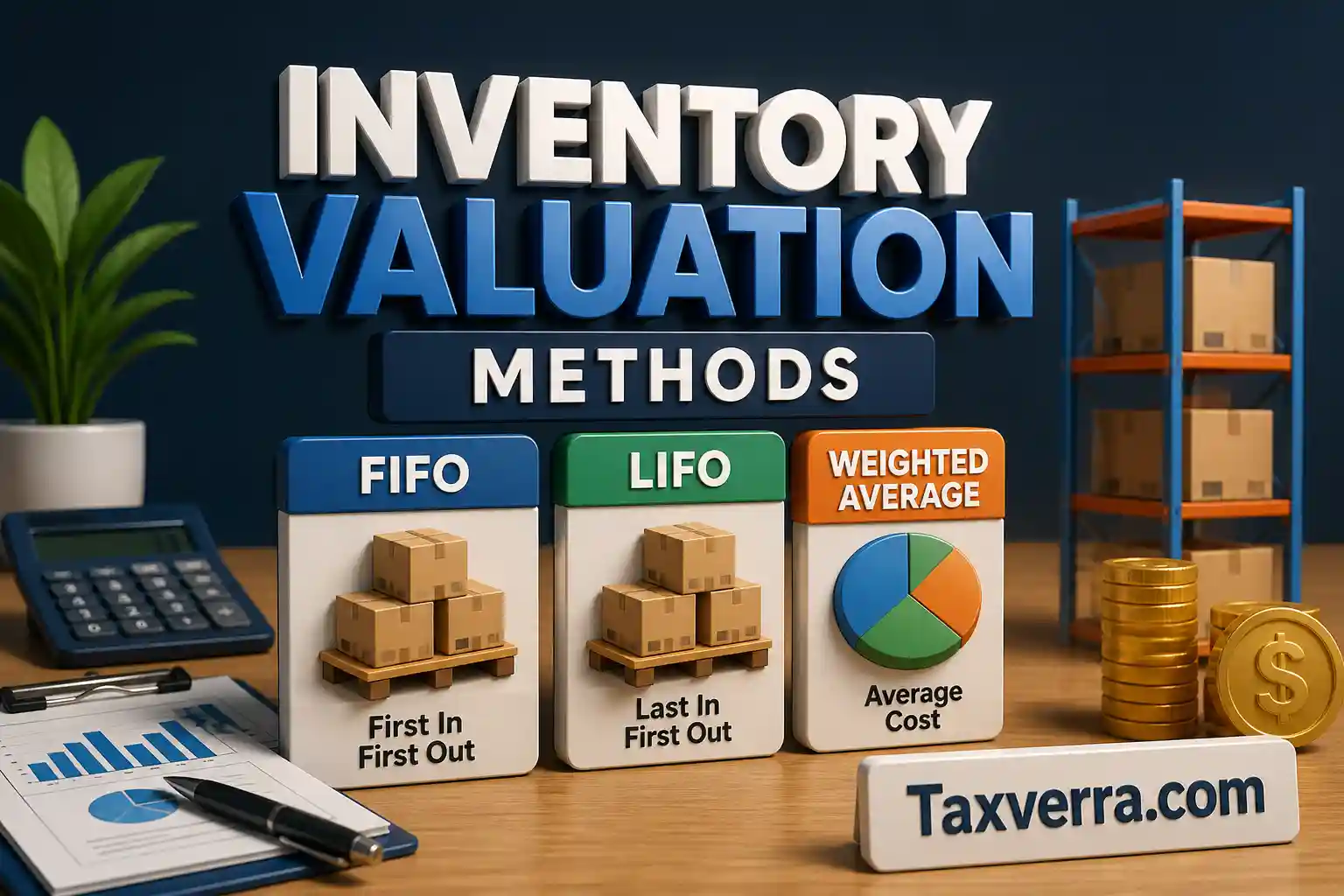
What Are Inventory Valuation Methods and Why They Matter in Real Accounting
Inventory valuation methods define how a business assigns cost to its inventory and ultimately determines cost of goods sold calculation and closing stock value. At a beginner level, think of inventory as money sitting on shelves. The method you choose decides how that money is measured in financial accounting inventory. In practice, inventory costing methods are not just accounting rules, they directly influence profit, taxes, and decision-making.
In my experience, many business owners assume inventory is simply counted physically, but the real complexity lies in valuation. Accounting inventory methods such as FIFO method, LIFO method, and weighted average method are built on cost flow assumptions, not physical movement. This is where most confusion begins.
A practical example is a retail client dealing in electronics. Prices fluctuate frequently, and the choice between stock valuation methods significantly changed their reported profits. Using FIFO during rising prices increased profits, while weighted average method gave a more stable margin.
Key reasons inventory valuation is important include accurate profit measurement, compliance with accounting principles inventory, and better business inventory management. Under IFRS inventory valuation rules, LIFO is not allowed, which often surprises businesses expanding internationally.
One mistake I often see is inconsistent application of methods. Businesses switch methods without understanding the impact, which creates compliance risks under GAAP inventory methods.
At an advanced level, inventory valuation techniques are used strategically. Companies may select a method that aligns with tax planning, financial reporting goals, or operational realities. Understanding inventory valuation explained at both conceptual and practical levels is essential for accountants and business owners alike.
Purpose and Importance of Inventory Valuation in Business Decisions
The purpose of inventory valuation goes beyond bookkeeping. It directly shapes how a business interprets its financial health and profitability. Inventory valuation methods are central to cost accounting methods and play a key role in cost of goods sold calculation, which ultimately affects net income.
From a practical standpoint, inventory valuation helps businesses answer three critical questions. How much profit did we actually make, what is the true value of our unsold stock, and how should we price our products going forward. These answers are not theoretical. They influence real-world decisions like pricing strategies, tax planning, and investment planning.
In my experience working with manufacturing clients, incorrect inventory valuation often leads to misleading profit figures. One client overstated profit simply because they ignored rising material costs while using outdated valuation techniques. Once corrected, their margins dropped significantly, but the numbers became realistic.
Inventory valuation is also essential for compliance. Financial accounting inventory must align with accounting principles inventory and reporting standards like GAAP inventory methods or IFRS inventory valuation. For example, IFRS prohibits LIFO method, which forces multinational businesses to adjust their reporting approach.
A practical example is a wholesale distributor dealing with seasonal goods. During inflation, FIFO method shows higher profits because older, cheaper inventory is recorded as sold. However, this also increases tax liability. On the other hand, weighted average method smooths out cost fluctuations, offering stability.
One mistake I often see is ignoring the impact on taxes. Businesses focus only on profit without realizing how inventory costing methods influence taxable income.
At a strategic level, inventory valuation techniques help businesses manage cash flow, optimize stock levels, and improve overall business inventory management. It is not just an accounting exercise, it is a decision-making tool.
Types of Inventory Costing Methods with Real Business Context
Inventory costing methods define how costs are assigned to inventory and cost of goods sold. The three primary methods are FIFO method, LIFO method, and weighted average method. Each has a different impact on financial accounting inventory and business outcomes.
FIFO method assumes the oldest inventory is sold first. This aligns closely with real-world flow in industries like food and pharmaceuticals. LIFO method assumes the newest inventory is sold first, which can reduce taxable income during inflation but is restricted under IFRS inventory valuation. Weighted average method calculates an average cost per unit, offering simplicity and consistency.
In my experience, choosing the right method depends heavily on the nature of the business. A retail clothing client benefited from FIFO because it reflected actual stock movement. Meanwhile, a construction materials supplier preferred weighted average method due to fluctuating purchase prices.
Here is a simple comparison for clarity:
Method | Cost Flow | Profit Impact in Inflation | Complexity
FIFO | Oldest first | Higher profit | Moderate
LIFO | Latest first | Lower profit | Complex
Weighted Average | Average cost | Stable profit | Simple
A practical example is a business purchasing goods at varying prices throughout the month. Under FIFO, earlier cheaper purchases are recorded as cost of goods sold, increasing profit. Under LIFO, recent higher costs reduce profit. Weighted average method balances both.
One mistake I often see is selecting a method purely based on tax benefits without considering operational reality. This creates inconsistencies in reporting and inventory management.
At an advanced level, companies may analyze FIFO vs LIFO vs weighted average not just for compliance but for strategic reporting. Inventory valuation guide principles suggest consistency is key, as frequent changes can distort financial statements and reduce credibility.
FIFO Method Explained with Practical Examples and Real Business Insights
The FIFO method assumes that the first items purchased are the first ones sold. At a beginner level, this sounds intuitive because it often matches the physical flow of goods, especially in industries dealing with perishable or fast-moving items. From an accounting perspective, FIFO method directly affects cost of goods sold calculation and ending inventory valuation.
The core formula behind FIFO is simple in concept but requires careful tracking. Cost of goods sold is calculated using the earliest purchase costs, while ending inventory reflects the most recent costs. This becomes particularly important during periods of inflation where prices are rising.
Step by step FIFO process
Identify purchase batches with quantities and costs
Record sales and match them with oldest inventory
Calculate cost of goods sold using earliest costs
Assign remaining inventory using latest purchase prices
A practical example is a retail store purchasing 100 units at 10 dollars and later 100 units at 15 dollars. If 120 units are sold, FIFO will assign 100 units at 10 and 20 units at 15 to cost of goods sold. The remaining 80 units will be valued at 15 dollars each.
In my experience, FIFO works exceptionally well for businesses where inventory turnover is high. One client in the grocery sector reduced wastage simply by aligning accounting with actual stock movement through FIFO.
Advantages include higher reported profits during inflation and better reflection of current inventory value. However, higher profits also mean higher taxes, which many businesses overlook.
One mistake I often see is poor record-keeping. FIFO requires detailed tracking of inventory layers, and without proper systems, errors in inventory valuation examples are common.
From a compliance perspective, FIFO is accepted under both GAAP inventory methods and IFRS inventory valuation, making it a reliable choice for global businesses.
LIFO Method Explained with Strategic Use Cases and Limitations
The LIFO method assumes that the most recently purchased inventory is sold first. This approach is less intuitive from a physical standpoint but can be strategically useful in financial reporting, particularly during inflation.
At its core, LIFO method assigns the latest costs to cost of goods sold calculation. This results in higher expenses and lower reported profits when prices are rising. While this may seem negative, it can reduce taxable income, which is why some businesses prefer it under GAAP inventory methods.
Step by step LIFO process
Identify latest purchase batches
Match sales with most recent inventory costs
Calculate cost of goods sold using newest prices
Assign remaining inventory using older costs
A practical example is a hardware supplier purchasing goods at increasing prices. If they buy units at 20, then 25, then 30, LIFO will assign 30 first when sales occur. This increases cost of goods sold and reduces profit.
In my experience, LIFO is often used by businesses aiming to manage tax exposure. One manufacturing client adopted LIFO during a period of rising raw material costs, which helped stabilize their tax burden.
However, there are important limitations. IFRS inventory valuation does not allow LIFO, which creates challenges for companies operating internationally. Additionally, LIFO can result in outdated inventory values on the balance sheet, as older costs remain in ending inventory.
One mistake I often see is using LIFO without understanding compliance requirements. Businesses expanding globally often face complications when they realize LIFO is not permitted under IFRS.
From a strategic standpoint, LIFO can be beneficial in specific economic conditions, but it requires careful consideration of reporting standards, tax implications, and long-term financial strategy.
Weighted Average Method Explained with Step by Step Calculation
The weighted average method simplifies inventory valuation by averaging the cost of all units available for sale. Instead of tracking individual purchase batches like FIFO or LIFO, this method spreads the cost evenly across all units.
The formula for weighted average method is
Weighted Average Cost per Unit equals Total Cost of Inventory divided by Total Units Available
Step by step process
Calculate total cost of all purchases
Calculate total number of units
Divide total cost by total units to get average cost
Multiply average cost by units sold for cost of goods sold
Assign remaining units using the same average cost
A practical example is a business purchasing 100 units at 10 and 100 units at 20. Total cost becomes 3000 and total units are 200. The average cost per unit is 15. If 120 units are sold, cost of goods sold will be calculated at 15 per unit.
In my experience, weighted average method is ideal for businesses dealing with large volumes of similar items where tracking individual batches is impractical. A pharmaceutical distributor I worked with used this method to simplify their accounting inventory methods.
Advantages include simplicity and stability in financial reporting. It smooths out price fluctuations, making it easier to analyze trends. However, it may not reflect actual cost flow accurately in certain industries.
One mistake I often see is recalculating averages incorrectly when using perpetual systems. Businesses must update the average cost after each purchase, not just at the end of the period.
From a compliance perspective, weighted average method is accepted under both GAAP inventory methods and IFRS inventory valuation, making it a flexible and widely used approach.
FIFO vs LIFO vs Weighted Average Method with Real Financial Impact
Choosing between FIFO method, LIFO method, and weighted average method is not just an accounting preference, it directly shapes profitability, tax exposure, and how financial statements are interpreted. At a beginner level, the difference lies in cost flow assumptions, but at an advanced level, the choice becomes a strategic decision.
Here is a practical comparison based on real business outcomes:
| Method | Cost Flow | Profit in Inflation | Tax Impact | Inventory Value |
|---|---|---|---|---|
| FIFO Method | Oldest cost first | Higher profit | Higher tax | Higher ending inventory |
| LIFO Method | Latest cost first | Lower profit | Lower tax | Lower ending inventory |
| Weighted Average | Average cost | Moderate profit | Balanced tax | Stable inventory value |
A practical example is a trading company importing goods during rising prices. Under FIFO, older cheaper goods are sold first, increasing profit margins. Under LIFO, higher recent costs reduce profit, offering tax relief. Weighted average method balances both, providing smoother financial results.
In my experience, many businesses initially choose a method without analyzing long-term implications. One client switched from FIFO to weighted average method to reduce volatility in reported profits, which improved investor confidence.
One mistake I often see is comparing methods without considering industry type. For example, FIFO works well for perishable goods, while weighted average method suits bulk inventory businesses.
From a compliance perspective, LIFO is restricted under IFRS inventory valuation, which limits its use globally. This becomes critical for companies planning international expansion.
At a strategic level, FIFO vs LIFO vs weighted average is not about right or wrong. It is about alignment with business goals, cost behavior, and financial reporting requirements.
Inventory Valuation Format and Step by Step Calculation Structure
Understanding the format of inventory valuation is essential for accurate cost of goods sold calculation and reporting. Many errors in inventory costing examples arise not from concepts but from poor structuring of calculations.
A standard inventory valuation format includes purchase records, sales records, cost allocation, and ending inventory calculation. Whether using FIFO method, LIFO method, or weighted average method, the structure must remain clear and consistent.
Here is a simple format used in practice:
| Date | Description | Units In | Cost per Unit | Total Cost | Units Out | Balance Units | Balance Value |
|---|
Step by step process for applying this format
Record all purchases with quantity and cost
Track sales and reduce inventory accordingly
Apply chosen inventory costing method
Calculate cost of goods sold based on method
Determine ending inventory value
A practical example is a small manufacturing business tracking raw materials. By maintaining a structured inventory ledger, they avoided misstatements in financial accounting inventory and improved audit readiness.
In my experience, businesses that use spreadsheets without a clear format often struggle during audits. One client faced discrepancies simply because they mixed purchase and sales data without a structured ledger.
One mistake I often see is ignoring the difference between periodic and perpetual systems. In a periodic system, calculations are done at the end of the period, while in a perpetual system, inventory is updated continuously.
Actionable tips for better inventory valuation
Always maintain a consistent format
Separate purchase and sales data clearly
Reconcile physical stock with records regularly
Use automation tools where possible
At an advanced level, structured inventory valuation techniques help businesses analyze trends, detect errors early, and improve overall business inventory management.
Step by Step Inventory Valuation Process with Real Workflow
Inventory valuation is not just about formulas, it is a workflow that integrates purchasing, sales, and accounting systems. Understanding the step by step process helps ensure accuracy and compliance with accounting principles inventory.
Step 1 Identify all inventory transactions
Collect complete data on purchases, sales, returns, and adjustments. Missing even one transaction can distort cost of goods sold calculation.
Step 2 Choose the appropriate inventory costing method
Select FIFO method, LIFO method, or weighted average method based on business type, compliance requirements, and financial goals.
Step 3 Apply cost flow assumption
Assign costs to sales and remaining inventory based on the selected method. This is where inventory valuation techniques differ significantly.
Step 4 Calculate cost of goods sold and ending inventory
Use the assigned costs to determine expense and asset values. This directly impacts profit and financial reporting.
Step 5 Record accounting entries
Update financial accounting inventory records, ensuring alignment with GAAP inventory methods or IFRS inventory valuation.
A practical example is a distribution company handling multiple product lines. By implementing a clear workflow, they reduced errors in inventory costing methods and improved reporting accuracy.
In my experience, businesses often skip documentation. One client relied on memory instead of records, leading to incorrect inventory valuation examples and audit issues.
One mistake I often see is failing to reconcile inventory regularly. Differences between physical stock and recorded inventory can accumulate and create major discrepancies.
How accountants use this in real life
They design systems that automatically track inventory movements
They ensure compliance with reporting standards
They analyze inventory data to support pricing and purchasing decisions
At an advanced level, inventory valuation becomes part of strategic planning. Businesses use it to forecast costs, manage risks, and optimize profitability.
Real-World Inventory Valuation Examples with Problems and Solutions
Understanding inventory valuation methods becomes much clearer when you solve real problems. In practice, accountants rely on structured calculations to ensure accuracy in cost of goods sold calculation and financial accounting inventory.
Consider this practical scenario. A business purchases 100 units at 10, then 100 units at 15, and sells 150 units. Under FIFO method, cost of goods sold will include 100 units at 10 and 50 units at 15. Ending inventory will be 50 units at 15. Under LIFO method, 100 units at 15 and 50 units at 10 will be assigned to cost of goods sold. Weighted average method will calculate a single average cost and apply it to all units.
Here is a simplified comparison:
| Method | COGS | Ending Inventory |
|---|---|---|
| FIFO Method | Lower COGS | Higher inventory value |
| LIFO Method | Higher COGS | Lower inventory value |
| Weighted Average | Moderate COGS | Balanced inventory value |
A practical example from my experience involves a wholesale trader who miscalculated inventory by mixing FIFO and weighted average method. This led to incorrect profit reporting and tax complications.
Step by step solution approach
List all purchases with cost and quantity
Identify total units available
Apply selected inventory costing method
Calculate cost of goods sold
Determine ending inventory
One mistake I often see is skipping intermediate steps. Businesses jump directly to final numbers without validating calculations, which leads to errors.
At an advanced level, inventory valuation examples are used not just for reporting but also for forecasting and pricing decisions.
Common Errors in Inventory Valuation and How to Avoid Them
Inventory valuation errors can significantly distort financial statements. Even small mistakes in inventory costing methods can lead to incorrect profit figures and compliance issues.
One common error is inconsistent application of methods. Businesses switch between FIFO method, LIFO method, and weighted average method without proper justification. This violates accounting principles inventory and creates confusion in financial reporting.
Another frequent mistake is incorrect cost allocation. For example, businesses often forget to include additional costs such as freight, handling, or taxes in inventory valuation. This results in undervaluation of inventory and inaccurate cost of goods sold calculation.
In my experience, poor record-keeping is one of the biggest challenges. A client once relied on manual tracking, which led to duplicate entries and missing transactions. This caused discrepancies between physical stock and recorded inventory.
Key errors to watch for
Ignoring purchase-related expenses
Mixing periodic and perpetual systems
Failing to reconcile inventory regularly
Using outdated cost data
One mistake I often see is overlooking obsolete inventory. Businesses continue to carry outdated stock at full value, which inflates assets and misleads decision-making.
Actionable tips
Maintain accurate and updated records
Use automated inventory systems
Perform regular stock audits
Follow consistent valuation methods
Avoiding these errors improves accuracy in financial accounting inventory and strengthens business inventory management.
Inventory Adjustments and Corrections in Real Accounting Practice
Inventory adjustments are necessary to ensure that recorded values match actual stock and comply with accounting standards. These adjustments directly impact cost of goods sold calculation and overall financial reporting.
Adjustments typically arise from physical stock differences, damaged goods, or pricing errors. Businesses must record these changes through proper journal entries to maintain accurate inventory valuation techniques.
A common adjustment is inventory write-down. When the market value of inventory falls below cost, businesses must reduce its value. This is required under IFRS inventory valuation and GAAP inventory methods to reflect realistic asset values.
Step by step adjustment process
Conduct physical stock verification
Compare physical count with recorded inventory
Identify discrepancies and reasons
Adjust inventory value in accounting records
Update financial statements accordingly
A practical example is a retail business discovering damaged goods during stock audit. The accountant reduced inventory value and recorded the loss, ensuring accurate financial accounting inventory.
In my experience, many businesses delay adjustments, which leads to accumulated errors. One client postponed inventory corrections for months, resulting in a significant mismatch during audit.
One mistake I often see is incorrect journal entries. Businesses adjust inventory without reflecting the impact on cost of goods sold, which creates imbalance in financial statements.
How accountants use this in real life
They ensure inventory reflects true economic value
They comply with accounting principles inventory
They support audit and financial reporting accuracy
At an advanced level, inventory adjustments are part of risk management. Proper handling ensures transparency and reliability in financial reporting.
Expert Tip (From Real Experience) and Practical Application
Inventory valuation is not just about choosing between FIFO method, LIFO method, or weighted average method. The real value lies in consistent application and integration with business operations.
In my experience, the best-performing businesses treat inventory valuation as a strategic tool rather than a compliance requirement. One client improved profitability simply by aligning inventory costing methods with their pricing strategy.
Expert Tip from real experience
Always choose a method that reflects actual business operations
Maintain consistency to avoid compliance issues
Regularly review inventory valuation techniques as business grows
A practical example is a manufacturing company that switched to weighted average method to handle fluctuating raw material costs. This stabilized their financial reporting and improved decision-making.
One mistake I often see is focusing only on short-term tax benefits. Businesses adopt LIFO method to reduce taxes but ignore long-term reporting challenges, especially under IFRS inventory valuation.
Actionable insights
Use technology to automate inventory tracking
Train staff on inventory accounting basics
Review inventory reports regularly
Align valuation method with business goals
How accountants use this in real life
They advise businesses on method selection
They ensure compliance with GAAP inventory methods
They analyze inventory data for strategic decisions
Inventory valuation guide principles emphasize accuracy, consistency, and relevance. When applied correctly, inventory valuation techniques become a powerful tool for financial control and business growth.
Practice Section to Test Your Understanding of Inventory Valuation Methods
To truly understand inventory valuation methods, practice is essential. In my experience, students and even junior accountants struggle not with theory but with applying FIFO method, LIFO method, and weighted average method in real scenarios.
MCQs
- Which inventory costing method results in higher profit during inflation
A FIFO method
B LIFO method
C Weighted average method
D None
Correct answer A FIFO method - Which method is not allowed under IFRS inventory valuation
A FIFO method
B LIFO method
C Weighted average method
D All are allowed
Correct answer B LIFO method - Weighted average method is best suited for
A Perishable goods
B Unique items
C Bulk similar items
D Luxury goods
Correct answer C Bulk similar items - Cost of goods sold calculation depends on
A Sales price
B Inventory valuation method
C Number of employees
D Marketing cost
Correct answer B Inventory valuation method - Which method provides stable profit results
A FIFO method
B LIFO method
C Weighted average method
D None
Correct answer C Weighted average method
Short Questions
Explain why FIFO method shows higher profit during inflation
What is the main advantage of weighted average method in inventory accounting
Practical Problem with Solution
A business purchases 100 units at 10 and 100 units at 20. It sells 150 units.
Solution
Total units available 200
Total cost 3000
FIFO method
COGS equals 100 units at 10 plus 50 units at 20 equals 2000
Ending inventory equals 50 units at 20 equals 1000
Weighted average method
Average cost equals 3000 divided by 200 equals 15
COGS equals 150 units at 15 equals 2250
Ending inventory equals 50 units at 15 equals 750
In my experience, solving such inventory valuation examples builds confidence and reduces calculation errors in real accounting work.
How Accountants Use Inventory Valuation in Real Life Business
Inventory valuation is a daily task for accountants, especially in businesses dealing with physical goods. It is not limited to reporting but extends to decision-making, pricing, and financial planning.
In real life, accountants use inventory costing methods to determine accurate profit margins. For example, a retail business relies on FIFO method to reflect actual stock movement, while a manufacturing firm may use weighted average method for simplicity.
A practical example is a distributor adjusting pricing based on cost of goods sold calculation. By analyzing inventory valuation techniques, they ensure that selling prices cover costs and generate profit.
In my experience, accountants also use inventory data for budgeting and forecasting. They analyze trends in financial accounting inventory to predict future costs and demand.
One mistake I often see is businesses ignoring inventory data in decision-making. They treat it as a compliance requirement rather than a strategic tool.
Key real-world uses
Profit measurement and reporting
Tax planning under GAAP inventory methods
Compliance with IFRS inventory valuation
Inventory control and business inventory management
At an advanced level, inventory valuation becomes part of financial strategy. It helps businesses optimize costs, manage risks, and improve operational efficiency.
Final Thought on Mastering Inventory Valuation Methods
Inventory valuation methods are not just accounting rules, they are powerful tools that shape financial outcomes. Understanding FIFO method, LIFO method, and weighted average method allows businesses to make informed decisions and maintain accurate financial records.
In my experience, the key to mastering inventory valuation lies in consistency and practice. Businesses that apply inventory costing methods correctly gain better control over profitability and financial reporting.
A practical example is a company that improved its financial accuracy simply by standardizing its inventory valuation techniques. This reduced errors and increased confidence in financial statements.
One mistake I often see is treating inventory valuation as a one-time task. In reality, it requires continuous monitoring and adjustment.
Key takeaways
Choose the right method based on business needs
Apply it consistently
Regularly review inventory data
Use technology to improve accuracy
Inventory valuation guide principles emphasize clarity, accuracy, and strategic use. When applied effectively, these methods become a foundation for strong financial management and business success.
FAQs on Inventory Valuation Methods with Practical Clarity
What are inventory valuation methods in accounting
Inventory valuation methods are accounting techniques used to assign cost to inventory and calculate cost of goods sold. The most common inventory costing methods include FIFO method, LIFO method, and weighted average method. These methods determine how inventory costs flow into financial statements. In practice, they directly impact profit, taxes, and financial accounting inventory. In my experience, understanding these methods is essential for accurate reporting and better business inventory management.
What is the difference between FIFO, LIFO, and weighted average method
The key difference lies in how costs are assigned. FIFO method uses the oldest costs first, LIFO method uses the latest costs, and weighted average method spreads cost evenly across all units. A practical example is during inflation where FIFO shows higher profit, LIFO shows lower profit, and weighted average provides stable results. One mistake I often see is businesses choosing a method without considering its financial impact.
Why is LIFO method not allowed under IFRS inventory valuation
LIFO method is not allowed under IFRS inventory valuation because it can distort the true value of inventory. It leaves older costs in ending inventory, which may not reflect current market conditions. From a practical standpoint, this reduces transparency in financial reporting. In my experience, businesses expanding internationally often need to switch from LIFO to FIFO or weighted average method to comply with IFRS.
How do inventory valuation methods affect cost of goods sold calculation
Inventory valuation methods directly determine how cost of goods sold is calculated. FIFO method results in lower COGS during inflation, LIFO method results in higher COGS, and weighted average method balances the cost. This impacts profit and tax liability. A practical example is a trading business where changing the method significantly altered reported profit.
Which inventory valuation method is best for small businesses
There is no single best method, but weighted average method is often preferred by small businesses due to its simplicity and stability. FIFO method is also suitable if inventory flow matches actual usage. In my experience, the best choice depends on the type of business, inventory nature, and reporting requirements.
How is weighted average cost calculated in inventory valuation
Weighted average cost is calculated by dividing total cost of inventory by total units available. The formula is simple but must be applied carefully. One mistake I often see is failing to update the average cost after each purchase in a perpetual system. Accurate calculation ensures reliable inventory valuation examples and reporting.
What are common mistakes in inventory valuation
Common mistakes include inconsistent use of inventory costing methods, ignoring additional costs like freight, and failing to reconcile physical stock. In my experience, poor record-keeping is a major issue. Businesses often underestimate the importance of accurate inventory valuation techniques, leading to financial errors.
How do inventory valuation methods impact financial statements
Inventory valuation methods affect both income statement and balance sheet. They influence cost of goods sold, profit, and ending inventory value. FIFO method increases profit during inflation, while LIFO reduces it. Weighted average method stabilizes financial results. Understanding this impact is crucial for financial decision-making.
Which method is better during inflation FIFO vs LIFO vs weighted average
During inflation, FIFO method shows higher profit, LIFO method reduces profit and tax burden, and weighted average method provides balanced results. In my experience, businesses choose based on their financial strategy rather than just profit outcome.
How often should inventory valuation be reviewed or updated
Inventory valuation should be reviewed regularly, ideally at the end of each accounting period or whenever there are significant changes in inventory or pricing. In practice, businesses using perpetual systems update continuously. Regular review ensures accuracy in financial accounting inventory and compliance with accounting principles inventory.

