

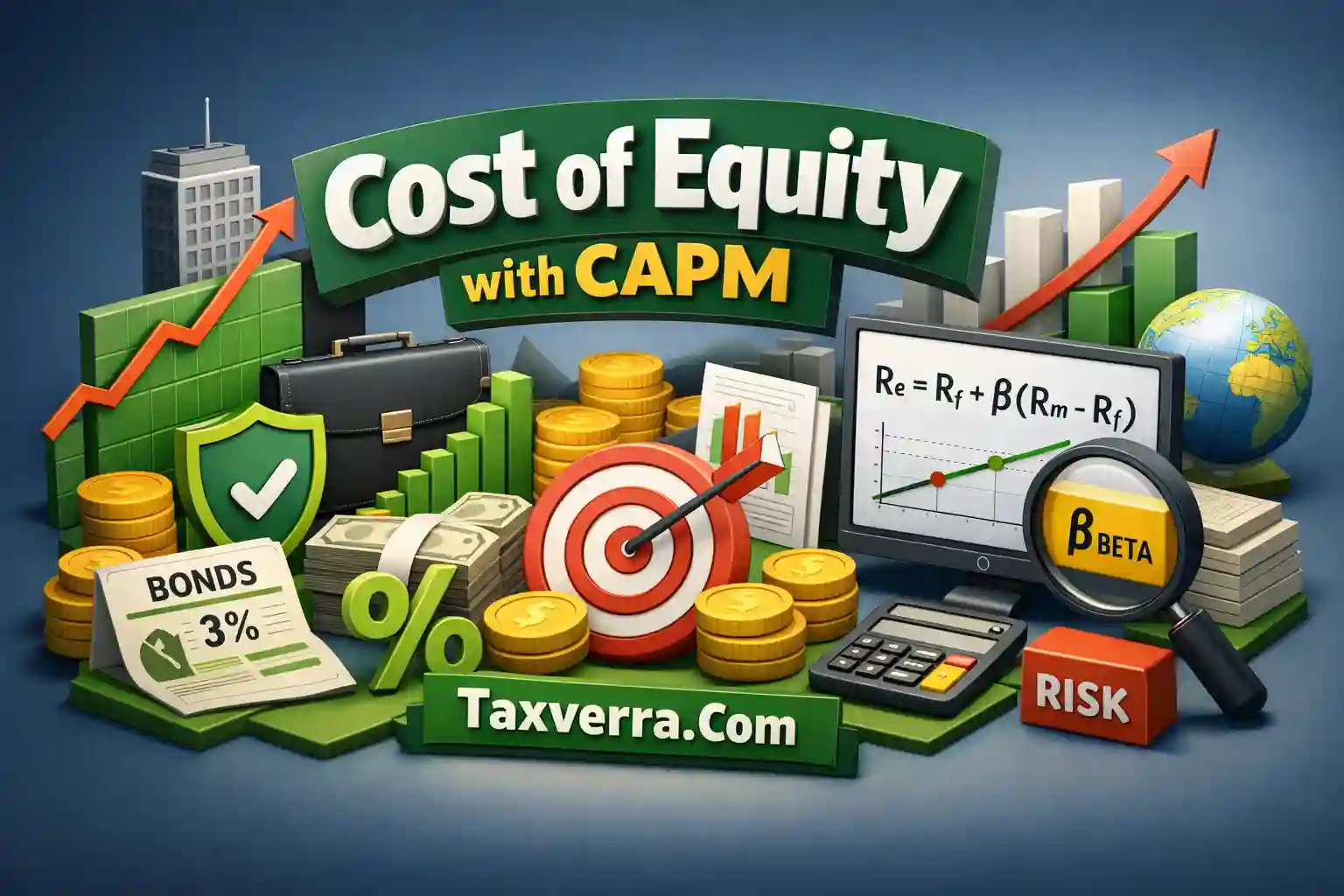
Understanding Cost of Equity from a Practical Lens
The cost of equity is not just a theoretical number from finance textbooks, it is the required rate of return that investors expect for taking on the risk of investing in a company. In real-world advisory work, this figure becomes critical when evaluating investment risk and return, setting hurdle rates, and making strategic financing decisions.
In my experience, many business owners confuse cost of equity with actual dividends or returns paid. That’s not accurate. It represents what investors expect, not necessarily what they receive. This expectation is driven by market conditions, company risk, and alternative investment opportunities.
A practical example is a client I worked with in the manufacturing sector. They were evaluating expansion but underestimated their cost of capital by ignoring equity expectations. Once we recalculated their equity cost calculation, their project that initially seemed profitable turned out to destroy value.
From a financial analysis perspective, cost of equity is used in:
- Valuation techniques such as discounted cash flow
- Financial modeling CAPM-based projections
- Determining weighted average cost of capital WACC
- Comparing stock return estimation against benchmarks
One mistake I often see is using arbitrary percentages like 10 percent or 12 percent without justification. This leads to flawed decision-making.
To approach this correctly, you need a structured model. That’s where the capital asset pricing model becomes essential, offering a logical way to quantify risk and expected return rather than guessing.
CAPM Explained in Real Business Context
The capital asset pricing model (CAPM) is one of the most widely used tools in corporate finance concepts for estimating the cost of equity formula. While it may look academic at first, in practice it’s surprisingly intuitive when applied correctly.
At its core, CAPM answers a simple question: how much return should an investor demand given the level of risk they are taking?
In real client engagements, I often describe CAPM as a bridge between investment risk and return. It links the risk-free baseline with market expectations and adjusts for company-specific risk using beta in CAPM.
A practical example is a startup client in the tech sector. They assumed high returns automatically justified their valuation. However, their systematic risk beta was significantly above 1, meaning investors would demand a much higher return. Once CAPM was applied, their valuation expectations became more realistic.
The CAPM framework considers:
- A baseline return from a risk free rate
- Additional return for market risk via market risk premium
- Adjustment for company risk using beta coefficient meaning
One mistake I often see is blindly applying CAPM without understanding its assumptions. For example, assuming stable markets in volatile economies leads to distorted outputs.
Despite its limitations, CAPM remains a cornerstone in:
- Equity valuation methods
- Stock return estimation
- Security market line analysis
When used properly, it brings discipline to financial decision-making and avoids subjective guesswork.
Why Cost of Equity Drives Smart Financial Decisions
The cost of equity plays a central role in shaping financial strategy, yet many businesses treat it as a secondary metric. In reality, it directly influences whether a company is creating or destroying value.
In my experience, the biggest impact of cost of equity is seen in capital budgeting decisions. If your expected return is lower than your required rate of return, you are effectively reducing shareholder value.
A practical example comes from a retail client evaluating store expansion. On paper, their project showed a 14 percent return. However, their cost of equity using CAPM was calculated at 16 percent due to high systematic risk beta. The expansion, though profitable in accounting terms, was financially unsound.
Cost of equity is critical in:
- Determining discount rates in valuation
- Calculating weighted average cost of capital WACC
- Assessing investment feasibility
- Benchmarking equity risk premium expectations
One mistake I often see is ignoring changes in market conditions. The market risk premium is not static. Economic shifts, inflation, and geopolitical risks can significantly alter investor expectations.
Another issue is underestimating risk. Companies often downplay their beta, leading to artificially low equity cost calculation.
To make better decisions:
- Always update CAPM inputs regularly
- Compare returns against realistic benchmarks
- Stress-test assumptions in financial models
When used correctly, cost of equity becomes a powerful decision-making tool rather than just a theoretical number.
Breaking Down the CAPM Formula with Clarity
The CAPM formula is simple in structure but powerful in application. It provides a structured way to calculate the expected return formula for equity investors.
Each component reflects a different dimension of risk and return. In practice, this formula is used extensively in financial modeling CAPM and valuation exercises.
Here’s how to interpret it in real terms:
- R_e represents the cost of equity or required return
- R_f is the risk free rate, typically government bond yields
- β (beta) measures systematic risk relative to the market
- R_m – R_f is the market risk premium, capturing extra return investors demand
In my experience, the formula itself is rarely the problem. The challenge lies in selecting the right inputs.
A practical example involved a logistics company where beta was taken from a global dataset instead of industry-specific benchmarks. This led to an understated equity cost calculation, affecting valuation significantly.
One mistake I often see is misunderstanding beta. A beta greater than 1 does not mean “better performance.” It means higher volatility and higher required returns.
To apply CAPM effectively:
- Use market-relevant data
- Adjust beta for leverage where necessary
- Ensure consistency across all inputs
When used correctly, the CAPM formula becomes a reliable tool for estimating investor expectations and guiding financial decisions.
Understanding Each CAPM Component in Depth
To truly master CAPM calculation, you need to go beyond the formula and understand each component deeply. Each input carries assumptions that can significantly influence the final cost of equity.
The risk free rate is usually derived from government securities. In stable economies, this is straightforward. However, in emerging markets, selecting the right benchmark becomes tricky. In my experience, using long-term bond yields provides a more realistic base.
The beta coefficient meaning is often misunderstood. It measures how sensitive a stock is to market movements. A beta of:
- 1 indicates market-level risk
- Greater than 1 signals higher volatility
- Less than 1 suggests lower risk
A practical example involved a client using a beta of 0.8 for a highly cyclical business. This underestimated their systematic risk beta, resulting in flawed valuation.
The market risk premium reflects the extra return investors expect over the risk-free rate. This varies by geography and economic conditions. One mistake I often see is using outdated or global averages without adjusting for local markets.
To ensure accuracy:
- Cross-check beta from multiple sources
- Adjust for company-specific factors
- Use forward-looking market assumptions
Each component plays a critical role in equity valuation methods and financial analysis tools. Small errors in inputs can lead to large valuation gaps.
Understanding these elements in depth is what separates a theoretical calculation from a practical, decision-ready cost of equity formula.
Step-by-Step CAPM Calculation That Works in Practice
When it comes to how to calculate cost of equity, the real value lies in applying the CAPM calculation in a structured and disciplined way. The formula is simple, but execution is where most professionals make mistakes.
R_e = R_f + \beta (R_m – R_f)
In practice, I follow a clear step-by-step approach with clients to ensure accuracy and consistency.
First, determine the risk free rate. This is typically based on long-term government bond yields. For valuation purposes, I prefer using a 10-year benchmark to align with long-term investment horizons.
Second, estimate the beta in CAPM. This can be sourced from financial databases, but adjustments are often needed. If the company is highly leveraged or operates in a niche sector, raw beta can be misleading.
Third, calculate the market risk premium. This is where judgment comes in. Historical averages may not reflect current market sentiment, so I often adjust based on forward-looking expectations.
Fourth, plug the values into the formula and compute the expected return formula.
A practical example is a client in the FMCG sector:
- Risk-free rate: 9 percent
- Beta: 1.2
- Market return: 15 percent
Market risk premium becomes 6 percent, leading to a cost of equity of 16.2 percent.
One mistake I often see is mixing nominal and real rates. If inflation assumptions are inconsistent, the entire equity cost calculation becomes unreliable.
For better results:
- Keep all inputs aligned in terms of currency and inflation
- Use industry-adjusted beta where possible
- Validate results against market benchmarks
This disciplined approach ensures your CAPM output reflects real-world investor expectations.
Real-World CAPM Example with Deep Insights
A CAPM example becomes far more meaningful when tied to real business scenarios rather than textbook numbers. Let me walk you through a case that highlights both calculation and interpretation.
A mid-sized textile company approached me for valuation support. They were seeking investment and needed a reliable cost of equity formula to justify their projections.
We gathered the following inputs:
| Component | Value |
|---|---|
| Risk-Free Rate | 10 percent |
| Beta | 1.4 |
| Market Return | 16 percent |
Using these, the market risk premium was 6 percent.
R_e = 10% + 1.4(16% – 10%)
The calculated cost of equity came out to 18.4 percent.
Now here’s where experience matters. The client initially thought this number was too high. However, their business had significant exposure to export volatility and currency risk, which justified a higher systematic risk beta.
One mistake I often see is focusing only on the final percentage without understanding the underlying risk drivers.
In this case, we used the result to:
- Adjust valuation expectations
- Reassess pricing strategy
- Evaluate financing mix
A practical lesson here is that CAPM is not just about numbers. It’s about interpreting what those numbers mean for investment risk and return.
When used correctly, a CAPM calculation becomes a powerful storytelling tool for investors, helping them understand why a certain return is justified.
Where to Find Reliable CAPM Inputs Without Guesswork
One of the biggest challenges in applying the capital asset pricing model is sourcing accurate inputs. In my experience, poor data selection is the main reason behind flawed equity cost calculation.
Let’s break down practical sources for each component.
For the risk free rate, government bond yields are the standard. In emerging markets, I recommend using long-term sovereign bonds and adjusting for inflation expectations if necessary.
For beta in CAPM, financial platforms like Bloomberg or Yahoo Finance are commonly used. However, raw beta should not be taken at face value. It often needs adjustments for leverage or industry differences.
A practical example involved a logistics firm using a beta of 0.9 from a global dataset. After adjusting for their higher debt levels, the revised beta was closer to 1.3, significantly impacting their cost of equity formula.
For the market risk premium, you can use:
- Historical averages from market studies
- Analyst forecasts
- Country-specific risk premiums
One mistake I often see is using global averages for local businesses. This ignores country risk and leads to understated expected return formula outputs.
To improve accuracy:
- Cross-check multiple data sources
- Align data with your valuation currency
- Use forward-looking assumptions where possible
Reliable inputs are the foundation of effective financial analysis tools. Without them, even the most accurate formula will produce misleading results.
Advantages of CAPM in Real Financial Decision-Making
Despite its academic origins, the capital asset pricing model offers several practical advantages when used correctly. It provides a structured approach to estimating the required rate of return, which is essential in corporate finance concepts.
In my experience, the biggest strength of CAPM is its simplicity. It breaks down complex investment risk and return into understandable components, making it easier to communicate with clients and stakeholders.
Key advantages include:
- Clear linkage between risk and expected return
- Widely accepted in equity valuation methods
- Easy integration into financial modeling CAPM frameworks
- Useful for calculating weighted average cost of capital WACC
A practical example is a client in the energy sector evaluating multiple projects. Using CAPM, we standardized the cost of equity, allowing for consistent comparison across investments.
Another advantage is its role in building the security market line, which visually represents the relationship between risk and return.
However, the real benefit comes from disciplined application. CAPM forces you to think critically about:
- Market conditions
- Business risk
- Investor expectations
One insight I’ve gained over the years is that CAPM works best when combined with professional judgment. Blind reliance on the model without context can lead to errors.
Used properly, CAPM becomes more than just a formula. It becomes a decision-making framework that aligns financial strategy with market realities.
Limitations of CAPM That Professionals Should Not Ignore
While CAPM is widely used, it is far from perfect. Understanding the limitations of CAPM is critical for making informed decisions and avoiding overconfidence in the results.
One major limitation is its reliance on assumptions. CAPM assumes:
- Markets are efficient
- Investors are rational
- Borrowing and lending occur at the same risk free rate
In reality, these assumptions rarely hold true, especially in emerging markets.
In my experience, another challenge is estimating beta coefficient meaning accurately. Beta is based on historical data, which may not reflect future risk. This becomes problematic in rapidly changing industries.
A practical example involved a tech startup where historical beta was unavailable. We had to rely on industry averages, which introduced estimation risk into the equity cost calculation.
Another limitation is the instability of the market risk premium. Economic shocks, inflation, and geopolitical events can quickly change investor expectations.
One mistake I often see is treating CAPM output as absolute truth. It should be viewed as an estimate, not a precise figure.
To manage these limitations:
- Use sensitivity analysis in your models
- Compare CAPM with other equity valuation methods
- Adjust inputs based on current market conditions
Despite its flaws, CAPM remains a valuable tool when used with caution. The key is to combine it with experience, judgment, and a clear understanding of its underlying assumptions.
CAPM vs Other Equity Valuation Methods in Practice
When evaluating the cost of equity, relying solely on the capital asset pricing model can be limiting. In real-world advisory work, I often compare CAPM with other equity valuation methods to validate results and avoid overconfidence in a single model.
The most common alternatives include the Dividend Discount Model (DDM) and the Bond Yield Plus Risk Premium approach. Each has its place depending on the nature of the business.
Here’s a practical comparison:
| Method | Best Use Case | Key Limitation |
|---|---|---|
| CAPM | Broad market-based valuation | Relies on assumptions |
| DDM | Stable dividend-paying firms | Not suitable for growth companies |
| Bond Yield + Premium | Private companies | Subjective risk premium |
A practical example comes from a client in the utilities sector. Since they had stable dividend payouts, we used DDM alongside CAPM. Interestingly, CAPM gave a required rate of return of 13 percent, while DDM suggested 11.5 percent. The difference highlighted market volatility not captured in dividend assumptions.
One mistake I often see is applying CAPM to private companies without adjustments. Since there’s no market beta available, analysts end up using unreliable proxies.
In my experience, the best approach is triangulation:
- Use CAPM as the base model
- Cross-check with at least one alternative
- Adjust based on business fundamentals
This layered approach strengthens your financial analysis tools and ensures your equity cost calculation is grounded in reality rather than theory.
How CAPM Influences Real Financial Decisions
The CAPM formula is not just a calculation tool, it directly impacts strategic decision-making across finance functions. From investment evaluation to capital structuring, its influence is far-reaching.
In my experience, CAPM is most impactful in capital budgeting. Companies use it to determine whether a project meets the required rate of return. If expected returns fall short, the project should ideally be rejected.
A practical example involved a manufacturing client considering automation. Their projected return was 15 percent, which initially seemed attractive. However, after applying CAPM calculation, their cost of equity was 17 percent due to high operational risk. The project was postponed, saving significant capital.
CAPM also plays a key role in:
- Setting discount rates in DCF valuation models
- Calculating weighted average cost of capital WACC
- Evaluating stock return estimation
- Benchmarking performance against the security market line
One mistake I often see is using outdated CAPM inputs. Even small changes in the market risk premium or risk free rate can significantly impact outcomes.
To use CAPM effectively in decisions:
- Regularly update assumptions
- Align inputs with current market conditions
- Use sensitivity analysis to test different scenarios
When applied correctly, CAPM becomes a decision filter that helps businesses allocate capital more efficiently and avoid value-destructive investments.
Common CAPM Mistakes That Distort Results
Even though the CAPM explained framework is straightforward, its practical application is filled with pitfalls. Over the years, I’ve seen recurring mistakes that significantly distort the cost of equity formula.
One of the most common issues is incorrect estimation of beta in CAPM. Analysts often take beta directly from online sources without questioning its relevance. Beta should reflect the company’s current risk profile, not outdated historical data.
Another frequent mistake is inconsistent data usage. Mixing nominal and real values or using different currencies can distort the expected return formula.
A practical example comes from a retail client who used a US-based market risk premium for a local business. This understated their equity risk premium, leading to an artificially low cost of equity.
Other common errors include:
- Ignoring country risk in emerging markets
- Using short-term risk free rate for long-term valuation
- Assuming beta remains constant over time
- Overlooking leverage adjustments
In my experience, one critical oversight is failing to validate results. Many professionals calculate CAPM once and move on without cross-checking.
To avoid these mistakes:
- Always question your inputs
- Use multiple data sources
- Perform sensitivity analysis
A disciplined approach ensures your financial modeling CAPM outputs are reliable and aligned with real-world conditions.
CAPM in Emerging vs Developed Markets Reality
Applying the capital asset pricing model in different economic environments requires careful adjustments. What works in developed markets does not always translate directly to emerging economies.
In developed markets, inputs like risk free rate and market risk premium are relatively stable and transparent. However, in emerging markets, additional factors such as political risk, currency volatility, and inflation must be considered.
In my experience working with businesses in developing regions, one of the biggest challenges is incorporating country risk premium into the cost of equity formula.
A practical example involved a client expanding into a high-risk market. Using standard CAPM inputs gave a required rate of return of 14 percent. After adding a country risk adjustment, the revised cost of equity increased to 19 percent, significantly changing the investment decision.
Key differences include:
- Higher volatility in systematic risk beta
- Less reliable market data
- Greater impact of macroeconomic factors
One mistake I often see is directly applying global averages without localization. This leads to unrealistic stock return estimation.
To improve accuracy:
- Add country-specific risk premiums
- Adjust beta for market conditions
- Use conservative assumptions
Understanding these nuances ensures CAPM remains relevant and reliable across different economic environments.
Practical Applications of CAPM in Valuation and Investment
The true power of CAPM lies in its application. Beyond theory, it plays a central role in valuation techniques, investment analysis, and strategic planning.
In my experience, CAPM is most commonly used in discounted cash flow valuation, where the cost of equity serves as the discount rate for future cash flows. This directly impacts company valuation.
A practical example involved a healthcare client seeking funding. By refining their CAPM calculation, we adjusted their valuation model, which improved investor confidence and negotiation outcomes.
CAPM is also used in:
- Portfolio management to assess investment risk and return
- Comparing expected returns with the security market line
- Estimating equity risk premium for strategic decisions
- Supporting financial modeling CAPM frameworks
One mistake I often see is using CAPM in isolation. It should be part of a broader toolkit that includes qualitative analysis and industry insights.
To maximize its value:
- Combine CAPM with other financial analysis tools
- Regularly update assumptions
- Align outputs with business strategy
When used effectively, CAPM becomes more than a formula. It becomes a strategic tool that helps businesses make informed, value-driven decisions in complex financial environments.
Frequently Asked Questions on Cost of Equity Using CAPM
When working with clients, I notice that even experienced professionals have recurring questions about the cost of equity, especially when applying the capital asset pricing model in real scenarios. Addressing these clearly can remove a lot of confusion.
One common question is whether CAPM is suitable for private companies. In my experience, it can be used, but with adjustments. Since there is no directly observable beta in CAPM, you need to rely on industry averages and then adjust for leverage and business-specific risk.
Another frequent concern is how often inputs should be updated. The answer is more often than most people think. The risk free rate and market risk premium can shift due to economic conditions. Using outdated inputs leads to misleading equity cost calculation.
Clients also ask whether CAPM guarantees accurate results. It does not. It provides an estimate of the required rate of return, not a precise number. That’s why cross-checking with other equity valuation methods is essential.
Here are a few practical clarifications:
- A higher beta coefficient meaning implies higher expected return, not better performance
- CAPM is more reliable for listed companies than private firms
- The expected return formula should always reflect current market conditions
- The equity risk premium varies significantly across countries
One mistake I often see is treating CAPM outputs as static. In reality, they should evolve with market dynamics.
A practical takeaway is to treat CAPM as a flexible framework rather than a fixed rule. When used with judgment, it becomes a powerful part of your financial analysis tools.
Final Thoughts from Real-World Financial Practice
After years of working with different industries, I can confidently say that understanding the cost of equity using CAPM is one of the most valuable skills in corporate finance concepts. It directly influences how businesses evaluate opportunities, manage risk, and create value.
In my experience, the real strength of CAPM lies not in the formula itself, but in how thoughtfully it is applied. The difference between a good and a poor analysis often comes down to input selection and interpretation.
A practical example that stands out is a client who initially rejected CAPM because they felt it was too theoretical. After walking them through a detailed CAPM example, they realized how it aligned investor expectations with their business risk. This shift in understanding helped them secure funding at more realistic terms.
Key lessons I’ve learned over time include:
- Always question your assumptions in the cost of equity formula
- Avoid relying on a single model for equity valuation methods
- Understand the story behind the numbers, not just the output
- Use CAPM as part of a broader financial modeling CAPM framework
One mistake I often see is overconfidence in precise numbers. Finance is not about exact answers, it’s about informed decisions under uncertainty.
When used correctly, CAPM helps bridge the gap between theory and practice. It aligns investment risk and return, supports better valuation techniques, and strengthens strategic decision-making.
Ultimately, mastering CAPM is less about memorizing formulas and more about developing the judgment to apply them effectively in real-world situations.

