

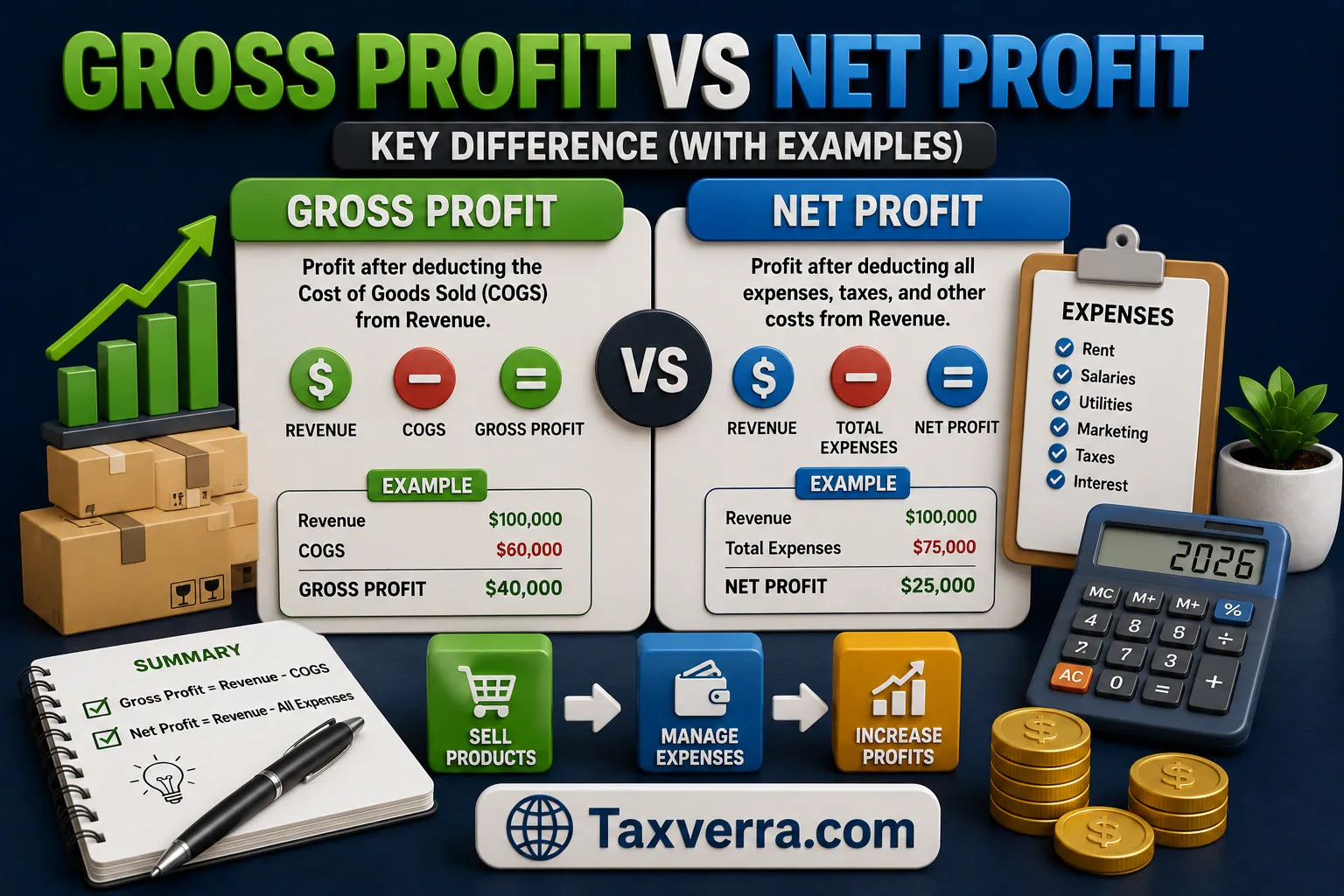
Understanding the difference between gross profit and net profit is essential for anyone looking to analyze a business’s financial performance accurately. Whether you are a small business owner, student, freelancer, or investor, knowing how these two key financial metrics work can help you make smarter decisions and evaluate profitability more effectively. While both gross profit and net profit are derived from a company’s income statement, they serve very different purposes and provide unique insights into business operations.
Gross profit refers to the amount a business earns after deducting the cost of goods sold (COGS) from total revenue. It highlights how efficiently a company produces or delivers its products and services. On the other hand, net profit is the final profit remaining after subtracting all expenses, including operating costs, taxes, interest, and other indirect expenses. This makes net profit a more comprehensive indicator of overall business profitability.
Many beginners often confuse gross profit and net profit, assuming they represent the same thing. However, the difference between gross profit and net profit lies in the level of expenses considered and the depth of financial insight each provides. For example, a business may have a strong gross profit but still struggle with a low net profit due to high operating expenses. Understanding this distinction is crucial for identifying cost issues, improving financial planning, and increasing overall efficiency.
In this complete guide, we will break down the difference between gross profit and net profit with examples, simple formulas, and real-life scenarios. By the end, you will clearly understand how to calculate both metrics, when to use them, and why they are critical for business success and financial analysis.
Introduction
What if your business is making strong sales but still not generating real profit? This is one of the most common and confusing situations many business owners face. The answer often lies in understanding the difference between gross profit and net profit two essential financial metrics that reveal very different sides of your business performance. At first glance, both may seem similar, but in reality, they tell completely different stories about how your business is earning and managing money.
Gross profit shows how much money you keep after covering the direct costs of producing goods or delivering services. It gives a quick snapshot of your operational efficiency. However, this number alone doesn’t tell the full story. That’s where net profit comes in. Net profit is the final amount left after deducting all expenses, including rent, salaries, utilities, taxes, and other overhead costs. In simple terms, gross profit shows potential, while net profit shows reality.
Understanding the difference between gross profit and net profit is crucial if you want to make better financial decisions, control costs, and grow your business sustainably. Many businesses appear profitable on the surface but struggle financially because they ignore the gap between these two figures. This is why investors, accountants, and successful entrepreneurs always pay close attention to both.
In this guide, we will clearly explain the difference between gross profit and net profit with examples, making it easy for beginners to understand. By the end, you’ll not only know how to calculate each metric but also how to use them to improve your business profitability and avoid common financial mistakes.
Concept Explained
What is Gross Profit Margin?
Gross Profit Margin is a key financial ratio that shows how much profit a business makes after covering the cost of goods sold (COGS), expressed as a percentage of revenue. It helps you understand how efficiently a company is producing or delivering its products and services.
Formula
Simple Explanation:
- It tells you how much profit you keep from each sale before expenses
- Higher margin = better efficiency
- Lower margin = higher production costs or pricing issues
Example:
Let’s say:
- Revenue = $10,000
- Cost of Goods Sold = $6,000
Gross Profit = $4,000
Gross Profit Margin = 40%
This means the business keeps 40% of its revenue after covering direct costs.
Why Gross Profit Margin is Important:
- Measures operational efficiency
- Helps in pricing decisions
- Shows how well you control production costs
- Used by investors to compare businesses in the same industry
What it tells you:
- Efficiency of production or service delivery
- Pricing effectiveness
- Direct cost control
It focuses only on direct costs like:
- Raw materials
- Manufacturing costs
- Direct labor
Important Note:
Gross Profit Margin does NOT include:
- Rent
- Salaries
- Marketing expenses
- Taxes
That’s why it’s different from net profit margin, which includes all expenses.
What is Net Profit Margin?
Net Profit Margin is a key financial metric that measures the percentage of revenue a business keeps as profit after all expenses have been deducted. Unlike gross profit margin, which only accounts for direct costs (COGS), net profit margin considers all operating expenses, taxes, interest, and other costs, giving a complete picture of a company’s profitability.
Formula
Example:
Suppose:
- Revenue = $10,000
- Cost of Goods Sold = $6,000
- Operating Expenses = $2,000
- Taxes & Interest = $500
Net Profit = $10,000 − ($6,000 + $2,000 + $500) = $1,500
Net Profit Margin = ($1,500 ÷ $10,000) × 100 = 15%
This means the business keeps 15 cents of every dollar after paying all expenses.
What it includes:
- Cost of goods sold
- Operating expenses
- Salaries
- Rent
- Marketing
- Taxes
- Interest
It reflects the overall profitability of your business.
Simple Explanation:
- Shows how much actual profit remains from every dollar of revenue
- Higher net profit margin = business is more efficient at controlling expenses
- Lower margin = business may have high overhead, debt, or inefficient operations
Why Net Profit Margin is Important:
- Measures overall profitability
- Helps compare performance across industries
- Reveals how efficiently a business manages all expenses
- Key metric for investors and lenders to assess financial health
Remember:
While gross profit margin focuses on production efficiency, net profit margin shows the true bottom line, including all costs.
Key Insight: Difference Between Gross Profit and Net Profit
Understanding the difference between gross profit and net profit is crucial for anyone looking to evaluate a business’s financial health. Here’s the key insight you need:
- Gross Profit shows how efficiently a business produces or delivers its products and services. It focuses only on direct costs like materials and labor, giving a snapshot of operational efficiency.
- Net Profit goes a step further it accounts for all expenses, including operating costs, taxes, interest, and overheads. This makes net profit the true measure of a business’s overall profitability.
Why This Matters:
- A business can have a high gross profit but a low net profit, meaning it’s generating revenue efficiently but overspending on other expenses.
- Investors and lenders often look at net profit to understand the sustainability and financial health of a business.
- Tracking both metrics together helps identify cost-saving opportunities and optimize pricing strategies.
Quick Example:
- Revenue: $50,000
- COGS: $30,000 → Gross Profit = $20,000
- Operating Expenses + Taxes + Interest = $12,000 → Net Profit = $8,000
- Gross Profit Margin = 40%
- Net Profit Margin = 16%
Key Insight: While the business keeps 40% from production efficiency, only 16% of revenue translates into actual profit after all expenses.
Components / Breakdown: Gross Profit vs Net Profit
To fully understand the difference between gross profit and net profit, it’s important to break down the components that make each metric. This not only clarifies how they are calculated but also highlights their unique purpose in analyzing business performance.
1. Gross Profit Components
Gross profit focuses only on the direct costs of producing goods or delivering services.
Key Components Include:
- Revenue / Sales – Total income generated from selling products or services.
- Cost of Goods Sold (COGS) – Direct costs of producing goods, including:
- Raw materials
- Manufacturing labor
- Packaging costs
- Freight for goods sold
Formula:
Gross\ Profit = Revenue – Cost\ of\ Goods\ Sold
Example:
- Revenue: $20,000
- COGS: $12,000
- Gross Profit = $8,000
Insight: Gross profit shows how efficiently a business is producing or delivering its products, before accounting for other expenses.
2. Net Profit Components
Net profit gives the bottom-line profitability, considering all expenses beyond production costs.
Key Components Include:
- Gross Profit – Starting point from the previous calculation.
- Operating Expenses – Costs to run the business, such as:
- Salaries & wages
- Rent / utilities
- Marketing & advertising
- Office supplies
- Interest Expenses – Cost of loans or borrowed funds.
- Taxes – Income tax or other statutory payments.
- Other Non-Operating Expenses – Miscellaneous expenses not related to core operations.
Formula:
Net\ Profit = Gross\ Profit – (Operating\ Expenses + Taxes + Interest + Other\ Expenses)
Example:
- Gross Profit: $8,000
- Operating Expenses: $3,000
- Taxes & Interest: $1,000
- Net Profit = $4,000
Insight: Net profit reveals how much actual profit a business retains after all costs, giving a clear picture of financial health.
Summary Table
| Metric | Components | Purpose | Example |
|---|---|---|---|
| Gross Profit | Revenue − COGS | Measures production efficiency | $8,000 from $20,000 sales |
| Net Profit | Gross Profit − All Expenses | Measures overall profitability | $4,000 remaining after all costs |
Gross Profit vs Net Profit: Comparison Table
| Feature / Aspect | Gross Profit | Net Profit |
|---|---|---|
| Definition | Profit after deducting direct costs (COGS) from revenue | Final profit after deducting all expenses including operating costs, taxes, and interest |
| Formula | Revenue − Cost of Goods Sold | Gross Profit − (Operating Expenses + Taxes + Interest + Other Expenses) |
| Purpose | Measures production or operational efficiency | Measures overall profitability / bottom-line performance |
| Focus | Direct costs only (materials, labor, production) | All costs (operating, taxes, interest, overhead) |
| Financial Statement | Appears in the income statement, above operating expenses | Appears at the bottom of the income statement |
| Example | Revenue $20,000 − COGS $12,000 = $8,000 | Gross Profit $8,000 − Operating Expenses & Taxes $4,000 = $4,000 |
| Insight | Shows how efficiently the business produces goods/services | Shows how much actual profit remains after all costs |
| Use Cases | Pricing decisions, production efficiency analysis | Investment analysis, profitability evaluation, cost management |
Real-World Examples: Difference Between Gross Profit and Net Profit
Understanding gross profit and net profit is easier with real-world examples. These examples will illustrate how revenue, costs, and expenses affect each metric and why both are essential for evaluating business health.
Example 1: Small Retail Store
- Revenue (Sales): $50,000
- Cost of Goods Sold (COGS): $30,000
- Operating Expenses: $10,000 (rent, salaries, utilities)
- Taxes & Interest: $3,000
Calculations:
- Gross Profit = Revenue − COGS = $50,000 − $30,000 = $20,000
- Net Profit = Gross Profit − (Operating Expenses + Taxes + Interest)
= $20,000 − ($10,000 + $3,000) = $7,000
Insight:
- Gross profit margin = 40% → indicates the store produces a healthy profit from sales after direct costs.
- Net profit margin = 14% → shows the actual profit remaining after all expenses.
Example 2: Freelance Graphic Designer
- Revenue: $5,000
- COGS (Software, Tools, Subscriptions): $500
- Operating Expenses (Internet, Marketing, Taxes): $1,000
Calculations:
- Gross Profit = $5,000 − $500 = $4,500
- Net Profit = $4,500 − $1,000 = $3,500
Insight:
- Gross profit is high because direct costs are low.
- Net profit shows how much money the freelancer actually keeps after all business expenses, which is critical for personal income planning.
Example 3: Manufacturing Business
- Revenue: $200,000
- COGS (Raw materials, labor, shipping): $120,000
- Operating Expenses: $50,000
- Taxes & Interest: $10,000
Calculations:
- Gross Profit = $200,000 − $120,000 = $80,000
- Net Profit = $80,000 − ($50,000 + $10,000) = $20,000
Insight:
- Gross profit is 40% → business efficiently produces products.
- Net profit is only 10% → high operating costs reduce the bottom line, signaling the need to optimize expenses.
Two Businesses Comparison: Gross Profit vs Net Profit
To better understand the difference between gross profit and net profit, let’s compare two businesses in the same industry. This comparison will highlight how costs and expenses impact the bottom line, even if revenue looks similar.
Business A: Café “Brew Bliss”
- Revenue (Monthly Sales): $50,000
- COGS (Ingredients, Packaging): $20,000
- Operating Expenses (Rent, Salaries, Utilities, Marketing): $20,000
- Taxes & Interest: $5,000
Calculations:
- Gross Profit = $50,000 − $20,000 = $30,000
- Net Profit = $30,000 − ($20,000 + $5,000) = $5,000
Insight:
- Gross profit margin = 60% → Café is efficient in producing its products.
- Net profit margin = 10% → High operating expenses reduce actual earnings.
Business B: Café “Daily Grind”
- Revenue (Monthly Sales): $50,000
- COGS (Ingredients, Packaging): $25,000
- Operating Expenses (Rent, Salaries, Utilities, Marketing): $15,000
- Taxes & Interest: $5,000
Calculations:
- Gross Profit = $50,000 − $25,000 = $25,000
- Net Profit = $25,000 − ($15,000 + $5,000) = $5,000
Insight:
Net profit margin = 10% → Despite higher COGS, net profit matches Business A because Business B has lower operating expenses.
Gross profit margin = 50% → Less efficient production compared to Business A.
Step-by-Step Application Guide: Using Gross Profit and Net Profit
Understanding the difference between gross profit and net profit is just the first step. The real value comes from applying these metrics to make informed business decisions. Follow this simple guide to calculate, analyze, and use these profits effectively.
Step 1: Gather Financial Data
Before calculating, collect all relevant information from your income statement:
- Revenue / Sales – Total income generated.
- Cost of Goods Sold (COGS) – Direct costs of producing goods or services.
- Operating Expenses – Salaries, rent, utilities, marketing.
- Taxes & Interest – Any statutory payments and loan costs.
SEO Tip: Keywords to use here – “gross profit vs net profit calculation,” “profit components,” “profit analysis.”
Step 2: Calculate Gross Profit
Use the formula:
Gross\ Profit = Revenue – Cost\ of\ Goods\ Sold
Example:
- Revenue = $50,000
- COGS = $30,000
- Gross Profit = $20,000
Insight: This shows the profit generated from core operations, before other expenses.
Step 3: Calculate Net Profit
Use the formula:
Net\ Profit = Gross\ Profit – (Operating\ Expenses + Taxes + Interest + Other\ Expenses)
Example:
- Gross Profit = $20,000
- Operating Expenses + Taxes + Interest = $15,000
- Net Profit = $5,000
Insight: Net profit reveals how much actual money remains after all business costs.
Step 4: Analyze Profit Margins
Calculate the profit margins to better understand efficiency:
- Gross Profit Margin (%) = (Gross Profit ÷ Revenue) × 100
- Net Profit Margin (%) = (Net Profit ÷ Revenue) × 100
Example:
- Gross Profit Margin = (20,000 ÷ 50,000) × 100 = 40%
- Net Profit Margin = (5,000 ÷ 50,000) × 100 = 10%
Insight: Comparing margins helps identify cost issues or inefficiencies in operations and overheads.
Step 5: Apply Insights to Business Decisions
Once calculated, use these metrics to:
- Set pricing strategies – Ensure your selling price covers production costs and overheads.
- Reduce expenses – Identify high-cost areas impacting net profit.
- Plan investments – Decide where additional funding can improve profitability.
- Benchmark performance – Compare with industry standards to stay competitive.
Key Rules / Principles: Gross Profit vs Net Profit
Understanding the difference between gross profit and net profit is essential, but applying the right principles ensures these metrics are meaningful for your business. Here are the most important rules to follow:
1. Always Keep Revenue and Costs Accurate
- Use up-to-date sales data for revenue.
- Track all direct costs for gross profit and all operating costs, taxes, and interest for net profit.
- Accuracy ensures profit calculations reflect reality, which is critical for financial decisions.
2. Separate Direct Costs from Indirect Costs
- Gross Profit = Revenue − Direct Costs (COGS)
- Net Profit = Gross Profit − Indirect Costs (Operating Expenses + Taxes + Interest)
- Keeping these separate prevents misinterpretation and highlights areas for efficiency improvement.
3. Analyze Both Metrics Together
- Gross profit alone shows production efficiency but ignores overheads.
- Net profit alone shows overall profitability but doesn’t reveal operational issues.
- Comparing both gives a complete picture of financial health.
4. Track Profit Margins, Not Just Absolute Numbers
- Calculate gross profit margin (%) and net profit margin (%) to measure efficiency and profitability relative to revenue.
- Margins help you benchmark performance, especially across different businesses or periods.
5. Monitor Regularly for Trends
- Track monthly, quarterly, and yearly to identify patterns.
- Look for shrinking gross profit margin → may indicate rising production costs.
- Watch net profit margin trends → may reveal increasing operating expenses or tax burdens.
6. Use Insights to Make Decisions
- Adjust pricing if gross profit is too low.
- Reduce unnecessary expenses if net profit is shrinking.
- Use profit analysis to plan investments, budget efficiently, and scale business sustainably.
Common Mistakes: Gross Profit vs Net Profit
Even experienced business owners and beginners often misinterpret gross profit and net profit, which can lead to poor financial decisions. Understanding these common mistakes helps avoid costly errors.
1. Confusing Gross Profit with Net Profit
- Many assume gross profit equals net profit.
- Reality: Gross profit only accounts for direct costs (COGS), while net profit considers all expenses including operating costs, taxes, and interest.
- SEO Tip: Keyword – gross profit vs net profit misunderstanding
2. Ignoring Operating Expenses
- Some businesses focus only on gross profit and overlook high overhead costs.
- Result: High gross profit but very low net profit → misleading financial health assessment.
3. Forgetting Taxes and Interest
- Net profit can be overestimated if taxes and interest are not subtracted.
- Always include all statutory and financial costs for accurate net profit calculation.
4. Not Tracking Profit Margins
- Absolute numbers (like $50,000 profit) are less informative than profit margins (%).
- Without margins, it’s hard to compare performance across months, businesses, or industries.
5. Using Inconsistent Accounting Periods
- Comparing gross and net profit across different timeframes (e.g., monthly revenue with yearly expenses) can lead to wrong conclusions.
- Always maintain consistent accounting periods for accurate analysis.
6. Ignoring Industry Benchmarks
- Profitability varies across industries.
- Comparing your business to an unrelated sector may give false performance insights.
Key Takeaway:
To avoid mistakes:
Benchmark against industry standards.
Track both gross and net profit.
Include all expenses for net profit.
Use margins and consistent periods for analysis.
Advanced Strategies & Pro Insights: Maximizing Gross and Net Profit
Once you understand the difference between gross profit and net profit, the next step is to use this knowledge strategically. Here are advanced strategies and pro insights to help you optimize profitability and make smarter business decisions.
1. Optimize Gross Profit Through Cost Control
- Negotiate supplier contracts to reduce COGS.
- Switch to more cost-efficient materials or production methods without compromising quality.
- Bundle or upsell products to increase revenue per unit.
- Pro Insight: Small improvements in COGS can significantly boost gross profit margins, which compounds over time.
2. Improve Net Profit by Managing Expenses
- Regularly audit operating expenses to identify wasteful spending.
- Outsource non-core tasks (e.g., bookkeeping, marketing) to reduce overheads.
- Review tax strategies to ensure lawful tax optimization.
- Pro Insight: Even if gross profit is high, failing to control expenses can lead to poor net profit and financial stress.
3. Use Gross vs Net Profit Analysis for Pricing Strategy
- Calculate profit margins for each product/service to set optimal pricing.
- Identify low-margin items that may be draining net profit.
- Pro Insight: Pricing decisions should balance competitive positioning with profitability, not revenue alone.
4. Forecast and Monitor Trends
- Track gross and net profit monthly, quarterly, and yearly.
- Use trends to predict cash flow issues or adjust budgets proactively.
- Pro Insight: Businesses that monitor profit trends can make timely decisions before problems escalate.
5. Benchmark Against Industry Standards
- Compare your gross and net profit margins with competitors or industry averages.
- Identify areas where your costs or expenses are higher than average.
- Pro Insight: Benchmarking helps in strategic planning, securing investment, and improving operational efficiency.
6. Leverage Gross and Net Profit for Investment Decisions
Pro Insight: Investors and lenders often focus on net profit, but gross profit analysis can reveal hidden opportunities to grow revenue efficiently.
“How much profit per sale?”
Use gross profit to evaluate production efficiency and product profitability.
Use net profit to assess overall business health and sustainability.
Takeaway:
- Gross profit = measure of operational efficiency.
- Net profit = true bottom line.
- Using advanced strategies for both helps you maximize revenue, reduce costs, and make informed business decisions.
Tools, Systems, and Practical Resources for Tracking Gross and Net Profit
Knowing the difference between gross profit and net profit is one thing but applying it consistently requires the right tools, systems, and practical resources. Here’s a guide to help you track, analyze, and optimize profits efficiently.
1. Accounting Software
Using dedicated accounting software simplifies tracking both gross and net profit:
- QuickBooks – Tracks income, COGS, and expenses automatically; generates profit reports.
- Xero – Cloud-based solution with real-time reporting for gross and net profit.
- Zoho Books – Ideal for small businesses to manage revenue, COGS, and operating expenses.
Pro Tip: Ensure your software allows you to separate direct costs from operating expenses, which is critical for accurate gross and net profit calculations.
2. Excel / Google Sheets Templates
- Create custom spreadsheets for revenue, COGS, operating expenses, and net profit tracking.
- Use formulas to automatically calculate gross profit, net profit, and profit margins.
- Visual charts in Excel/Sheets can help spot trends quickly.
Example Formula:
- Gross Profit =
Revenue - COGS - Net Profit =
Gross Profit - (Operating Expenses + Taxes + Interest)
3. Financial Dashboards
- Tools like Power BI or Tableau can visualize gross vs net profit over time.
- Dashboards allow you to monitor profit trends, margins, and cost drivers in real-time.
4. Cost Management Systems
- Implement inventory and supply chain tracking systems to reduce COGS.
- Use expense management tools like Expensify or Zoho Expense to track operating costs.
- Accurate cost tracking directly improves both gross and net profit.
5. Profit Analysis Resources
- Online Profit Calculators – Quick checks for gross and net profit margins.
- Financial blogs & courses – Learn industry standards, advanced strategies, and profit optimization tips.
- Accounting textbooks & guides – Deepen understanding of profit calculations and financial statements.
Takeaway:
Using the right tools, systems, and resources makes it easier to calculate, track, and optimize both gross and net profit, allowing you to make informed business decisions and maximize overall profitability.
Real Business Use Case: Gross Profit vs Net Profit
Understanding the difference between gross profit and net profit becomes much clearer when you look at a real business scenario. Let’s take a practical example from a small retail business to see how these metrics guide decisions.
Business Scenario: “Urban Threads” – A Small Clothing Store
Monthly Financials:
- Revenue (Sales): $80,000
- Cost of Goods Sold (COGS): $40,000 (clothing purchase, shipping, packaging)
- Operating Expenses: $25,000 (rent, utilities, salaries, marketing)
- Taxes & Interest: $5,000
Step 1: Calculate Gross Profit
- Gross Profit = Revenue − COGS
- $80,000 − $40,000 = $40,000
Gross Profit Margin:
- (40,000 ÷ 80,000) × 100 = 50%
Step 2: Calculate Net Profit
- Net Profit = Gross Profit − (Operating Expenses + Taxes & Interest)
- $40,000 − ($25,000 + $5,000) = $10,000
Net Profit Margin:
- (10,000 ÷ 80,000) × 100 = 12.5%
Analysis & Insights:
- Gross Profit shows that “Urban Threads” is efficient at sourcing and selling products they retain 50% of revenue after direct costs.
- Net Profit indicates the actual bottom-line profitability after all operating costs and taxes only 12.5% of revenue is real profit.
- Even though gross profit looks healthy, the net profit margin reveals that high overhead costs significantly reduce earnings.
- By analyzing both metrics, the business can:
- Negotiate better deals with suppliers to increase gross profit
- Reduce operating expenses or optimize staffing to improve net profit
- Make smarter decisions about pricing, marketing budgets, and expansion plans
Pro Insight:
Using both metrics together allows for accurate financial analysis, better decision-making, and sustainable growth.nue growth.
Many small businesses focus on gross profit and ignore net profit, leading to overestimated profitability.
Action Plan: Implementing Gross and Net Profit Insights
Understanding the difference between gross profit and net profit is essential, but actionable steps are what turn insights into results. Here’s a step-by-step plan to apply these metrics to your business:
Step 1: Collect Accurate Financial Data
- Gather all revenue, COGS, operating expenses, taxes, and interest.
- Ensure records are consistent and up-to-date.
- Tools: QuickBooks, Xero, Zoho Books, Excel/Google Sheets templates.
Step 2: Calculate Gross and Net Profit
- Gross Profit = Revenue − COGS
- Net Profit = Gross Profit − (Operating Expenses + Taxes + Interest)
- Include profit margins for both to assess efficiency (% of revenue).
Step 3: Analyze Profit Margins
- Identify products or services with high or low gross profit margins.
- Compare net profit margins over time to track financial health.
- Look for trends indicating rising costs or declining profitability.
Step 4: Optimize Revenue and Costs
- Increase sales of high-margin products.
- Reduce direct costs to improve gross profit.
- Control operating expenses to boost net profit.
Step 5: Benchmark Against Industry Standards
- Compare your gross and net profit margins with competitors or industry averages.
- Identify areas where your costs are higher than average and take corrective action.
Step 6: Monitor and Adjust Regularly
- Track metrics monthly, quarterly, and yearly.
- Use dashboards or spreadsheets for visual insights.
- Adjust strategies based on trends: pricing, sourcing, marketing, or cost reduction.
Step 7: Make Strategic Decisions
Ensure decisions are backed by both gross and net profit analysis.
Use profit insights to plan:
Expansion or scaling
Investments in marketing or inventory
Staffing and operational improvements
Takeaway:
By following this action plan, you can turn raw financial data into actionable insights, optimize profitability, and make informed decisions that grow your business sustainably.
FAQs: Difference Between Gross Profit and Net Profit
1. What is the difference between gross profit and net profit?
Answer:
Gross profit is the revenue left after subtracting direct costs (COGS), showing how efficiently a business produces or delivers its products. Net profit is the final profit remaining after subtracting all expenses, including operating costs, taxes, and interest. Net profit shows the true bottom-line profitability.
2. How do you calculate gross profit?
Answer:
Gross Profit = Revenue − Cost of Goods Sold (COGS)
This can be expressed in dollars or as a percentage (gross profit margin):
Gross Profit Margin (%) = (Gross Profit ÷ Revenue) × 100
3. How do you calculate net profit?
Answer:
Net Profit = Gross Profit − (Operating Expenses + Taxes + Interest + Other Expenses)
Net profit margin (%) can also be calculated:
Net Profit Margin (%) = (Net Profit ÷ Revenue) × 100
4. Why is gross profit different from net profit?
Answer:
Gross profit only considers direct costs, while net profit accounts for all expenses. A business can have a high gross profit but low net profit if operating expenses, taxes, or interest are high.
5. Why are gross and net profit important for a business?
Answer:
- Gross profit measures production efficiency and helps in pricing decisions.
- Net profit reveals the true financial health of the business, showing how much profit remains after all costs.
6. Can a business have high gross profit but low net profit?
Answer:
Yes. If operating expenses, taxes, or interest are high, net profit will be low even if gross profit is strong. This is why both metrics must be analyzed together.
7. How can businesses improve net profit?
Answer:
Monitor expenses and pricing strategies regularly
Reduce operating costs and overheads
Optimize production and COGS to increase gross profit
Implement efficient tax planning
Final Thought
Conclusion: Difference Between Gross Profit and Net Profit
Understanding the difference between gross profit and net profit is essential for any business owner, accountant, or financial analyst. While gross profit highlights the efficiency of your core operations by showing how much revenue remains after covering direct costs, net profit reveals the true bottom-line profitability, accounting for all operating expenses, taxes, and interest.
When to Use Gross Profit vs Net Profit
- Gross profit helps evaluate production efficiency, pricing strategies, and cost control.
- Net profit indicates the overall financial health and sustainability of a business.
By tracking these metrics regularly, analyzing profit margins, and applying strategies like cost optimization, pricing adjustments, and expense management, businesses can make informed financial decisions, increase profitability, and plan for sustainable growth.
Whether you are running a small retail store, a freelance business, or a large manufacturing firm, applying the principles, tools, and real-world insights outlined in this guide ensures you can maximize efficiency, optimize profits, and maintain a healthy bottom line.
Remember: Gross profit shows the potential, net profit shows the reality and knowing both is the key to business success.

