

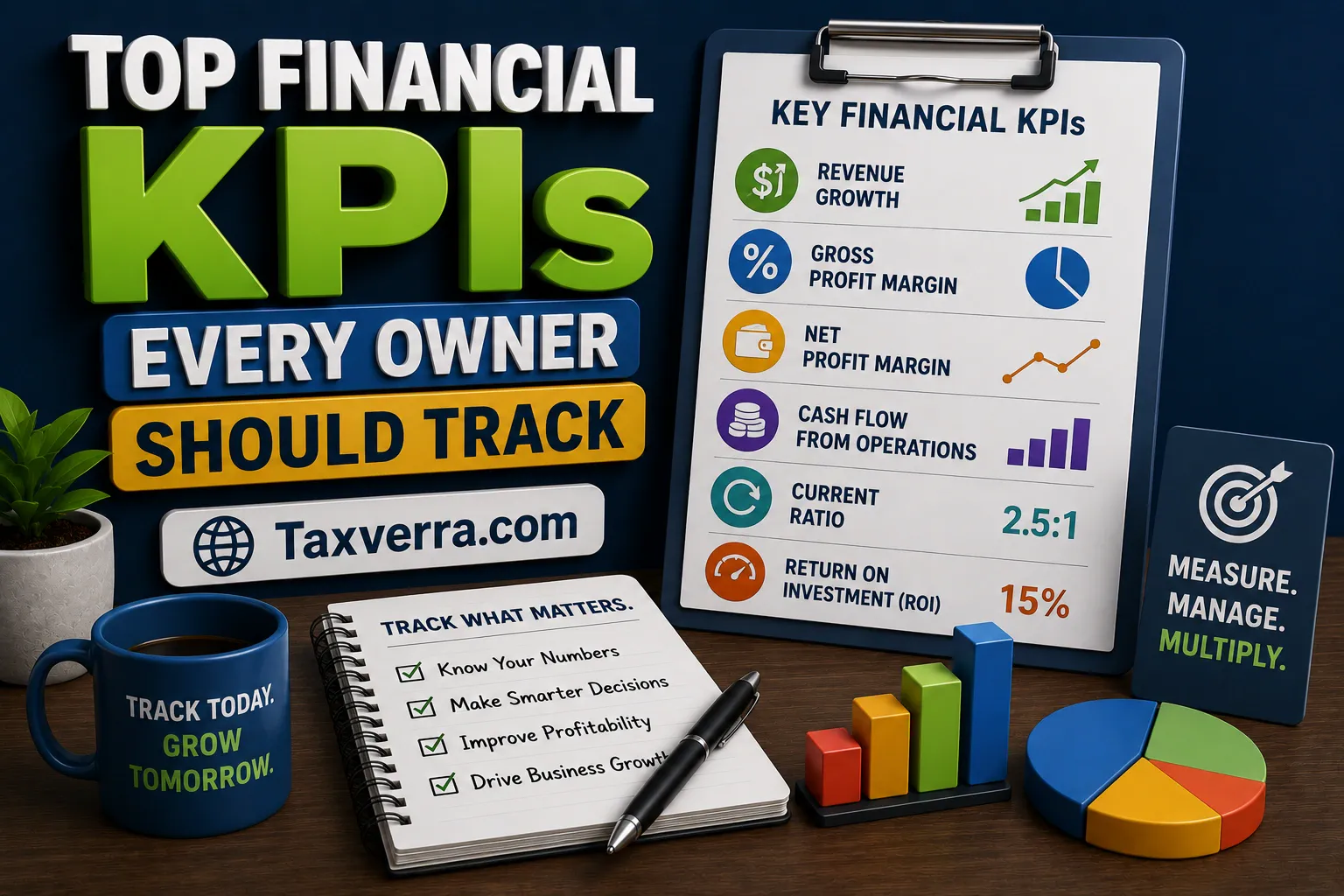
Understanding your financial performance is one of the most important aspects of running a successful business. Many business owners focus heavily on sales and growth, but without tracking the right financial data, it becomes difficult to know whether the business is truly profitable or sustainable in the long run. This is where Financial KPIs (Key Performance Indicators) come into play. These metrics provide clear insights into how well your business is performing and help you make informed, data-driven decisions.
Financial KPIs are not just numbers on a report they are powerful tools that reveal the financial health of your business. They help you monitor cash flow, measure profitability, control costs, and evaluate overall efficiency. By regularly analyzing these indicators, you can identify strengths, uncover weaknesses, and take corrective actions before small issues turn into major problems. Whether it’s tracking your profit margins, understanding your expenses, or evaluating revenue growth, KPIs give you a complete picture of your financial position.
For many entrepreneurs, especially those managing growing operations, it can be overwhelming to decide which metrics matter the most. Not all KPIs are equally important, and focusing on too many can lead to confusion. The key is to concentrate on the most relevant financial indicators that directly impact your business goals. By doing so, you can simplify decision-making and stay focused on what truly drives success.
Another important benefit of financial KPIs is that they help you plan for the future. With accurate data and consistent tracking, you can forecast trends, set realistic targets, and make strategic decisions with confidence. This not only improves day-to-day operations but also strengthens long-term growth and stability.
In this guide, we will explore the most essential financial KPIs that every business owner should track. You’ll learn what each metric means, why it matters, and how it can help you improve your financial performance. By the end, you’ll have a clearer understanding of how to use these indicators to build a stronger, more profitable business.
What Are Financial KPIs?
Financial KPIs (Key Performance Indicators) are measurable values that help you evaluate how well your business is performing financially. These indicators focus on key areas such as profitability, revenue, expenses, and cash flow, giving you a clear picture of your overall financial health. Instead of relying on guesswork, financial KPIs provide accurate data that supports better decision-making.
In simple terms, financial KPIs act as a scorecard for your business. They show whether you are making a profit, managing costs effectively, and growing at a sustainable rate. For example, metrics like profit margin, revenue growth, and cash flow help you understand if your business is moving in the right direction or if adjustments are needed.
Example:
Suppose your business earns $10,000 in revenue in a month and your total expenses are $7,000. Your net profit is $3,000. Using this, your Net Profit Margin KPI would be 30%. This tells you that for every dollar you earn, you keep $0.30 as profit. If this percentage increases over time, it means your business is becoming more profitable.
One of the biggest advantages of financial KPIs is that they turn complex financial data into easy-to-understand insights. Rather than analyzing lengthy financial statements, you can focus on a few key metrics that highlight performance trends and potential issues. This makes it easier to identify problems early and take corrective action before they impact your business.
Financial KPIs are also essential for setting goals and measuring progress. By tracking these indicators over time, you can compare your performance against targets and industry benchmarks. This helps you stay focused, improve efficiency, and make strategic decisions with confidence.
Overall, financial KPIs are a powerful tool for any business owner who wants to improve financial performance, ensure stability, and achieve long-term success.
Why Financial KPIs Matter for Business Growth
Financial KPIs (Key Performance Indicators) play a crucial role in driving business growth because they provide clear, measurable insights into how your business is performing. Without tracking these key metrics, it becomes difficult to understand whether your business is actually growing or just generating revenue without real profitability. KPIs help you move beyond assumptions and make decisions based on real data.
One of the main reasons financial KPIs matter is that they help you identify what is working and what is not. For example, if your revenue is increasing but your profit margins are decreasing, it signals that costs may be rising too quickly. This allows you to take action early such as reducing expenses or adjusting pricing before it affects your overall growth.
Financial KPIs also improve decision-making. Instead of relying on intuition, you can use data to guide your strategies. Whether it’s expanding your operations, investing in new products, or managing expenses, KPIs give you the confidence to make informed choices that support long-term success.
Another important benefit is better cash flow management. Many businesses struggle not because they are unprofitable, but because they run out of cash. By tracking KPIs like cash flow and accounts receivable, you can ensure that your business has enough liquidity to meet its obligations and continue operating smoothly.
Example:
Imagine your business is growing quickly, and sales have increased by 20% over the last few months. However, your cash flow KPI shows a decline because customers are taking longer to pay. This insight helps you take corrective action such as improving your collection process or offering early payment discounts so your growth does not lead to financial strain.
Financial KPIs also help you set realistic goals and measure progress over time. By regularly monitoring these indicators, you can compare your performance against targets and make adjustments as needed. This keeps your business aligned with its growth objectives and ensures you stay on the right path.
In summary, financial KPIs are essential for sustainable business growth. They provide clarity, improve decision-making, and help you stay in control of your financial performance, allowing you to grow your business with confidence and stability.
Why Financial KPIs Are Critical for Small Businesses
Financial KPIs (Key Performance Indicators) are especially important for small businesses because resources are often limited and every decision has a direct impact on success. Unlike larger companies, small businesses usually operate with tighter budgets, fewer staff, and less margin for error. This makes it essential to closely monitor financial performance to ensure stability and growth.
One of the key reasons financial KPIs are critical is that they provide clarity and control over your finances. Small business owners often manage multiple roles, and without clear financial data, it becomes easy to lose track of income, expenses, and profitability. KPIs simplify this by highlighting the most important numbers, allowing you to quickly understand where your business stands.
Financial KPIs also help small businesses make smarter decisions. Instead of relying on guesswork, you can use data to guide your actions. For example, tracking your profit margin can help you decide whether to increase prices or reduce costs. Similarly, monitoring cash flow ensures you have enough money to cover daily operations and avoid financial stress.
Another important factor is risk management. Small businesses are more vulnerable to financial challenges such as unexpected expenses, late payments, or declining sales. By regularly tracking KPIs, you can identify warning signs early and take corrective action before problems become serious.
Example:
Imagine a small business generating steady sales, but its expenses are increasing faster than its revenue. By tracking a KPI like the expense ratio, the owner can quickly spot this issue and take action such as cutting unnecessary costs or negotiating better supplier prices to protect profitability.
Financial KPIs also play a major role in planning and growth. They help you set realistic goals, measure progress, and stay focused on what truly matters. Whether you want to expand your business, hire more employees, or invest in new opportunities, having accurate financial data ensures you make decisions with confidence.
In short, financial KPIs are not just useful they are essential for small businesses. They provide the insights needed to stay in control, reduce risks, and build a strong foundation for long-term success.
How to Choose the Right Financial KPIs
Choosing the right financial KPIs is crucial for effectively measuring your business performance. Not all metrics are equally important, and focusing on too many can create confusion and dilute your efforts. The goal is to identify the KPIs that directly align with your business objectives and provide actionable insights.
1. Align KPIs with Your Business Goals
Start by identifying your key business objectives. Are you focused on increasing profitability, improving cash flow, or growing revenue? Your KPIs should reflect these goals. For example, if your goal is profitability, metrics like net profit margin and gross profit margin will be most relevant.
2. Focus on Actionable Metrics
A good KPI should guide decision-making. Avoid metrics that provide information without helping you take action. For instance, tracking total sales may be less useful than tracking revenue growth rate or customer acquisition cost, which reveal opportunities for improvement.
3. Keep It Simple
Especially for small businesses, it’s better to track a few meaningful KPIs consistently rather than trying to monitor every possible metric. Too many indicators can lead to information overload and reduce the effectiveness of KPI tracking.
4. Consider Industry Benchmarks
Understanding how similar businesses perform can help you choose relevant KPIs. Benchmarks provide context and allow you to compare your performance to industry standards, helping identify areas for improvement.
5. Track Short-Term and Long-Term Metrics
A mix of short-term and long-term KPIs is important. Short-term metrics, like weekly cash flow or monthly sales, help you monitor daily operations. Long-term KPIs, like return on investment (ROI) or yearly revenue growth, help evaluate strategic progress and overall business growth.
Example:
Suppose your goal is to improve profitability. Instead of tracking all financial metrics, you might focus on three KPIs: net profit margin, operating expense ratio, and cash flow. Monitoring these consistently provides actionable insights to reduce costs, optimize operations, and maintain healthy finances.
Choosing the right financial KPIs ensures that you focus on the numbers that truly matter, make informed decisions, and drive your business toward sustainable growth.
Profitability KPIs (Measure Your Earnings Power)
Understanding your earnings and financial efficiency is essential for business growth. These KPIs help you track profitability, manage cash flow, and measure the effectiveness of your operations and investments.
1. Net Profit Margin
Net profit margin shows the percentage of revenue that remains as profit after all expenses, taxes, and interest are deducted.
Formula:
Example:
Revenue: $50,000 | Total Expenses: $40,000 → Net Profit = $10,000
You keep $0.20 for every $1 earned.
2. Gross Profit Margin
Gross profit margin measures revenue remaining after subtracting the cost of goods sold (COGS), showing how efficiently products/services are delivered.
Formula:
Example:
Revenue: $50,000 | COGS: $30,000 → Gross Profit = $20,000
3. Operating Profit Margin
Operating profit margin shows profit after operational expenses but before taxes and interest. It measures operational efficiency.
Formula:
Why It Matters:
Tracking operating profit helps identify unnecessary expenses and optimize your day-to-day operations.
4. Cash Flow Management
Cash flow KPIs track the money coming in and going out of your business. Healthy cash flow ensures you can cover expenses, invest in growth, and handle unexpected costs.
Example:
If your business receives $15,000 in payments but spends $12,000 on expenses, your net cash flow is $3,000. Positive cash flow indicates financial stability.
5. Operating Expenses Ratio
This KPI shows the percentage of revenue spent on operating expenses, helping you control costs and improve efficiency.
Formula:
Example:
Revenue: $50,000 | Operating Expenses: $20,000
Lower ratios indicate better cost control.
6. Break-Even Point
The break-even point shows the revenue required to cover all expenses. It helps determine when your business becomes profitable.
Formula:
Example:
Fixed Costs: $10,000 | Selling Price per Unit: $50 | Variable Cost per Unit: $30
You need to sell 500 units to cover all costs.
7. Accounts Receivable Turnover
This KPI measures how quickly customers pay their invoices, showing the efficiency of your collections process.
Formula:
Accounts Receivable Turnover=Average Accounts ReceivableNet Credit Sales
Example:
Net Credit Sales: $60,000 | Average Accounts Receivable: $10,000
Your business collects its receivables 6 times per year.
8. Return on Investment (ROI)
ROI measures the profitability of an investment relative to its cost, helping assess whether a business initiative is worth pursuing.
Formula:
Example:
Investment: $5,000 | Profit Generated: $2,000
This investment generated a 40% return.
Summary:
By monitoring these profitability and financial KPIs, business owners can make informed decisions, control costs, optimize operations, and measure growth. Regularly tracking these metrics ensures financial stability, identifies potential problems early, and supports long-term success.
Liquidity KPIs (Can You Pay Your Bills?)
Liquidity KPIs are critical for understanding your business’s ability to meet short-term financial obligations. While profitability shows how much you earn, liquidity measures whether you have enough cash or liquid assets to pay bills, salaries, and other immediate expenses. Monitoring liquidity KPIs helps prevent cash flow problems that could disrupt operations or even threaten business survival.
1. Current Ratio
The current ratio measures your ability to pay short-term liabilities with short-term assets. It’s a key indicator of financial stability.
Formula:
Example:
Current Assets: $30,000 | Current Liabilities: $20,000
A ratio above 1 indicates that your business has more assets than liabilities, which is generally healthy.
2. Quick Ratio (Acid-Test Ratio)
The quick ratio refines the current ratio by excluding inventory, focusing only on the most liquid assets. This shows whether your business can meet obligations without relying on inventory sales.
Formula:
Example:
Current Assets: $30,000 | Inventory: $5,000 | Current Liabilities: $20,000
A quick ratio above 1 indicates good short-term financial health.
3. Cash Ratio
The cash ratio measures the ability to pay short-term obligations using only cash and cash equivalents. It’s the most conservative liquidity metric.
Formula:
Example:
Cash & Equivalents: $15,000 | Current Liabilities: $20,000
A cash ratio below 1 isn’t necessarily bad, but it highlights the need to manage cash carefully.
Why Liquidity KPIs Matter
Even profitable businesses can fail if they don’t have enough liquidity. By tracking these KPIs, business owners can:
- Ensure bills and salaries are paid on time
- Plan for unexpected expenses
- Avoid short-term financial crises
- Make informed decisions about borrowing or investing
Example:
A company shows strong profits on paper but has slow-paying clients. Monitoring liquidity KPIs like the quick ratio or cash ratio alerts the owner that immediate cash may be insufficient to cover bills, allowing them to take corrective actions such as improving collections or arranging short-term financing.
Monitoring liquidity KPIs ensures your business stays financially healthy day-to-day while supporting long-term growth. Profitability is important, but cash flow and liquidity are what keep your business running.
Efficiency KPIs (How Well You Use Resources)
Efficiency KPIs measure how effectively your business uses its resources such as time, money, and assets to generate revenue and maintain operations. While profitability tells you if your business is making money, efficiency KPIs reveal how well you are using the resources you already have to achieve growth. High efficiency reduces waste, lowers costs, and maximizes productivity.
1. Inventory Turnover
Inventory turnover measures how quickly your inventory is sold and replaced over a period. A higher turnover indicates efficient inventory management, while a low turnover may signal overstocking or slow-moving products.
Formula:
Example:
COGS: $60,000 | Average Inventory: $15,000
This means your inventory turns over 4 times a year.
2. Accounts Receivable Turnover
This KPI shows how efficiently your business collects payments from customers. A higher turnover indicates faster collections, improving cash flow and reducing bad debts.
Formula:
Example:
Net Credit Sales: $60,000 | Average Accounts Receivable: $10,000
The business collects its receivables six times per year, which is a strong indicator of efficiency.
3. Accounts Payable Turnover
Accounts payable turnover measures how quickly your business pays its suppliers. Maintaining a balanced turnover ensures good supplier relationships without unnecessarily tying up cash.
Formula:
Example:
Supplier Purchases: $40,000 | Average Accounts Payable: $10,000
This means the business pays its suppliers 4 times a year.
4. Asset Turnover Ratio
Asset turnover measures how efficiently your business uses its total assets to generate revenue. Higher turnover indicates better utilization of assets.
Formula:
Example:
Revenue: $100,000 | Total Assets: $50,000
This shows that each dollar of assets generates $2 in revenue.
Why Efficiency KPIs Matter
Efficiency KPIs help business owners:
- Identify waste or underutilized resources
- Improve cash flow and reduce costs
- Optimize operations for better productivity
- Make data-driven decisions about staffing, inventory, and asset management
Example:
A company notices that inventory turnover is low while accounts receivable turnover is high. This indicates that while customers pay quickly, products are sitting in stock too long. By improving inventory management, the company can reduce holding costs and free up cash for other investments.
Tracking efficiency KPIs ensures that your business is not only profitable but also using resources in the smartest way possible. Combining efficiency insights with profitability and liquidity KPIs gives a complete view of operational and financial health.
Growth KPIs (Track Your Business Expansion & Revenue Growth)
Growth KPIs are essential for measuring how quickly your business is expanding and whether your strategies are leading to increased revenue, market share, or overall business size. While profitability and efficiency KPIs show the health of your current operations, growth KPIs indicate whether your business is moving forward and achieving long-term objectives.
1. Revenue Growth Rate
Revenue growth rate measures how much your revenue increases over a specific period. It’s one of the most important indicators of business expansion.
Formula:
Example:
Last Month Revenue: $50,000 | This Month Revenue: $60,000
A 20% growth rate shows that the business is expanding steadily.
2. Customer Acquisition Rate
This KPI tracks how quickly your business gains new customers. Growth depends on attracting and retaining customers consistently.
Formula:
Example:
Starting Customers: 200 | New Customers: 50
This indicates that your customer base grew by 25% during the period.
3. Market Share
Market share shows your business’s portion of total sales in your industry or sector. Increasing market share indicates growth relative to competitors.
Formula:
Example:
Your Sales: $500,000 | Total Industry Sales: $5,000,000
An increasing market share shows your business is growing faster than competitors.
4. Repeat Customer Rate
Repeat customer rate measures how often customers return to buy again. Growth is easier and cheaper when existing customers continue to generate revenue.
Formula:
Example:
Total Customers: 200 | Returning Customers: 120
A 60% repeat rate indicates strong customer loyalty, which supports sustainable growth.
5. Return on Investment (ROI) for Growth Initiatives
Growth often requires investment in marketing, new products, or expansion. ROI measures the return generated from these investments.
Formula:
Example:
Investment in marketing: $5,000 | Additional Revenue Generated: $10,000 | Costs: $5,000 → Profit: $5,000
This means the investment doubled your money, proving it was effective for growth.
Why Growth KPIs Matter
Tracking growth KPIs allows business owners to:
- Measure revenue expansion and market performance
- Evaluate the success of marketing and sales strategies
- Make data-driven decisions for scaling operations
- Ensure long-term sustainability
Example:
A business shows increasing revenue but a declining repeat customer rate. This indicates that while growth is happening, customer retention may be weakening. By addressing retention strategies, the business can ensure sustainable, long-term growth rather than temporary spikes.
Monitoring growth KPIs alongside profitability, liquidity, and efficiency KPIs gives a complete picture of your business performance. These metrics help you make strategic decisions, allocate resources effectively, and plan for sustainable expansion.
Cash Flow KPIs (The Lifeline of Your Business)
Cash flow is the lifeblood of any business. Even profitable companies can fail if they don’t manage their cash properly. Cash flow KPIs help you monitor the movement of money in and out of your business, ensuring that you can cover expenses, pay employees, invest in growth, and respond to unexpected challenges.
1. Operating Cash Flow (OCF)
Operating cash flow measures the cash generated from your core business operations. It shows whether your business generates enough cash to sustain operations without relying on external financing.
Formula:
Example:
Net Income: $20,000 | Non-Cash Expenses (Depreciation): $5,000 | Increase in Accounts Receivable: $3,000
This means the business generated $22,000 in cash from its operations.
2. Free Cash Flow (FCF)
Free cash flow shows how much cash is available after covering capital expenditures like equipment or property purchases. It indicates the cash available for expansion, debt repayment, or dividends.
Formula:
Example:
Operating Cash Flow: $22,000 | Capital Expenditures: $7,000
The business has $15,000 available to reinvest or save.
3. Cash Conversion Cycle (CCC)
The cash conversion cycle measures how long it takes to turn investments in inventory and other resources into cash from sales. A shorter cycle indicates efficient cash management.
Formula:
Example:
Inventory Days: 30 | Receivables Days: 20 | Payables Days: 15
It takes 35 days to convert resources into cash.
4. Cash Flow Margin
Cash flow margin shows what percentage of revenue is converted into cash. This helps you understand how efficiently your business turns sales into cash.
Formula:
Example:
Operating Cash Flow: $22,000 | Revenue: $50,000
This means 44% of your revenue is available as cash.
Why Cash Flow KPIs Matter
Even profitable businesses can struggle if they cannot manage cash effectively. Monitoring cash flow KPIs helps you:
- Ensure liquidity to pay bills and salaries
- Plan for investments or unexpected expenses
- Avoid financial crises due to poor cash management
- Make informed strategic decisions
Example:
A company shows strong profits but a declining cash flow margin. This indicates that revenue is not translating into usable cash, possibly due to slow customer payments or high inventory levels. Tracking cash flow KPIs allows the business to adjust payment terms or improve collections before problems escalate.
Cash flow KPIs are the lifeline of your business. Combining these with profitability, efficiency, liquidity, and growth KPIs provides a full picture of your financial health and ensures your business remains sustainable and scalable.
Real-World Example (Practical Application)
To see how financial KPIs work in practice, let’s look at a small retail business, “BrightShop,” and how they use these metrics to manage and grow their company.
Scenario:
BrightShop sells home décor products and generates $100,000 in monthly revenue. The owner wants to understand profitability, cash flow, efficiency, and growth to make informed decisions.
Step 1: Profitability KPIs
- Net Profit Margin: Revenue = $100,000, Total Expenses = $80,000 → Net Profit = $20,000
BrightShop keeps $0.20 of every $1 earned, showing healthy profitability.
- Gross Profit Margin: COGS = $50,000 → Gross Profit = $50,000
This indicates efficient product sourcing and pricing.
Step 2: Liquidity & Cash Flow KPIs
- Current Ratio: Current Assets = $60,000, Current Liabilities = $40,000 → 1.5
BrightShop can cover short-term debts comfortably. - Operating Cash Flow: $25,000
The business generates enough cash from operations to cover daily expenses without loans. - Cash Conversion Cycle: Inventory Days = 30, Receivable Days = 20, Payable Days = 15 → CCC = 35 days
It takes just over a month to turn investments into cash, which is manageable for their business.
Step 3: Efficiency KPIs
- Inventory Turnover: COGS = $50,000, Average Inventory = $12,500 → Turnover = 4
BrightShop sells and replaces inventory 4 times per year, showing efficient inventory management. - Accounts Receivable Turnover: Net Credit Sales = $60,000, Average AR = $10,000 → Turnover = 6
Customers pay relatively quickly, ensuring steady cash flow.
Step 4: Growth KPIs
- Revenue Growth Rate: Last Month = $90,000, This Month = $100,000 → Growth = 11.1%
BrightShop is steadily expanding revenue month over month. - Repeat Customer Rate: 120 out of 200 customers return → 60%
High repeat customer rate ensures sustainable growth and customer loyalty.
Step 5: Actionable Insights
By analyzing these KPIs, the owner of BrightShop identified:
- Cash flow is healthy, but CCC could be reduced by negotiating faster payments from clients.
- Inventory turnover is good, but some slow-moving products could be discounted to free up cash.
- Revenue is growing, but increasing repeat customer engagement through loyalty programs could accelerate growth.
Result:
Using financial KPIs, BrightShop improved decision-making, optimized operations, and planned strategic growth confidently, all while maintaining profitability and financial stability.
This practical example shows how tracking KPIs in real-time provides actionable insights that directly impact your business performance.
Deep Insights (Expert-Level Understanding)
While tracking financial KPIs provides a clear picture of your business’s health, analyzing them at an expert level unlocks deeper insights that drive strategic decision-making and long-term growth. Moving beyond the surface-level numbers allows business owners to identify trends, anticipate challenges, and optimize every aspect of operations.
1. Look for KPI Relationships
KPIs rarely operate in isolation. Understanding the relationships between metrics can reveal hidden patterns:
- Profitability vs. Cash Flow: A company may show strong profits but poor cash flow. For example, high sales with delayed customer payments inflate revenue but reduce cash availability. Monitoring both metrics together helps prevent liquidity crises.
- Growth vs. Efficiency: Rapid revenue growth may strain operations. Tracking efficiency KPIs such as inventory turnover and accounts receivable ensures growth is sustainable and resources are used wisely.
Expert Tip: Use dashboards or KPI software to cross-analyze metrics and detect these interactions in real time.
2. Benchmark Against Industry Standards
Expert-level KPI analysis involves comparing your metrics with competitors and industry averages. Benchmarking highlights strengths, weaknesses, and opportunities.
Example:
If your net profit margin is 20% but the industry average is 25%, you may need to optimize pricing or reduce operating costs to stay competitive.
3. Trend Analysis Over Time
Single data points provide limited insight. Tracking KPIs over months, quarters, or years reveals trends and patterns that inform strategy.
Example:
- Rising gross profit margin but declining net profit margin may indicate increasing operational costs.
- Declining repeat customer rate over multiple periods signals a potential retention problem before it impacts revenue significantly.
4. Focus on Leading vs. Lagging Indicators
Understanding whether a KPI is a leading or lagging indicator is crucial for strategic decisions:
- Leading KPIs: Predict future performance (e.g., customer acquisition rate, cash conversion cycle).
- Lagging KPIs: Reflect past performance (e.g., net profit, ROI).
Expert Insight: Leading KPIs allow you to take proactive measures, while lagging KPIs validate your strategies and track outcomes.
5. KPI-Driven Decision Making
Expert business owners don’t just track KPIs they act on them:
- Adjust pricing strategies based on profit margin trends.
- Improve operational efficiency by monitoring inventory and receivables.
- Prioritize investments with the highest ROI.
- Optimize cash flow cycles to support sustainable growth.
Example:
A business sees a decline in operating cash flow while revenue increases. An expert analysis may reveal that accounts receivable is growing too fast, prompting stricter payment terms or incentives for early payments.
6. Use KPIs to Forecast and Plan
Advanced KPI analysis allows for predictive insights. Using historical data and trend analysis, businesses can forecast revenue, plan budgets, and allocate resources more effectively.
Example:
By analyzing historical cash flow patterns and seasonal revenue trends, a business can anticipate slow months and prepare financing strategies in advance.
Conclusion
Expert-level KPI analysis transforms raw financial data into actionable intelligence. It moves you from reactive management to proactive, strategic decision-making. By understanding KPI relationships, benchmarking, analyzing trends, and focusing on leading indicators, you can not only maintain financial health but also accelerate growth, improve efficiency, and future-proof your business.
Practical Takeaways
After understanding all the different financial KPIs and their significance, the next step is turning insights into action. Here are practical takeaways every business owner can implement to improve performance and growth:
1. Focus on Key KPIs Relevant to Your Business
Don’t track every possible KPI. Identify the metrics that directly impact your business goals profitability, cash flow, efficiency, and growth and monitor them consistently.
Action Step: Choose 5–10 KPIs that reflect your business priorities and set up a regular review schedule.
2. Use KPIs to Make Data-Driven Decisions
KPI tracking is only valuable if it influences your strategy. Use the data to optimize pricing, manage expenses, improve inventory, or adjust marketing campaigns.
Action Step: Compare KPIs monthly or quarterly, and make at least one actionable change based on insights.
3. Monitor Trends, Not Just Numbers
Single data points are limited. Focus on trends over time to spot patterns and anticipate challenges.
Action Step: Maintain historical KPI data and create visual charts or dashboards for better trend analysis.
4. Combine Multiple KPIs for a Holistic View
Profitability, liquidity, efficiency, and growth KPIs are interconnected. A complete understanding comes from analyzing them together rather than in isolation.
Action Step: Create a KPI dashboard that shows related metrics side by side, such as revenue growth vs. cash flow or inventory turnover vs. sales.
5. Benchmark Against Industry Standards
Compare your KPIs to competitors or industry averages to see where you stand and identify improvement areas.
Action Step: Research industry benchmarks for net profit margin, gross margin, and growth rates to guide strategic decisions.
6. Take Action Early
KPIs are most effective when used proactively. Leading indicators like customer acquisition rate, cash conversion cycle, and accounts receivable turnover help anticipate problems before they escalate.
Action Step: Regularly review leading KPIs and implement corrective measures early.
7. Automate and Simplify KPI Tracking
Manual tracking can be time-consuming and prone to errors. Automating KPI tracking with accounting software or dashboards saves time and improves accuracy.
Action Step: Use tools like QuickBooks, Xero, or KPI dashboards to monitor real-time financial performance.
8. Keep Improving
KPIs are not static. Regularly evaluate which metrics matter most as your business evolves, and adjust your focus accordingly.
Action Step: Review your KPI framework at least twice a year to ensure it aligns with your growth goals and operational strategy.
Summary:
By focusing on the right KPIs, monitoring trends, combining insights, and taking timely action, you can improve profitability, manage cash flow, optimize efficiency, and sustain growth. Implement these practical takeaways to turn financial data into real business results.
FAQs (Frequently Asked Questions About Financial KPIs)
1. What are financial KPIs?
Financial KPIs (Key Performance Indicators) are measurable metrics that help business owners track financial health, profitability, cash flow, efficiency, and growth. They provide actionable insights for better decision-making.
2. Why are financial KPIs important for small businesses?
Financial KPIs are essential for small businesses because they help owners monitor profitability, manage cash flow, control expenses, and make data-driven decisions. Tracking KPIs reduces risks and ensures long-term sustainability.
3. How often should I track financial KPIs?
The frequency depends on the KPI and your business needs:
- Daily/weekly: Cash flow, accounts receivable, and inventory turnover.
- Monthly: Profit margins, operating expenses ratio, and revenue growth.
- Quarterly/Annually: ROI, market share, and long-term growth metrics.
4. Which financial KPIs are most important for a small business?
Some of the most critical KPIs for small businesses include:
- Net Profit Margin
- Gross Profit Margin
- Operating Expenses Ratio
- Cash Flow (Operating & Free Cash Flow)
- Revenue Growth Rate
- Accounts Receivable Turnover
5. Can KPIs predict future business performance?
Yes. Leading KPIs, like cash conversion cycle, customer acquisition rate, and accounts receivable turnover, help anticipate potential issues and guide proactive strategies. Lagging KPIs, like net profit or ROI, validate past performance.
6. How do I choose the right KPIs for my business?
Focus on KPIs that align with your business goals. Consider profitability, cash flow, efficiency, and growth. Avoid tracking too many metrics choose the ones that provide actionable insights and monitor them consistently.
7. What tools can I use to track financial KPIs?
There are many accounting and analytics tools to automate KPI tracking:
- QuickBooks
- Xero
- Zoho Books
- Excel or Google Sheets (with KPI dashboards)
- Business intelligence software like Tableau or Power BI
8. How can KPIs improve business decision-making?
KPIs provide real-time data on financial health, helping you:
- Identify areas to cut costs or improve efficiency
- Adjust pricing strategies or sales tactics
- Plan investments and expansion strategies
- Forecast future growth and avoid financial risks
9. Are financial KPIs only for large companies?
No. Financial KPIs are vital for businesses of all sizes. For small businesses, they provide clarity, improve decision-making, and help maintain profitability and cash flow with limited resources.
10. How often should I review and update my KPIs?
Review KPIs regularly—monthly for operational metrics and quarterly or annually for strategic KPIs. Update your KPI framework as your business grows or goals change to stay aligned with your objectives.
Final Thought
Financial KPIs are more than just numbers they are the roadmap to business success. Tracking and analyzing the right KPIs allows you to understand profitability, manage cash flow, optimize efficiency, and drive sustainable growth. For small business owners, these metrics provide clarity, reduce risk, and enable smarter decision-making.
The true power of KPIs comes from consistent monitoring, trend analysis, and acting on insights. Whether it’s improving profit margins, shortening your cash conversion cycle, or increasing customer retention, financial KPIs give you the tools to make informed, strategic choices.
By combining profitability, liquidity, efficiency, growth, and cash flow KPIs, and pairing them with expert-level insights and practical takeaways, you can transform raw financial data into actionable intelligence. This approach not only strengthens day-to-day operations but also sets the foundation for long-term success and scalability.
In the end, businesses that actively track and use KPIs are not just reacting to numbers they are steering their business toward growth, stability, and financial freedom. Start tracking the right KPIs today, and turn your financial data into a powerful growth engine for your business.

