

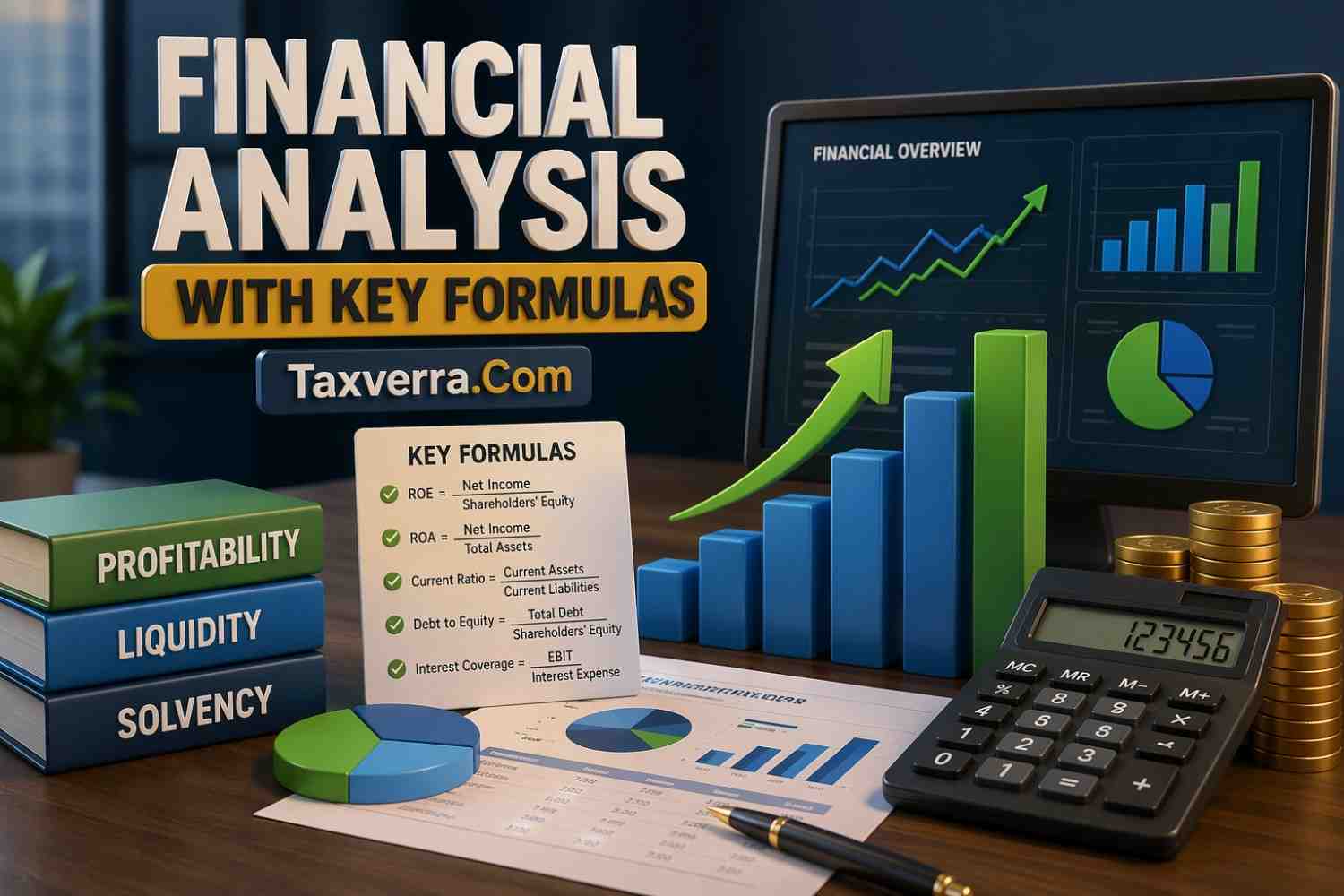
1. Strategic Foundation of Advanced Financial Statement Analysis
When you move into advanced financial statement analysis, the focus shifts from calculating numbers to understanding financial behavior. Anyone can compute ratios, but very few can explain why performance is improving or deteriorating.
In my experience, the biggest turning point for business owners is when they stop focusing on profit alone and start evaluating financial sustainability. A business can report strong earnings and still struggle operationally. That’s where financial statement interpretation becomes critical.
A practical example comes from a distribution client I worked with. Their income statement analysis showed steady growth in profits, which initially looked impressive. But when we examined the cash flow analysis, operating cash was declining. Digging into the balance sheet analysis, we found receivables increasing at a much faster pace than sales. The business was growing on paper, but not in liquidity.
This is where financial data analysis connects key elements:
- Profit without cash often signals collection issues
- Asset growth without proportional returns indicates inefficiency
- Debt-driven expansion can create long-term pressure
One mistake I often see is over-reliance on metrics like the return on equity formula without understanding what is driving it. A high return may be the result of excessive leverage rather than operational strength.
At an advanced level, the goal is not to calculate more ratios but to form informed financial judgment. You should be able to explain whether performance is sustainable, where risks are building, and how decisions today will affect future financial stability.
2. Why Financial Ratios Are the Language of Financial Insight
Raw financial figures rarely provide clarity on their own. This is why financial statement analysis formulas and key financial ratios are essential. They translate data into relationships that reveal how efficiently a business is operating.
In practice, I rarely begin with absolute numbers. Instead, I look at ratio analysis formulas to understand performance relative to scale. A company generating higher profit is not necessarily better if its efficiency is lower.
Consider this comparison from a real client discussion:
| Metric | Company A | Company B |
|---|---|---|
| Revenue | 10M | 4M |
| Net Profit | 1M | 800K |
| Net Profit Margin | 10% | 20% |
At first glance, Company A appears stronger. However, profitability ratios clearly show that Company B is operating more efficiently.
One mistake I often see is relying on a single ratio in isolation. For instance, a strong current ratio formula may give a false sense of security if it is supported by slow-moving inventory or delayed receivables.
In advanced ratio analysis, interpretation matters more than calculation. You should always:
- Compare ratios over multiple periods
- Evaluate them against industry benchmarks
- Combine multiple ratios to get a complete view
A practical example is a retail client where a slight decline in inventory turnover ratio initially seemed insignificant. However, when combined with declining margins, it revealed overstocking and pricing inefficiencies.
Ratios should be treated as signals, not conclusions. The real value lies in connecting them to operational decisions and overall financial performance analysis.
3. Understanding Financial Statements Like a Decision-Maker
To perform effective advanced accounting analysis, financial statements must be read with intent. Each statement serves a purpose, but the real insight comes from how they interact.
The income statement analysis focuses on profitability, the balance sheet analysis reflects financial position, and the cash flow analysis reveals actual liquidity movement. When these are viewed together, they provide a complete picture of financial health.
A practical example is a service business I advised that reported strong profits year after year. On the surface, everything appeared stable. However, their operating cash flow remained negative. The issue was early revenue recognition combined with delayed cash collection. Profits existed in accounting terms, but not in reality.
One mistake I often see is ignoring working capital movements. For example:
- Increasing sales
- Rising receivables
- Declining cash
This combination often signals hidden liquidity pressure.
In business financial analysis, it is important to connect:
- Revenue growth with receivable trends
- Asset expansion with return generation
- Debt levels with earnings consistency
The balance sheet, in particular, provides valuable insights into capital structure and financial risk. In my experience, many problems that later appear in profitability can be traced back to balance sheet inefficiencies.
Understanding financial statements at an advanced level means identifying patterns, not just reading figures. You are essentially analyzing how decisions made by management are reflected across all three statements.
4. Profitability Analysis: Identifying Sustainable Earnings
Profitability is often the first area of focus in financial performance analysis, but surface-level profit figures can be misleading. Using profitability ratios such as the return on assets formula and return on equity formula, you can evaluate how effectively a business generates earnings.
In my experience, the key question is not how much profit a business earns, but how efficiently it generates that profit.
A manufacturing client I worked with showed improving net profit margins over several periods. At first, this suggested better cost control. However, when we analyzed return on assets, it became clear that asset growth was outpacing profit growth. Capital was being deployed inefficiently, which raised concerns about long-term performance.
Here is how different ratios provide different perspectives:
| Ratio | Insight |
|---|---|
| Net Profit Margin | Efficiency in managing costs |
| Return on Assets | Effectiveness of asset utilization |
| Return on Equity | Return generated for shareholders |
One mistake I often see is interpreting a high return on equity as a sign of strong performance without considering leverage. Debt can significantly inflate this ratio, masking underlying risk.
Another real-world situation involved a startup that improved margins through aggressive cost reductions. While profitability improved temporarily, operational quality declined, eventually affecting revenue.
Practical insights I consistently recommend include:
- Evaluating profitability alongside cash flow
- Comparing asset growth with profit trends
- Monitoring consistency in margins rather than isolated improvements
True profitability is not about short-term gains. It reflects a business’s ability to generate consistent and sustainable earnings over time.
5. Liquidity Analysis: Assessing Short-Term Financial Stability
Liquidity is a critical component of financial health analysis, yet it is often misunderstood. Businesses rarely fail due to lack of profit; they fail due to lack of cash. This is why liquidity ratios are essential in advanced analysis.
Commonly used measures include the current ratio formula and the quick ratio formula, but the interpretation behind these numbers is where real insight lies.
A wholesale client I worked with reported a current ratio above 2, which typically indicates strong liquidity. However, when we calculated the quick ratio, the number dropped significantly. Most of their current assets were tied up in inventory that was not moving efficiently.
This highlights a common issue.
One mistake I often see is assuming that higher liquidity automatically indicates better financial health. In reality, excessive liquidity may point to:
- Inefficient use of capital
- Idle cash reserves
- Weak investment planning
In advanced ratio analysis, it is important to examine the quality of assets, not just the quantity. Key considerations include:
- Speed of receivables collection
- Inventory turnover efficiency
- Alignment between payables and cash inflows
Another client case involved a profitable business that frequently struggled to meet short-term obligations. The root cause was poor working capital management rather than weak earnings.
Actionable steps I usually suggest:
- Monitor liquidity trends regularly rather than annually
- Improve receivables collection processes
- Avoid overstocking inventory
Liquidity analysis ultimately helps ensure that a business can maintain operations smoothly while supporting growth without financial strain.
6. Leverage Analysis: Understanding Financial Risk Behind the Numbers
When I review a company’s financials, one of the first things I assess is its capital structure. Solvency ratios such as the debt to equity ratio and interest coverage ratio reveal how a business is financed and whether that structure is sustainable.
In my experience, debt itself is not the problem. Mismanaged debt is. A company using leverage wisely can accelerate growth, but excessive reliance creates long-term pressure.
A practical example comes from a construction client. Their profits were stable, but the debt to equity ratio had doubled within two years. On paper, performance looked consistent, but their interest coverage ratio was declining. Eventually, even a small dip in revenue created repayment stress.
Key interpretations I usually focus on:
- Rising debt with flat profits signals increasing risk
- Strong interest coverage indicates repayment comfort
- Low equity base amplifies financial volatility
One mistake I often see is ignoring how leverage affects other ratios. For example, a high return on equity formula may simply reflect heavy borrowing rather than strong operations.
In corporate finance analysis, leverage should always be evaluated alongside profitability and cash flow. Debt is only safe when supported by consistent earnings and reliable cash generation.
Actionable insights:
- Monitor debt trends over time, not just current levels
- Align borrowing with revenue-generating assets
- Avoid financing long-term assets with short-term debt
Leverage analysis is ultimately about understanding how much risk a business is carrying beneath its reported performance.
7. Efficiency Ratios: Measuring Operational Discipline
A profitable business can still be inefficient. This is why efficiency ratios such as the inventory turnover ratio, receivables turnover, and asset turnover are essential in advanced financial statement analysis.
These ratios show how effectively a company is using its resources to generate revenue.
A practical example is a retail client whose profits were stable, but cash flow remained inconsistent. When we analyzed the inventory turnover ratio, it had declined steadily. Inventory was sitting longer, tying up capital and increasing storage costs.
Here are the key efficiency indicators I rely on:
| Ratio | What It Indicates |
|---|---|
| Inventory Turnover | Stock movement efficiency |
| Receivables Turnover | Collection efficiency |
| Total Asset Turnover | Overall asset utilization |
One mistake I often see is focusing only on profitability without analyzing operational efficiency. A company may appear successful, but inefficient processes can quietly reduce long-term performance.
Another real-world case involved a service firm with strong revenue growth. However, receivables turnover was weakening. Clients were taking longer to pay, which created hidden pressure on cash flow.
In financial performance analysis, efficiency ratios often explain why cash flow does not align with profits.
Practical steps I usually recommend:
- Track turnover ratios monthly
- Identify slow-moving inventory early
- Strengthen credit control policies
Efficiency analysis highlights how well management is running day-to-day operations, which ultimately drives sustainable performance.
8. Advanced Cash Flow Analysis: Where Financial Reality Becomes Clear
Profit can be influenced by accounting decisions, but cash flow reflects reality. This is why cash flow analysis is one of the most important parts of advanced accounting analysis.
Key cash flow ratios I often use include:
- Operating Cash Flow Ratio
- Free Cash Flow
- Cash Flow Coverage Ratios
A practical example is a manufacturing business that showed consistent profits over several years. However, operating cash flow was declining. The issue was aggressive revenue recognition combined with delayed collections. On paper, the business looked healthy. In reality, liquidity was weakening.
One mistake I often see is assuming that positive net income guarantees strong cash flow. This is not always true. Differences arise due to:
- Changes in working capital
- Non-cash expenses
- Timing differences in revenue recognition
Here is how I typically break it down:
| Measure | Insight |
|---|---|
| Operating Cash Flow | Core business liquidity |
| Free Cash Flow | Funds available after investment |
| Cash Flow Coverage | Ability to meet obligations |
Another real-world case involved a company generating strong operating cash flow but negative free cash flow due to heavy capital expenditure. This was not necessarily a bad sign, but it required careful evaluation of future returns.
In financial statement insights, cash flow analysis helps answer one critical question:
Is the business generating real, usable cash?
Practical recommendations:
- Always reconcile profit with cash flow
- Monitor working capital closely
- Evaluate capital expenditure impact
Cash flow is the most reliable indicator of financial strength, especially in uncertain conditions.
9. DuPont Analysis: Breaking Down Return on Equity
The dupont analysis explained approach is one of the most powerful tools in advanced ratio analysis. It breaks down the return on equity formula into components that reveal what is actually driving performance.
Instead of viewing ROE as a single number, DuPont analysis separates it into:
- Profit Margin
- Asset Turnover
- Financial Leverage
A practical example is a client who reported an ROE of 22 percent. At first glance, it looked impressive. However, when we applied DuPont analysis, we discovered that most of the return was driven by high leverage rather than operational efficiency.
This distinction is critical.
Here is a simplified breakdown:
| Component | What It Shows |
|---|---|
| Profit Margin | Cost efficiency |
| Asset Turnover | Resource utilization |
| Leverage | Financial structure impact |
One mistake I often see is assuming that a high ROE automatically indicates strong performance. Without breaking it down, you may overlook underlying risks.
Another case involved a company with moderate ROE but strong asset turnover and low leverage. In reality, this business was more stable and sustainable than one with a higher ROE driven by debt.
In financial analysis for investors, DuPont analysis provides clarity by identifying the real drivers of returns.
Practical insights:
- Use DuPont analysis to validate ROE quality
- Compare components across competitors
- Focus on improving operational drivers, not just leverage
This approach transforms ROE from a simple ratio into a meaningful analytical tool.
10. Horizontal and Vertical Analysis: Seeing Trends and Structure Clearly
While ratios provide relationships, horizontal analysis financial statements and vertical analysis accounting techniques help you understand trends and composition.
Horizontal analysis focuses on changes over time. Vertical analysis expresses each item as a percentage of a base figure, such as revenue.
In my experience, combining these two methods provides powerful insights into financial statement interpretation.
A practical example is a company I reviewed where revenue was growing steadily. At first glance, performance seemed strong. However, through horizontal analysis, operating expenses were growing at a faster rate. Vertical analysis confirmed that expenses were consuming a larger percentage of revenue over time.
This revealed declining efficiency despite growth.
Here is a simple illustration:
| Item | Year 1 | Year 2 | % of Revenue (Year 2) |
|---|---|---|---|
| Revenue | 1,000 | 1,200 | 100% |
| Expenses | 600 | 800 | 67% |
| Profit | 400 | 400 | 33% |
One mistake I often see is focusing only on growth figures without analyzing cost structure changes.
Another real-world case involved a business with stable profits but increasing administrative expenses. Vertical analysis highlighted inefficiencies that were not obvious from absolute numbers.
In financial analysis techniques, these methods are essential for:
- Identifying trends early
- Understanding cost structure shifts
- Supporting forecasting decisions
Practical recommendations:
- Perform horizontal analysis over at least three years
- Use vertical analysis to evaluate cost control
- Combine both for deeper insight
These techniques provide clarity by showing not just what changed, but how financial structure is evolving over time.
11. Earnings Quality Analysis: Identifying Red Flags Behind Reported Profits
Not all profits are created equal. In advanced financial statement analysis, one of the most critical skills is assessing earnings quality. This is where many investors and business owners get misled because they focus on reported numbers without questioning their reliability.
In my experience, the first step is to compare income statement analysis with cash flow analysis. If profits are rising but operating cash flow is not, it’s a warning sign that earnings may not be fully backed by cash.
A practical example is a client in the services sector who showed consistent profit growth. However, a deeper look revealed increasing receivables and declining cash flow. The business was recognizing revenue aggressively, which inflated profits but weakened liquidity.
Common red flags I usually watch for:
- Large gap between net income and operating cash flow
- Frequent changes in accounting policies
- Unusual spikes in revenue near period-end
- Rising accruals without corresponding cash movement
One mistake I often see is ignoring accruals. High accruals can indicate that profits are being recorded without actual cash realization, which affects sustainability.
Another case involved a company capitalizing expenses to improve short-term profits. While this boosted reported earnings, it created long-term distortions in financial performance.
In financial statement insights, earnings quality analysis helps answer a key question:
Are profits real, repeatable, and supported by cash?
Practical steps:
- Compare net income with operating cash flow
- Analyze trends in accruals
- Look for consistency in accounting practices
Strong earnings quality reflects a business with transparent reporting and stable operations.
12. Financial Modeling and Forecasting Using Ratios
Once you understand historical performance, the next step in financial modeling techniques is forecasting future outcomes. This is where advanced financial statement analysis becomes forward-looking.
In practice, I rarely rely on assumptions alone. Instead, I use ratio analysis formulas to build projections that are grounded in historical trends.
A practical example is a retail client planning expansion. Instead of guessing future profits, we used historical profitability ratios, efficiency ratios, and working capital patterns to forecast revenue, costs, and cash flow.
Key components I usually model:
- Revenue growth based on past trends
- Cost structure using margin ratios
- Working capital using turnover ratios
- Capital expenditure and funding needs
One mistake I often see is creating overly optimistic projections without linking them to real data. For example, projecting high sales growth without adjusting inventory and receivables leads to unrealistic forecasts.
Here’s a simplified approach:
| Area | Method |
|---|---|
| Revenue | Historical growth trend |
| Expenses | Percentage of revenue |
| Working Capital | Turnover ratios |
| Cash Flow | Adjusted from projections |
Another real-world case involved a startup projecting aggressive growth but ignoring cash flow requirements. The model showed profitability, but liquidity issues appeared early due to underestimating working capital needs.
In financial forecasting methods, accuracy comes from realism, not optimism.
Practical tips:
- Base projections on historical ratios
- Stress-test different scenarios
- Align forecasts with operational capacity
Financial modeling is not about predicting the future perfectly, but about preparing for it with structured analysis.
13. Industry Benchmarking and Comparative Analysis
Numbers have limited meaning without context. This is why industry benchmarking is essential in business financial analysis. A company’s performance should always be evaluated relative to its peers.
In my experience, many businesses believe they are performing well simply because their internal numbers are improving. However, when compared to industry standards, the picture can change significantly.
A practical example is a manufacturing client with a net profit margin of 12 percent. Internally, this looked strong. But after benchmarking against competitors operating at 18 percent, it became clear that cost efficiency needed improvement.
Key areas I usually compare:
- Profitability ratios
- Liquidity ratios
- Solvency ratios
- Efficiency ratios
One mistake I often see is comparing companies across different industries. Each industry has its own operating dynamics, so benchmarks must be relevant.
Here’s a simplified comparison framework:
| Metric | Company | Industry Average |
|---|---|---|
| Net Margin | 12% | 18% |
| Current Ratio | 1.5 | 1.8 |
| Inventory Turnover | 4x | 6x |
Another case involved a retail business with strong liquidity but below-average inventory turnover. Benchmarking revealed inefficiencies in stock management that were not obvious internally.
In corporate finance analysis, benchmarking helps identify strengths and weaknesses that internal analysis alone cannot reveal.
Practical recommendations:
- Use industry reports and competitor data
- Focus on key ratios, not all metrics
- Identify gaps and prioritize improvements
Comparative analysis turns isolated financial data into meaningful performance evaluation.
14. Limitations of Financial Statement Analysis
While advanced financial statement analysis is powerful, it is not without limitations. Understanding these limitations is essential to avoid overconfidence in conclusions.
In my experience, one of the biggest challenges is that financial statements are based on historical data. They show what has happened, not necessarily what will happen.
A practical example is a company that showed strong past performance but was operating in a declining industry. Financial statements alone did not reflect future risks.
Key limitations I often highlight:
- Historical nature of financial data
- Dependence on accounting policies
- Potential for management manipulation
- Lack of qualitative factors
One mistake I often see is treating ratios as absolute truths. For example, a strong current ratio formula does not guarantee liquidity if receivables are not collectible.
Another case involved a business with strong profitability but declining customer satisfaction. Financial statements did not capture this risk, but it eventually impacted revenue.
In financial statement interpretation, numbers should always be combined with business context.
Practical insights:
- Supplement analysis with industry knowledge
- Consider market conditions and competition
- Evaluate management decisions alongside financial data
Financial analysis provides valuable insights, but it should not be used in isolation when making critical decisions.
15. Common Mistakes That Distort Financial Analysis
Even experienced professionals can make errors in advanced ratio analysis if they overlook key details. Recognizing common mistakes is essential for improving accuracy.
One mistake I often see is analyzing ratios without context. For example, a high debt to equity ratio may seem risky, but in capital-intensive industries, it can be normal.
Another common issue is focusing only on short-term performance. A business may show strong quarterly results, but long-term trends may reveal declining performance.
A practical example involves a company that improved margins by cutting essential costs. In the short term, profitability increased, but operational efficiency declined, affecting future growth.
Frequent mistakes include:
- Relying on a single ratio
- Ignoring industry benchmarks
- Overlooking cash flow
- Misinterpreting trends
Another real-world case involved an investor who relied heavily on return on equity formula without analyzing leverage. The investment appeared attractive but carried significant financial risk.
In financial analysis for investors, avoiding these mistakes can significantly improve decision-making.
Practical steps:
- Use multiple ratios together
- Analyze trends over time
- Always include cash flow analysis
- Validate findings with qualitative insights
Financial analysis is as much about avoiding errors as it is about applying formulas correctly.
16. Practical Case Study: Applying Key Financial Ratios Step by Step
To bring everything together, let’s walk through a simplified company performance analysis using key ratios.
Consider a mid-sized trading business with the following data:
| Metric | Value |
|---|---|
| Revenue | 5M |
| Net Profit | 500K |
| Total Assets | 3M |
| Equity | 1M |
| Current Assets | 1.5M |
| Current Liabilities | 1M |
Step 1 is profitability analysis. Net profit margin is 10 percent, which indicates moderate efficiency.
Step 2 is asset utilization. Using the return on assets formula, performance is around 16.7 percent, showing decent use of assets.
Step 3 is leverage. The debt to equity ratio is relatively high, indicating reliance on borrowed funds.
Step 4 is liquidity. The current ratio formula is 1.5, suggesting acceptable short-term stability.
A practical insight from similar real cases is that businesses like this often face pressure when expanding because liquidity and leverage are already tight.
One mistake I often see is stopping at calculation. The real value lies in interpretation:
- Profitability is stable but not exceptional
- Leverage introduces risk
- Liquidity is adequate but not strong
Another case involved a similar company that expanded rapidly without improving efficiency, leading to cash flow issues.
In advanced financial statement insights, the goal is to connect all ratios into a clear narrative about performance, risk, and future potential.
16. Tools and Systems That Strengthen Financial Analysis Accuracy in Practice
In modern advanced financial statement analysis, tools matter as much as accounting knowledge. Over the years, I’ve seen a clear difference between businesses that rely on manual spreadsheets and those that use structured systems for financial data analysis. The quality of insights depends heavily on how clean, consistent, and automated your data flow is.
Most professionals start with Excel, and in my experience, it still remains the most powerful tool for financial modeling techniques when used correctly. However, the key is not just using formulas but building structured models that connect income statement, balance sheet, and cash flow data dynamically.
A practical example: I worked with a mid-sized trading company that was manually preparing monthly reports. Errors were frequent, and decision-making was delayed. After shifting to an Excel-based financial model with automated financial metrics formulas, reporting time reduced by almost 60%, and accuracy improved significantly.
Common tools used in professional financial analysis for investors and corporate environments include:
- Excel for ratio analysis and modeling
- Power BI for visualization of financial performance analysis
- Accounting software like QuickBooks or Xero for structured data
- ERP systems for large-scale corporate finance analysis
One mistake I often see is overcomplicating tools. Businesses try to use advanced dashboards without fixing basic accounting accuracy first. If your income statement analysis data is incorrect, no tool will fix the interpretation.
Actionable tips:
- Always validate raw accounting data before analysis
- Build simple models before advanced automation
- Standardize chart of accounts for consistency
- Use dashboards only after mastering ratios
Tools should enhance financial statement insights, not replace analytical thinking.
17. Practical Expert Insights for Accurate Financial Interpretation
After years of working with different industries, I can confidently say that financial statement interpretation is more art than calculation. Numbers alone do not tell the full story unless you understand the business context behind them.
One of the most important principles in advanced accounting analysis is consistency. A single ratio is never enough. For example, a high return on equity formula may look impressive, but if it is driven by excessive debt, the risk level is significantly higher.
A real-world example: I reviewed a service company that showed strong profitability ratios and growing net income. However, deeper financial health analysis revealed that most profits were coming from one-time contracts, not recurring revenue. This made future earnings unstable.
Key expert insights:
- Always compare ratios across at least 3–5 years
- Combine liquidity ratios, profitability ratios, and solvency ratios together
- Look for hidden relationships between cash flow and profit
- Never rely on a single metric for decision-making
One mistake I often see is analysts treating financial statement analysis formulas as final answers. In reality, they are just indicators. The real skill lies in interpreting why those numbers are changing.
From experience, the most successful financial analysts think in layers:
- First layer: raw numbers
- Second layer: ratios
- Third layer: business behavior behind the ratios
That layered thinking is what separates basic accounting from true corporate finance analysis.
Frequently Asked Questions
Q1: Which financial ratio is most important for overall analysis?
There is no single most important ratio in financial performance analysis. Each ratio highlights a different angle. Investors usually focus on return on equity formula, lenders focus on interest coverage ratio, and short-term stability is measured using current ratio formula and quick ratio formula. A complete analysis always combines multiple ratios.
Q2: Why do profitable companies still fail in real business situations?
This is a classic issue in financial health analysis. Profit does not guarantee liquidity. A company may show strong income in income statement analysis, but still fail due to poor cash flow analysis, delayed receivables, or excessive inventory buildup.
Q3: How should I properly compare two companies?
In financial analysis for investors, comparison should never rely only on revenue or net profit. A proper comparison includes:
- Profitability ratios
- Liquidity ratios
- Solvency ratios
- Efficiency ratios
- Cash flow ratios
This provides a full picture of financial statement interpretation.
Q4: How frequently should financial analysis be done?
From experience, internal financial data analysis should be done monthly, while strategic reviews should be quarterly. This helps detect early warning signs in performance trends.
Q5: What is the most common mistake in financial analysis?
One mistake I often see is treating ratios as final conclusions instead of indicators. In advanced accounting analysis, ratios must always be supported with business context and trend analysis.
Q6: Why is cash flow more important than profit in some cases?
Because cash flow reflects real liquidity. A business can survive without profit temporarily, but it cannot survive without cash. That’s why cash flow analysis is critical in financial statement insights.
Q7: What is the role of industry comparison in financial analysis?
Industry benchmarking helps determine whether ratios are actually strong or weak. A “good” net profit margin in one industry may be poor in another.
Q8: Can financial ratios alone predict business success?
No. Ratios are indicators, not predictions. Strong financial analysis techniques combine ratios, trends, management decisions, and market conditions.
Q9: What is the biggest misunderstanding in financial statement analysis?
Many believe higher revenue means a strong business. In reality, financial statement analysis formulas often show that efficiency and cash flow matter more than sales volume.
Q10: How do professional analysts avoid wrong conclusions?
Experienced analysts always combine:
- Trend analysis
- Ratio analysis
- Cash flow behavior
- Business model understanding
This approach produces reliable financial statement insights instead of misleading results.
19. Final Thought: What Financial Statements Really Teach You About a Business
At a practical level, advanced financial statement analysis is never just about working through financial statement analysis formulas. It is about understanding how a business actually behaves when money moves in and out of it. After years of reviewing different companies, I’ve learned that the numbers are always honest, but they can easily be misunderstood if you only look at them on the surface.
In real situations, a company can show strong profit in the income statement analysis, yet still struggle to pay suppliers or employees. That’s usually where cash flow analysis tells a very different story. On the other side, a strong balance sheet analysis might look safe, but efficiency issues hidden inside operations can slowly reduce real performance.
I remember working with a client in the trading sector who was very confident about their growth because profits were increasing every year. But when we went deeper into financial performance analysis, we found that most of their cash was stuck in unsold inventory. The business looked successful in reports, but in reality, cash pressure was building quietly in the background. That one insight changed how they managed stock and planning.
One thing I’ve consistently seen is that people focus too much on results and not enough on the reasons behind those results. A rising return on equity formula might look positive, but if it is driven by higher debt, the risk side is often ignored. Similarly, improving margins may not mean much if cash conversion is slowing down.
Good financial analysis techniques always connect multiple angles together:
- Profit tells you earning strength
- Cash flow tells you survival strength
- Ratios tell you structural strength
- Trends tell you direction
When you bring all of this together, financial statement interpretation becomes less about numbers and more about understanding decisions, risks, and business behavior. That’s where real insight comes from, and that’s what separates basic reporting from meaningful financial understanding.

