

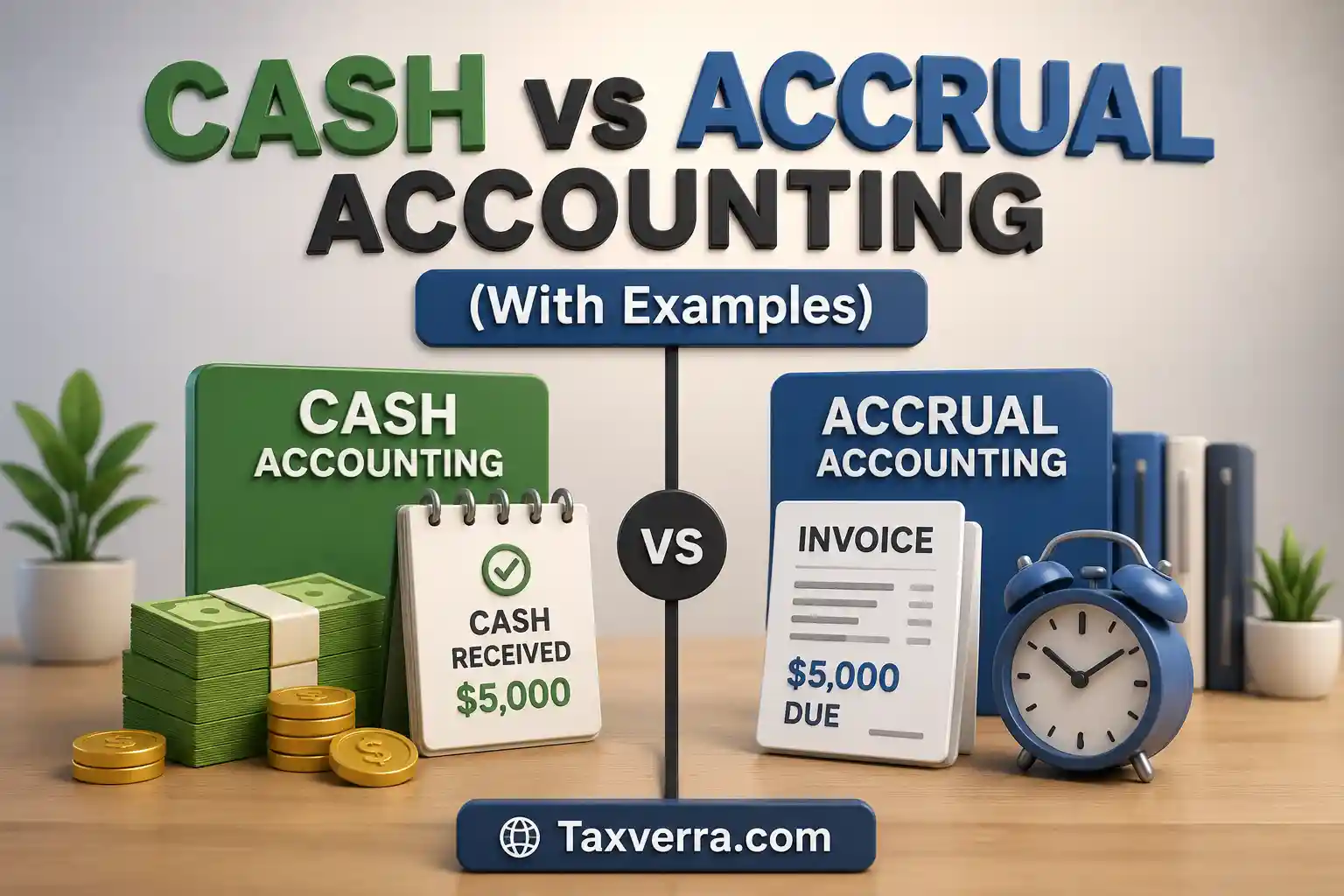
Managing business finances requires choosing the right accounting method to record income and expenses. Two of the most common methods used by businesses are cash accounting and accrual accounting. Each method records financial transactions differently and provides a different perspective on a company’s financial performance.
Understanding the difference between cash accounting and accrual accounting is important for business owners, accountants, and entrepreneurs. The accounting method you choose affects how you report revenue, track expenses, manage taxes, and evaluate the financial health of your business.
In this guide, we will explain cash accounting vs accrual accounting, how each method works, their advantages and disadvantages, and real-world examples to help you understand which system may be best for your business.
What Is the Difference Between Cash Accounting and Accrual Accounting?
The main difference between cash accounting and accrual accounting lies in when transactions are recorded.
- Cash accounting records revenue and expenses only when cash is actually received or paid.
- Accrual accounting records revenue when it is earned and expenses when they are incurred, regardless of when cash is exchanged.
In simple terms:
- Cash accounting focuses on cash flow.
- Accrual accounting focuses on financial performance.
Both methods have their advantages, depending on the size and complexity of the business.
What Is Cash Accounting?
Cash accounting is a simple accounting method in which financial transactions are recorded only when money changes hands.
Revenue is recorded when a business receives payment, and expenses are recorded when the business pays bills.
This method focuses entirely on the movement of cash in and out of the business.
Example of Cash Accounting
Imagine a small business provides consulting services in March but receives payment in April.
Using the cash accounting method, the revenue would be recorded in April, when the payment is received.
This approach makes it easy to track how much cash is available at any time.
How Cash Accounting Works
Under cash accounting, transactions are recorded at the time cash is exchanged.
Revenue Recording
Revenue is recorded when payment is received from customers.
Expense Recording
Expenses are recorded when payments are made to suppliers or service providers.
This means some transactions may be delayed in financial records until the cash actually moves.
Advantages of Cash Accounting
Cash accounting offers several benefits, especially for small businesses.
Simplicity
This method is straightforward and easy to understand. Business owners can easily track incoming and outgoing cash.
Better Cash Flow Awareness
Since transactions are recorded when cash moves, business owners always know their current cash position.
Lower Accounting Costs
Cash accounting is easier to maintain, which often reduces accounting and bookkeeping expenses.
Suitable for Small Businesses
Many small businesses and freelancers prefer this method because it requires less complex record keeping.
Disadvantages of Cash Accounting
Despite its simplicity, cash accounting has several limitations.
Limited Financial Insight
It does not show a complete picture of a company’s financial obligations or expected income.
Difficult Financial Planning
Businesses may struggle to forecast future finances because unpaid invoices and upcoming expenses are not recorded.
Not Suitable for Large Businesses
Larger companies with complex financial operations usually require accrual accounting.
What Is Accrual Accounting?
Accrual accounting is a method where transactions are recorded when they are earned or incurred, not when cash is received or paid.
This method provides a more accurate view of a company’s financial performance because it matches revenue with the expenses incurred to generate it.
Accrual accounting is widely used by medium and large businesses and is required under many accounting standards.
Example of Accrual Accounting
Suppose a business provides services worth $2,000 in March but receives payment in April.
Using the accrual accounting method, the revenue would be recorded in March, when the service was performed.
Even though the payment has not yet been received, the income is recognized because it has already been earned.
How Accrual Accounting Works
Accrual accounting records transactions based on economic activity rather than cash movement.
Revenue Recognition
Revenue is recorded when a product or service is delivered to the customer.
Expense Recognition
Expenses are recorded when they are incurred, even if payment occurs later.
This approach ensures that income and expenses are matched in the correct accounting period.
Advantages of Accrual Accounting
Accrual accounting offers several benefits for businesses.
More Accurate Financial Reporting
This method reflects the actual financial performance of a company during a specific period.
Better Business Planning
By recording all obligations and expected income, businesses can plan finances more effectively.
Required by Accounting Standards
Many accounting frameworks require accrual accounting for financial reporting.
Improved Financial Analysis
Investors and stakeholders can evaluate business performance more accurately.
Disadvantages of Accrual Accounting
Although more accurate, accrual accounting has some drawbacks.
More Complex
It requires more detailed record keeping and accounting knowledge.
Cash Flow May Be Less Clear
A company may appear profitable on paper even if it has not yet received cash.
Higher Accounting Costs
Businesses often need professional accountants or advanced software to maintain accrual accounting records.
Cash Accounting vs Accrual Accounting: Key Differences
Both accounting methods differ in several important ways.
| Feature | Cash Accounting | Accrual Accounting |
|---|---|---|
| Transaction Recording | When cash is received or paid | When income is earned or expenses incurred |
| Financial Accuracy | Limited | More accurate |
| Complexity | Simple | More complex |
| Cash Flow Tracking | Clear | Less immediate |
| Financial Planning | Limited | More effective |
| Suitability | Small businesses | Medium and large businesses |
Real-World Example Comparing Both Methods
Consider a marketing agency that completes a project worth $5,000 in January but receives payment in February.
Cash Accounting
Revenue is recorded in February when payment is received.
Accrual Accounting
Revenue is recorded in January when the service was completed.
This difference can significantly affect financial reports for each month.
When Should Businesses Use Cash Accounting?
Cash accounting is usually best for:
- Freelancers
- Sole proprietors
- Small service businesses
- Companies with simple transactions
These businesses often prioritize tracking actual cash flow.
When Should Businesses Use Accrual Accounting?
Accrual accounting is better suited for:
- Growing businesses
- Companies with inventory
- Businesses seeking investors
- Larger organizations with complex finances
Accrual accounting provides a more accurate financial picture.
Can a Business Switch Between Accounting Methods?
Yes, businesses can switch between accounting methods. However, changing methods may require approval from tax authorities and careful adjustments to financial records.
Many businesses start with cash accounting and later transition to accrual accounting as they grow.
Cash Accounting vs Accrual Accounting for Taxes
Tax reporting can differ depending on the accounting method used.
Cash Accounting for Taxes
Taxes are based on actual cash received and expenses paid during the tax year.
Accrual Accounting for Taxes
Taxes are based on income earned and expenses incurred during the accounting period.
Tax regulations may require certain businesses to use the accrual method, especially if they exceed specific revenue thresholds.
Role of Accounting Software
Modern accounting software makes it easier to manage both accounting methods.
Popular platforms include:
- QuickBooks
- Xero
- FreshBooks
- Wave Accounting
These tools allow businesses to record transactions automatically and generate financial reports.
Frequently Asked Questions
What is the main difference between cash and accrual accounting?
The main difference is timing. Cash accounting records transactions when cash moves, while accrual accounting records transactions when they occur.
Which accounting method is better?
Neither method is universally better. Cash accounting is simpler, while accrual accounting provides a more accurate financial picture.
Do small businesses use cash accounting?
Yes. Many small businesses use cash accounting because it is easier to manage and requires less accounting expertise.
Why do large companies use accrual accounting?
Large companies use accrual accounting because it provides detailed financial reporting and meets accounting standards.
Conclusion
Understanding cash accounting vs accrual accounting is essential for choosing the right financial reporting method for your business. Cash accounting focuses on actual cash flow, making it simple and practical for small businesses. Accrual accounting, on the other hand, records transactions when they occur, providing a more accurate view of financial performance.
Both methods have advantages and limitations, and the right choice depends on the size, complexity, and financial goals of your business. As businesses grow, many transition from cash accounting to accrual accounting to gain better financial insights and comply with accounting standards.
Selecting the appropriate accounting method helps businesses maintain accurate records, improve financial planning, and make informed decisions for long-term success.

