

Double Entry Accounting System Examples (With Journal Entries)
Understanding theory is useful, but real clarity comes when you see how the double entry accounting system works in practical business situations. In real accounting practice, every transaction is recorded through a journal entry with equal debit and credit impact, ensuring financial accuracy at all times.
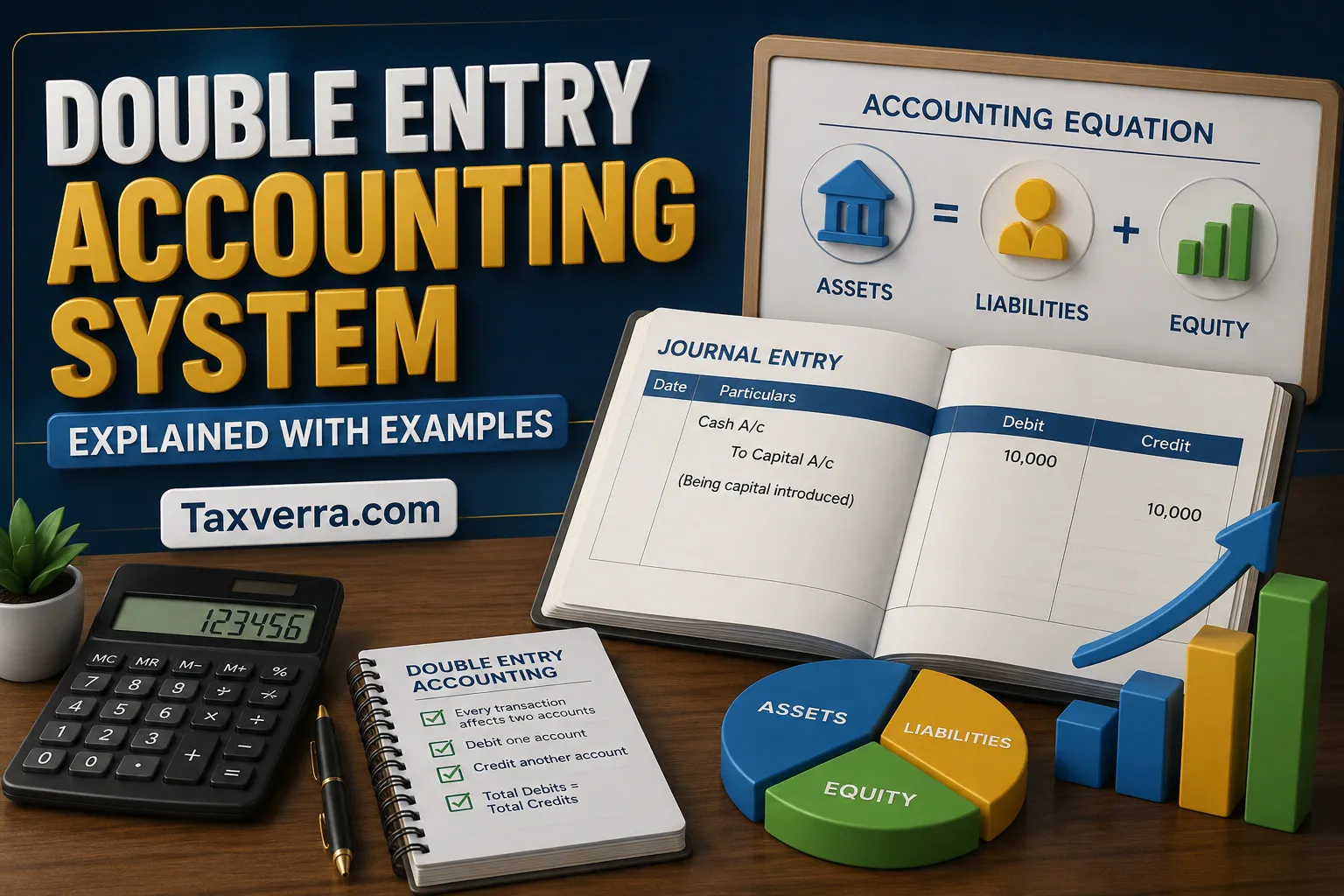
A common example is when a business owner invests cash into the company. Suppose the owner injects $10,000 into the business. The cash account increases, so it is debited, and the owner’s capital increases, so it is credited. The entry reflects both the inflow of resources and the increase in equity.
| Account | Debit | Credit |
|---|---|---|
| Cash | 10,000 | |
| Capital | 10,000 |
A second example involves purchasing office equipment. If a business buys equipment worth $5,000 in cash, the equipment account increases while cash decreases.
| Account | Debit | Credit |
|---|---|---|
| Equipment | 5,000 | |
| Cash | 5,000 |
In my experience, one mistake I often see is beginners confusing expense purchases with asset purchases. Equipment is an asset, not an expense, and this distinction is critical in financial reporting.
Another practical scenario is purchasing goods on credit. A retail store buys inventory worth $8,000 from a supplier.
| Account | Debit | Credit |
|---|---|---|
| Inventory | 8,000 | |
| Accounts Payable | 8,000 |
A real-world example from a client showed how missed credit purchases distorted profit calculations because inventory was not properly recorded.
When goods are sold for cash, the entry becomes:
| Account | Debit | Credit |
|---|---|---|
| Cash | 6,000 | |
| Sales Revenue | 6,000 |
Similarly, credit sales increase accounts receivable:
| Account | Debit | Credit |
|---|---|---|
| Accounts Receivable | 7,500 | |
| Sales Revenue | 7,500 |
These examples demonstrate how every transaction impacts two accounts simultaneously, maintaining the balance of the accounting system.
Real-World Double Entry Accounting Examples for Small Businesses
In real business environments, the double entry bookkeeping system is not abstract theory; it is part of daily operations. Let’s take a small retail shop as an example.
When the shop purchases inventory on credit, it records inventory as an asset and creates a liability. When it sells goods, it records cash or receivables along with revenue. Every movement has two sides.
A service-based business provides another example. Suppose a consulting firm completes a project and receives $3,000 in cash. Cash increases and service revenue increases.
| Account | Debit | Credit |
|---|---|---|
| Cash | 3,000 | |
| Service Revenue | 3,000 |
In another case, if payment is received later, accounts receivable is used instead of cash.
One practical insight from experience is that service businesses often forget to record accrued revenue. This leads to understated income in financial statements.
For e-commerce businesses, transactions become more complex. A sale may involve revenue, delivery expense, payment gateway charges, and inventory reduction all in one transaction.
One mistake I often see is ignoring transaction fees from payment processors, which leads to inflated profit figures. Proper double entry accounting ensures every cost is recorded accurately.
Small businesses that maintain proper bookkeeping systems usually have better cash flow visibility and fewer tax surprises at year-end.
Double Entry Accounting vs Single Entry Accounting
The difference between single entry vs double entry accounting is fundamental for understanding financial accuracy.
Single entry accounting records only one side of a transaction, usually cash in or cash out. It is simple but incomplete. Double entry accounting records both sides, providing a complete financial picture.
| Feature | Single Entry | Double Entry |
|---|---|---|
| Accuracy | Low | High |
| Completeness | Partial | Full |
| Error Detection | Difficult | Easy |
| Financial Statements | Limited | Fully Supported |
For example, if a business buys inventory on credit, single entry accounting might ignore the transaction entirely until payment is made. This creates misleading financial results.
In contrast, double entry bookkeeping records both inventory and liability immediately.
In my experience, many small businesses start with single entry systems but quickly struggle when transactions increase. The lack of structured records leads to confusion during tax filing and audits.
Double entry accounting is essential for businesses that want growth, funding, or compliance readiness.
Common Errors in the Double Entry Accounting System
Even though the double entry accounting system is designed for accuracy, errors still occur due to human mistakes.
One common error is omission, where a transaction is not recorded at all. This creates missing financial data and affects profitability analysis.
Another frequent issue is commission errors, where transactions are recorded in the wrong account. For example, recording equipment purchase as an expense instead of an asset.
A third issue is principle errors, where incorrect accounting rules are applied. This can distort financial statements significantly.
| Error Type | Description | Impact |
|---|---|---|
| Omission | Transaction not recorded | Incomplete records |
| Commission | Wrong account used | Misclassification |
| Principle | Wrong accounting treatment | Financial distortion |
| Compensating | Two errors cancel out | Hard to detect |
A real client case involved recording supplier payments twice, which inflated expenses and reduced reported profit incorrectly.
One mistake I often see is assuming that software eliminates errors. While software reduces manual mistakes, incorrect inputs still produce incorrect outputs.
Proper review and reconciliation are essential parts of the accounting cycle.
Adjustments in the Double Entry Accounting System
Adjusting entries are essential in the double entry accounting system to ensure financial statements reflect the true financial position of a business.
These adjustments are usually made at the end of an accounting period and include accrued expenses, prepaid expenses, accrued income, unearned revenue, and depreciation.
For example, if rent for December has not been paid but is due, it must be recorded as an accrued expense.
| Account | Debit | Credit |
|---|---|---|
| Rent Expense | 1,000 | |
| Accrued Rent Payable | 1,000 |
Another example is prepaid insurance. If a business pays $12,000 for a year, only a portion is expensed monthly.
| Account | Debit | Credit |
|---|---|---|
| Insurance Expense | 1,000 | |
| Prepaid Insurance | 1,000 |
In my experience, adjustment entries are often ignored by beginners, leading to inaccurate profit reporting.
Depreciation is another key adjustment. Assets lose value over time, and this must be recorded properly to reflect real asset value.
Adjustments ensure that revenues and expenses are matched correctly, following the accrual accounting principle. Without adjustments, financial statements can mislead business owners and investors.
Advantages of the Double Entry Accounting System
The advantages of the double entry accounting system make it the global standard for financial reporting.
One major advantage is accuracy. Since every transaction has two entries, errors are easier to detect and correct.
Another benefit is complete financial visibility. Businesses can track assets, liabilities, income, and expenses in detail.
It also improves decision-making. Managers can analyze profitability, cost structures, and cash flow trends effectively.
In my experience, businesses that maintain proper double entry bookkeeping are more likely to secure loans and attract investors because their financial records are reliable.
Other advantages include:
- Better fraud detection
- Easier audits
- Improved compliance
- Structured financial reporting
- Reliable tax preparation
A practical example is a startup that was able to secure funding after presenting well-maintained financial statements prepared using double entry accounting principles.
Without this system, financial credibility is significantly reduced, especially when dealing with external stakeholders.
Limitations of the Double Entry Accounting System
Despite its benefits, the double entry accounting system has some limitations.
It is more complex than single entry accounting, especially for beginners or very small businesses. It requires knowledge of debit and credit rules, accounting principles, and proper classification of accounts.
It is also time-consuming if done manually. Every transaction must be recorded twice, posted to ledgers, and verified.
In my experience, small business owners often struggle initially because they try to manage bookkeeping without proper training.
| Limitation | Impact |
|---|---|
| Complexity | Requires accounting knowledge |
| Time-consuming | Manual entry takes effort |
| Training required | Not beginner-friendly |
| Errors still possible | If entries are incorrect |
Another limitation is that it still depends on human accuracy. While the system is designed to detect imbalance, it cannot detect incorrect classification automatically.
However, modern accounting software reduces many of these limitations, making the system easier to manage in real-world business environments.
Best Practices for Maintaining Accurate Double Entry Records
Maintaining accurate records in the double entry bookkeeping system requires discipline, consistency, and proper financial habits. Businesses that follow structured practices usually experience fewer errors and more reliable financial statements.
One of the most important practices is recording transactions daily. Delayed entries often lead to missing details, incorrect classifications, and reconciliation issues at month-end.
Another critical practice is regular reconciliation of accounts. Bank statements, supplier balances, and customer accounts should be checked frequently to ensure accuracy.
A real client example involved a service company that discovered a recurring billing error only after implementing monthly reconciliation checks. The issue had been affecting their revenue reporting for months.
Best practices include:
- Record transactions immediately
- Maintain a standardized chart of accounts
- Reconcile bank and ledger accounts regularly
- Review journal entries before posting
- Keep supporting documents for every transaction
- Separate business and personal expenses
In my experience, one mistake I often see is inconsistent account naming. For example, using “Office Supplies,” “Office Expenses,” and “Stationery Costs” interchangeably creates confusion during reporting.
A well-organized accounting system ensures smoother audits, accurate tax filing, and better financial decision-making.
Ultimately, discipline in bookkeeping is more important than the system itself. Even the best accounting system fails if data entry is careless or inconsistent.
How Accounting Software Uses the Double Entry Accounting System
Modern accounting software is built entirely on the double entry accounting system, even though users may not see it directly. Every transaction entered into software automatically generates corresponding debit and credit entries in the background.
For example, when a business records a sales invoice in software, the system automatically:
- Debits accounts receivable or cash
- Credits sales revenue
This automation reduces manual effort and improves accuracy.
A practical benefit is real-time financial reporting. Businesses can instantly generate balance sheets, income statements, and cash flow reports without manually preparing ledger summaries.
In my experience working with growing businesses, switching from manual bookkeeping to software significantly reduces month-end closing time. Tasks that once took several days can now be completed in hours.
Key features of accounting software include:
- Automated journal entries
- Real-time ledger updates
- Bank reconciliation tools
- Expense tracking systems
- Financial dashboards and reports
However, one common misconception is that software eliminates accounting knowledge requirements. This is incorrect. Software only processes what is entered; if transactions are misclassified, reports will still be inaccurate.
For example, recording a capital expense as a regular expense in software will distort profit calculations even though the system is automated.
Therefore, understanding double entry principles remains essential even in advanced digital environments.
How Accountants Use Double Entry Accounting in Real Life
In real-world accounting practice, professionals rely on the double entry accounting system for every aspect of financial management. It is not just a recording method; it is a decision-making tool.
Accountants use it to prepare financial statements, analyze business performance, and ensure compliance with tax laws and accounting standards.
A real example comes from a manufacturing client where I helped restructure their bookkeeping system. Initially, expenses were not properly categorized, and inventory was not tracked correctly. After implementing proper double entry accounting, the business gained clarity on production costs and profit margins.
Accountants typically use the system for:
- Monthly financial reporting
- Tax preparation and compliance
- Budgeting and forecasting
- Audit support and documentation
- Financial analysis for management decisions
In my experience, one of the most valuable uses of double entry accounting is identifying financial trends. By analyzing ledger data, accountants can detect declining margins, rising expenses, or cash flow issues early.
Another practical use is fraud detection. Because every transaction leaves a dual record, inconsistencies become easier to identify during audits or internal reviews.
Ultimately, accountants rely on this system not just for recording numbers, but for interpreting financial health and guiding business strategy.
Expert Tip (From Real Experience)
In professional accounting practice, accuracy is not achieved by software alone but by disciplined bookkeeping habits.
One mistake I often see is businesses focusing only on profit figures while ignoring balance sheet accuracy. In reality, financial health depends equally on liabilities, receivables, and asset management.
A key insight from experience is this: always review your ledger before trusting your financial statements. Even small misclassifications can significantly impact reported profit.
Another practical tip is to maintain a clear audit trail for every transaction. Supporting documents like invoices, receipts, and contracts should always match journal entries.
Businesses that follow these practices rarely face audit issues and usually maintain stronger financial control.
Practical Business Case Study
A small e-commerce business was struggling with unclear profit margins. Although sales were increasing, bank balances did not reflect expected profits.
After reviewing their accounting system, the issue was traced to missing entries for:
- Payment gateway fees
- Return transactions
- Shipping costs
- Inventory adjustments
Once proper double entry bookkeeping was implemented, the business discovered that actual profit was significantly lower than reported.
After corrections:
- Expenses were properly recorded
- Inventory tracking was corrected
- Revenue was adjusted for returns
Within two months, financial reporting became accurate, and the business was able to optimize pricing strategy and reduce unnecessary costs.
This case clearly shows how proper double entry accounting transforms decision-making.
Common Audit Findings Related to Double Entry Bookkeeping
During audits, several recurring issues are often identified in businesses that do not maintain proper accounting systems.
Common findings include:
- Missing journal entries
- Incorrect account classification
- Unreconciled bank balances
- Duplicate entries
- Unrecorded liabilities
Auditors rely heavily on double entry accounting to verify financial accuracy. If the system is not maintained properly, audit adjustments become necessary, which can delay reporting and increase compliance costs.
One frequent issue I have seen is incomplete liability recording, especially for unpaid supplier invoices. This leads to understated expenses and overstated profits.
Proper double entry accounting significantly reduces audit risks and improves financial transparency.
Final Thoughts on the Double Entry Accounting System
The double entry accounting system is more than a bookkeeping method; it is a complete financial language that every business uses to understand its performance, obligations, and growth potential. When applied correctly, it creates a structured financial environment where every transaction has meaning and traceability.
In real business environments, I have observed that companies that consistently maintain proper double entry bookkeeping are far more stable in decision-making. They don’t rely on guesswork; instead, they rely on accurate financial data generated from well-maintained accounting records. This becomes especially important when businesses grow, hire employees, or deal with external investors.
One mistake I often see is treating accounting as a compliance task instead of a decision-making tool. In reality, double entry accounting is what allows business owners to understand whether they are truly profitable, not just cash-rich. Many businesses fail not because they lack sales, but because their financial structure is unclear.
The system also plays a critical role in taxation, audits, and financial reporting. Without it, preparing accurate statements becomes nearly impossible. Even modern accounting software relies on these same principles in the background, proving that double entry accounting is not outdated but foundational.
From a professional perspective, mastering this system is not optional for accountants or business owners. It is essential for financial control, transparency, and long-term sustainability. Once understood properly, it becomes a powerful tool for managing growth and reducing financial risk.
Practice Section
5 Multiple Choice Questions (MCQs)
1. What is the main principle of double entry accounting?
A. Record only cash transactions
B. Every transaction affects two accounts
C. Only expenses are recorded
D. Only income is recorded
Correct Answer: B
2. Which equation is central to double entry accounting?
A. Revenue = Expenses
B. Assets = Expenses + Revenue
C. Assets = Liabilities + Equity
D. Cash = Profit
Correct Answer: C
3. What is debited when cash is received?
A. Cash account
B. Revenue account
C. Expense account
D. Liability account
Correct Answer: A
4. What is credited when a business earns revenue?
A. Cash
B. Expense
C. Revenue
D. Asset
Correct Answer: C
5. Which of the following is a liability?
A. Equipment
B. Cash
C. Accounts Payable
D. Inventory
Correct Answer: C
2 Short Questions
Q1: Why is double entry accounting important for businesses?
Double entry accounting is important because it ensures every transaction is recorded accurately in two accounts, maintaining the balance of the accounting equation. It improves financial accuracy, helps detect errors, and supports reliable financial reporting for decision-making and compliance.
Q2: What is the difference between debit and credit in accounting?
Debit and credit are two sides of a transaction. Debit increases assets and expenses, while credit increases liabilities, income, and equity. Together, they ensure that every financial transaction remains balanced within the accounting system.
1 Practical Problem with Complete Solution
Problem:
A business owner starts a company with $15,000 cash. Later, the business purchases inventory worth $5,000 in cash and sells goods worth $3,000 in cash.
Solution:
Step 1: Owner invests capital
| Account | Debit | Credit |
|---|---|---|
| Cash | 15,000 | |
| Capital | 15,000 |
Step 2: Purchase inventory
| Account | Debit | Credit |
|---|---|---|
| Inventory | 5,000 | |
| Cash | 5,000 |
Step 3: Cash sales
| Account | Debit | Credit |
|---|---|---|
| Cash | 3,000 | |
| Sales Revenue | 3,000 |
Final Impact:
- Cash = 13,000
- Inventory = 5,000
- Capital = 15,000
- Revenue = 3,000
This shows how every transaction affects at least two accounts while keeping the system balanced.
Frequently Asked Questions (FAQs)
1. What is the double entry accounting system in simple words?
It is a bookkeeping system where every transaction is recorded in two accounts, ensuring that total debits always equal total credits.
2. Why is double entry accounting important?
It is important because it ensures accurate financial records, helps detect errors, and supports proper financial reporting and decision-making.
3. What are debit and credit rules in accounting?
Debit increases assets and expenses, while credit increases liabilities, income, and equity. These rules ensure balance in the accounting system.
4. What is the accounting equation?
The accounting equation is: Assets = Liabilities + Equity. It is the foundation of double entry accounting.
5. Is double entry accounting used in small businesses?
Yes, even small businesses use it because it provides accurate financial tracking and helps with tax and reporting requirements.
6. What are common mistakes in double entry bookkeeping?
Common mistakes include incorrect classification of accounts, missing entries, and recording transactions in the wrong period.
7. How does double entry help prevent fraud?
It creates a dual record of every transaction, making inconsistencies easier to detect during audits or reviews.
8. Can accounting software replace double entry accounting knowledge?
No. Software automates entries, but understanding double entry principles is still necessary to ensure correct data entry and interpretation.

