

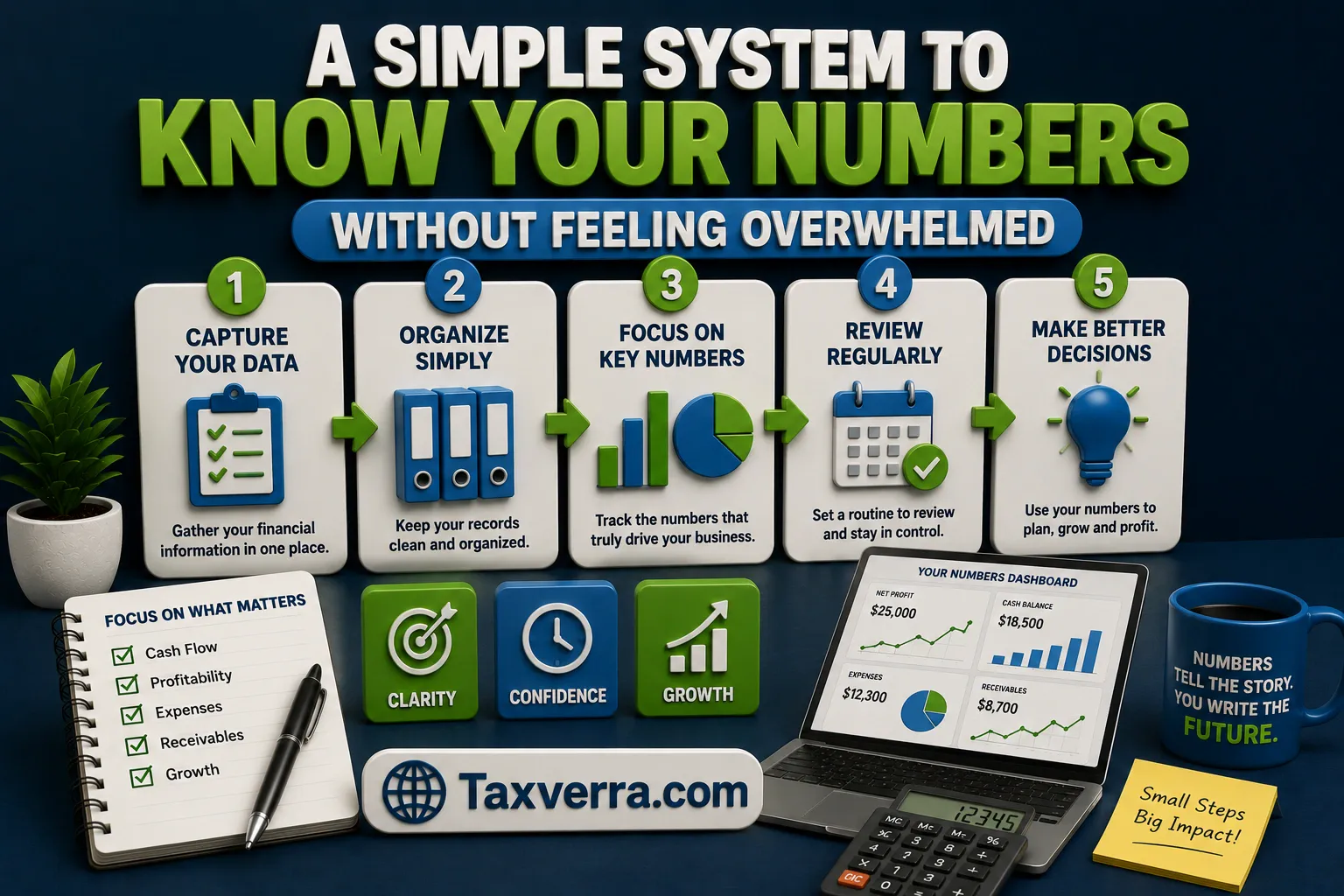
1.You Open the Reports, Then Close Them Again
- Start with a business owner logging into QuickBooks, Xero, or a spreadsheet, seeing too many reports, too many categories, too many metrics, and no clear starting point.
- Show the real pain: they are not avoiding the numbers because they do not care. They are avoiding them because every review session feels like work without a payoff.
- Add relatable moments: revenue looks fine but cash is tight, expenses feel high but no one knows exactly where, payroll is coming up, and the owner still cannot answer “are we actually doing okay?”
- Set up the promise: the goal is not to become more “financial.” It is to build a simple repeatable system that makes the right numbers obvious.
2. What People Think “Knowing Your Numbers” Means vs What It Actually Means
- What people think: you need to master every financial statement and track dozens of metrics.
- What actually happens: most small businesses only need a short handful of numbers reviewed consistently and in context.
- What people think: more dashboards create more control.
- What actually happens: too many numbers usually create more hesitation, more second-guessing, and less action.
- What people think: the problem is not enough data.
- What actually happens: the problem is weak filtering, inconsistent review habits, and numbers that are not tied to decisions.
- Make it clear that “knowing your numbers” is not about reading everything. It is about reading the right things in the right order.
3. What Small Business Owners Actually Need to Know Each Month
- Narrow the concept down to practical essentials.
- Cover the few categories that actually matter:
- cash available now
- money coming in soon
- money going out soon
- profit trend
- biggest expense pressures
- tax money that should not be touched
- debt obligations
- Explain that owners usually do not need a giant KPI stack. They need enough visibility to answer:
- Can I cover the next few weeks?
- Are we making money consistently?
- What is draining cash?
- What needs attention right now?
- Stress that the right system is different from a full finance department scorecard.
4. The Core Problem: Owners Are Looking at Reports, Not Running a Review System
- Explain that overwhelm comes less from the numbers themselves and more from the lack of a repeatable process.
- Show the common pattern:
- open software
- click around randomly
- get distracted by details
- notice something odd
- do nothing because there is no next step
- Introduce the idea that a simple review order matters more than fancy software.
- Frame the rest of the article around a system, not a pile of tips.
5. The Few Numbers I’d Put on One Page for a Small Business Owner
- Build a practical one-page monthly snapshot.
- Include only high-value numbers such as:
- current cash balance
- 30-day cash obligations
- accounts receivable due soon
- accounts payable due soon
- monthly revenue
- gross profit or contribution margin if relevant
- operating profit
- owner pay or draws
- tax set-aside balance
- top 3 expense categories or biggest expense changes
- Explain why each one earns its place.
- Make the point that if a number does not drive a decision, it does not belong on the front page.
6. The Order Matters: A Simple Review Sequence That Reduces Overwhelm
- Walk through the review in the order a real advisor would use:
- cash first
- short-term obligations second
- receivables and payables third
- revenue and margins fourth
- expense drift fifth
- profit sixth
- taxes and debt after that
- Explain why this order works.
- Example: if cash is tight, the owner should not spend 20 minutes staring at net profit percentage before checking receivables, bills due, and payroll timing.
- This is one of the biggest content gaps. Most articles list reports, but not the best sequence to review them.
7. Real-Life Scenarios With Specifics
- Scenario 1: Owner sees $38,000 in monthly revenue and assumes the month was strong, but $14,000 of that is still unpaid and payroll is due Friday.
- Scenario 2: A business shows a profit, but card processing fees, loan payments, and tax obligations are squeezing cash harder than the P&L suggests.
- Scenario 3: Owner checks revenue daily but never watches expense creep, and six small recurring software charges plus rising contractor costs quietly kill margin.
- Scenario 4: A seasonal business panics in a slow month because the owner is looking at one bad number without comparing it to timing, trends, and upcoming receivables.
- Make these practical, with exact figures and decision consequences.
8. The Mistakes Section: Common Errors and Why Owners Keep Making Them
- Looking only at revenue because it feels motivating.
- Ignoring the balance sheet because it feels harder to understand.
- Confusing profit with cash.
- Tracking too many KPIs copied from larger businesses or online templates.
- Reviewing numbers only when stressed, behind, or forced to.
- Failing to separate business cash from tax money and owner spending.
- Looking at reports that are incomplete, outdated, or unreconciled.
- Not comparing numbers month to month.
- Not tying a number to an action.
- Explain why these mistakes happen: time pressure, report overload, low trust in the books, and the natural tendency to avoid numbers that create discomfort.
9. The Step-by-Step System: How to Know Your Numbers Without Turning It Into a Full-Time Job
- Step 1: Clean the source data first.
- Make sure bookkeeping is current enough to trust.
- Step 2: Build one monthly snapshot.
- One page, no clutter, only decision-driving numbers.
- Step 3: Review in the same order every month.
- Cash, obligations, receivables, payables, revenue, margins, expenses, profit, taxes.
- Step 4: Add a short weekly pulse check.
- Focus only on cash, collections, bills due, and any major changes.
- Step 5: Flag anything that needs action.
- Do not just observe numbers. Assign follow-up.
- Step 6: Compare this month to last month and same month last year if possible.
- Step 7: Write a two-minute summary in plain English.
- What improved, what tightened, what needs attention next.
- Step 8: Share or review with the right person.
- Owner alone, partner, bookkeeper, or advisor.
- Make this feel practical and manageable, not corporate.
10. What Each Number Is Actually For
- This is where many articles stay too theoretical.
- Explain the job of each number:
- cash tells you room to breathe
- receivables tell you whether sales are turning into money
- payables tell you upcoming pressure
- profit tells you whether the model works
- margin tells you whether pricing or costs are slipping
- expense trends tell you where control is weakening
- tax set-aside tells you whether future stress is being created now
- Owners are less overwhelmed when they know why a number matters, not just its definition.
11. What Most Articles Miss
- The right numbers depend on the business model.
- A service business, retail shop, contractor, agency, and e-commerce brand should not all track the same front-page metrics.
- Overwhelm is often a trust problem, not an intelligence problem.
- If the books are messy, owners stop believing the numbers and stop looking.
- Numbers without thresholds are weak tools.
- If you do not know what “too low,” “too high,” or “off-track” looks like, you end up staring at data instead of deciding.
- Small business owners often need translation, not more reports.
- One sentence of interpretation can matter more than ten extra charts.
12. Contrarian Angle: You Probably Need Fewer Metrics, Not Better Dashboards
- Push against the common advice to track everything.
- Explain that a simple sheet reviewed consistently beats a fancy dashboard that gets ignored.
- Another overlooked angle: daily checking can actually increase anxiety if the business only changes meaningfully week to week or month to month.
- Another contrarian point: not every owner should monitor every line item. Some should review summary numbers and let the bookkeeper or advisor handle the underlying detail.
- This section helps separate useful discipline from obsessive monitoring.
13. How I’d Set This Up for Different Types of Owners
- Owner who hates numbers and wants the simplest possible system.
- Owner who likes detail but gets lost in it.
- Owner with a bookkeeper and needs a review format, not raw data.
- Solo owner doing their own books versus multi-person company with staff and payroll.
- This adds practical nuance most articles leave out.
14. Simple Action Plan at the End
- Pull last month’s reports only after bookkeeping is current.
- Create a one-page snapshot with 8 to 10 numbers max.
- Review them in the same order every month.
- Add a 15-minute weekly pulse check for cash, receivables, and bills due.
- Mark one action next to any number that looks off.
- Stop tracking metrics that never lead to decisions.
- Set one threshold for each critical number so you know what needs attention.
- End with the core message: the goal is not to become obsessed with numbers. It is to build a system that makes the business easier to steer.

