

1. The Books Look “Mostly Fine” Until Something Important Depends on Them
- Open with a business owner who thinks bookkeeping is under control because transactions are in the software and the bank balance looks decent.
- Then something real happens: tax estimate due, loan application, partner asks about profit, payroll cash is tight, or sales look strong but owner still feels broke.
- Show the core frustration: the problem is not just being behind. It is having books that look finished but cannot be trusted.
- Make this feel normal. Most small businesses do not fail bookkeeping because they are lazy. They fail because monthly bookkeeping gets treated like admin instead of financial control.
2. What Owners Think Monthly Bookkeeping Is vs What It Actually Is
- What owners think: monthly bookkeeping means logging transactions and reconciling the bank.
- What actually happens: monthly bookkeeping is a review process that catches errors, cleans up timing issues, and turns messy transaction history into numbers you can actually use.
- What owners think: if software imported it, it must be correct.
- What actually happens: bank feeds save time but they also import duplicates, wrong dates, bad categories, partial data, and false confidence.
- What owners think: bookkeeping is backward-looking admin.
- What actually happens: good monthly bookkeeping protects cash flow, tax planning, payroll timing, pricing decisions, and owner pay.
3. What “Monthly Bookkeeping” Really Includes in the Real World
- Define monthly bookkeeping in practical terms, not textbook terms.
- Explain that the job is not just entering data. It is checking whether the story the books are telling is actually true.
- Cover the real moving parts:
- bank and credit card reconciliation
- review of uncategorized and suspicious transactions
- accounts receivable and unpaid invoices
- accounts payable and bills due
- payroll entries and payroll liabilities
- loan balances and debt payments
- merchant processor deposits and fees
- sales tax or other tax liabilities
- owner draws, reimbursements, and personal charges
- month-end review of P&L and balance sheet
- Emphasize that a clean P&L means very little if the balance sheet is wrong.
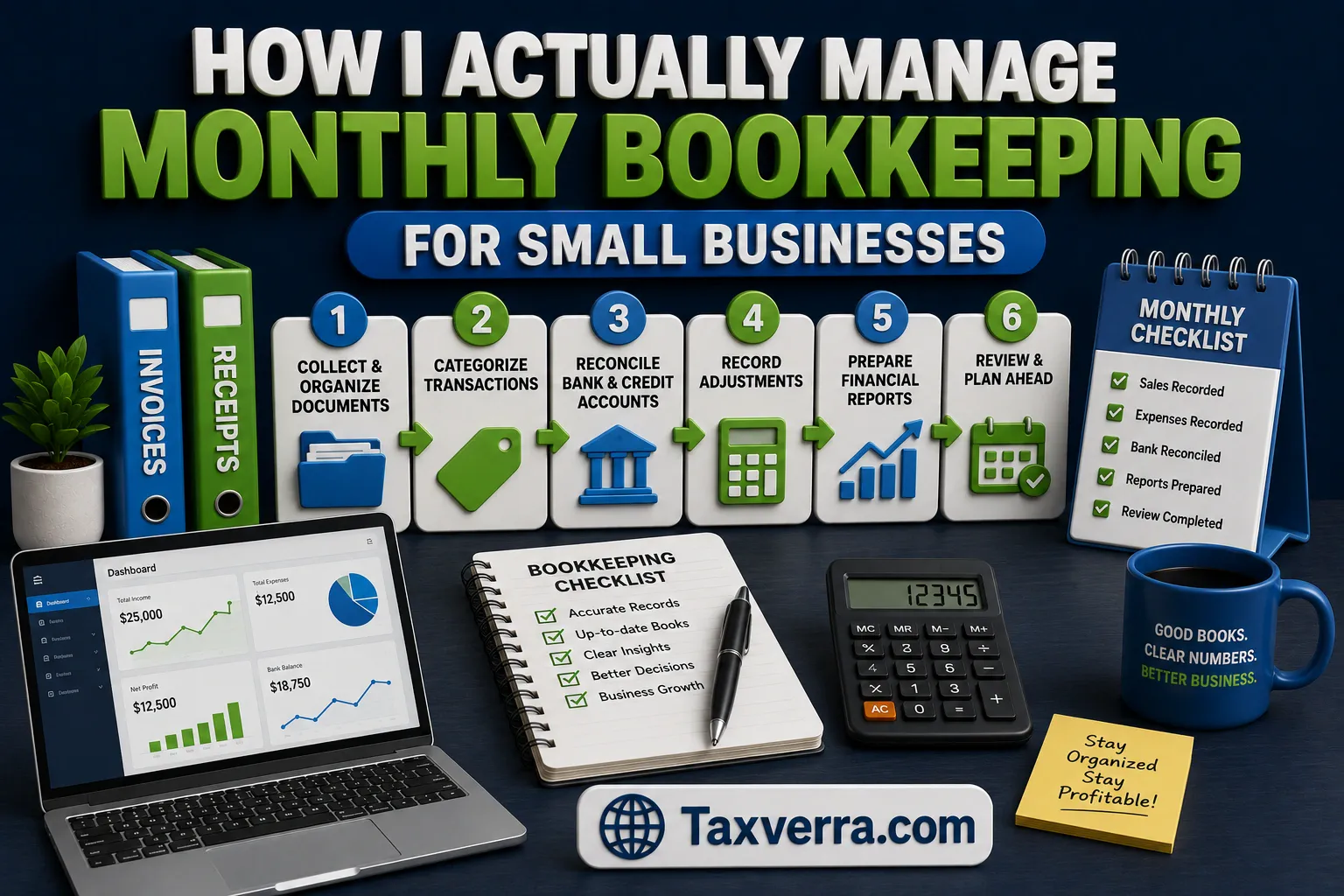
4. The Monthly Workflow I Actually Use
- Walk through the order of operations, because this is where most articles stay vague.
- Suggested flow:
- close out prior month bank activity
- reconcile bank accounts first
- reconcile credit cards second
- clear uncategorized and ask questions early
- check A/R and A/P
- post or verify payroll correctly
- review loans and liability accounts
- tie out sales channels and payment processors
- review fixed assets or large purchases
- scan the P&L for weirdness
- scan the balance sheet for things that should not be sitting there
- Explain why order matters. If bank rec is wrong, everything downstream gets harder.
5. The Real Problems That Blow Up Monthly Bookkeeping
- Missing receipts for large or unusual expenses.
- Personal spending mixed into business accounts.
- Duplicate transactions from app integrations or bank feed errors.
- Loan payments booked entirely as expense instead of split between principal and interest.
- Payroll journals not matching payroll reports.
- Stripe, PayPal, Square, Amazon, or Shopify net deposits being booked as sales with fees disappearing.
- Old uncategorized balances sitting there month after month because nobody wants to deal with them.
- Journal entries made by different people with no explanation.
- Month-end reports showing profit while cash is tight because receivables or liabilities are being ignored.
- Explain why these problems happen: software shortcuts, rushed cleanup, no document flow, weak owner habits, and no monthly review discipline.
6. Real-Life Scenarios With Specifics
- Scenario 1: A consultant showing $14,000 profit for the month, but forgot quarterly tax set-asides and had $9,000 in unpaid client invoices. On paper profitable, in real life squeezed.
- Scenario 2: A retail business booking Shopify payouts as revenue without separating fees, refunds, and sales tax, causing overstated income.
- Scenario 3: An owner paying personal fuel, meals, and subscriptions from the business card, then wondering why expenses look inflated and reports are useless.
- Scenario 4: A service company making loan payments monthly but booking the full payment to interest expense, which distorts profit and leaves the balance sheet wrong.
- Scenario 5: A growing business with payroll processed correctly by the provider, but not reflected properly in the books, leaving payroll liabilities and wage expense out of sync.
- Use real numbers and consequences so the reader sees what “bad books” actually cost.
7. The Reports I Actually Look At Every Month and What I’m Checking For
- Profit and loss:
- unusual spikes or drops
- margins that do not make sense
- duplicate subscriptions or recurring waste
- revenue that looks too good for the cash position
- Balance sheet:
- old receivables
- strange asset balances
- liabilities that have not moved
- negative balances where they should not exist
- payroll liabilities that do not tie out
- loan balances that never decline
- Cash flow view:
- whether operating cash is actually supporting the business
- A/R aging:
- who is late, how long, and whether revenue is turning into cash
- A/P aging:
- what is due now and what pressure is coming next
- Stress that bookkeeping is not complete until the numbers are reviewed, not just entered.
8. Mistakes Section: Common Errors and Why They Keep Happening
- Reconciling only the bank but ignoring credit cards.
- Trusting auto-categorization too much.
- Waiting until year-end to clean up the mess.
- Treating every transaction under one amount as “miscellaneous.”
- Ignoring balance sheet accounts because the owner only reads the P&L.
- Letting uncategorized, ask-my-accountant, or suspense balances pile up.
- Posting payroll as one lump number without checking wage taxes and withholdings.
- Mixing bookkeeping with tax assumptions too early.
- Not locking prior months, which lets old numbers keep changing.
- Explain why these happen: owners are busy, bookkeepers are rushed, software looks easier than it is, and nobody wants to slow down and ask follow-up questions.
9. The Step-by-Step Monthly Bookkeeping System
- Step 1: Collect everything before review starts.
- What this means: statements, loan docs, payroll reports, merchant processor summaries, major receipts, missing invoice info.
- Step 2: Reconcile cash accounts fully.
- Match balances to statements, not just transactions on screen.
- Step 3: Clean transaction coding.
- Fix duplicates, owner charges, transfers, loan payments, and odd entries.
- Step 4: Review receivables and payables.
- Make sure unpaid invoices and vendor bills are real and current.
- Step 5: Verify payroll and taxes.
- Confirm payroll expense, employer taxes, withholdings, and liabilities.
- Step 6: Review sales channels and net deposits.
- Tie processor activity to actual revenue, fees, refunds, and taxes.
- Step 7: Review liabilities and debt.
- Loans, sales tax payable, payroll liabilities, credit card balances.
- Step 8: Review financial statements for reasonableness.
- Ask “does this make sense for how the business actually operated?”
- Step 9: Lock the month and note open issues.
- Prevent silent changes later.
- Step 10: Share the few numbers that matter with the owner.
- Profit, cash, receivables, payables, tax set-aside, and any red flags.
10. What I Ask Clients for Every Month, Because This Is Where Accuracy Lives or Dies
- Missing receipts for unusual charges.
- Whether any payments were owner-related.
- Details on new loans, new equipment, or new subscriptions.
- Large deposits that are not obvious sales.
- Whether payroll changed, owners got paid differently, or bonuses ran.
- Whether any invoices are disputed or probably uncollectible.
- Whether taxes were paid outside the main account.
- This section is useful because most articles act like bookkeeping is just software work. It is not. It depends on getting answers from the owner.
11. Insights Most Articles Miss
- The biggest monthly bookkeeping problem is not categorization. It is unresolved questions left sitting too long.
- Books can be technically “closed” and still be bad decision-making tools.
- Balance sheet neglect is one of the biggest reasons owners think they are making more money than they really are.
- Merchant processors and payroll are two of the most common hidden error zones in small business books.
- Monthly bookkeeping should reduce surprises. If surprises keep happening, the process is not working.
- Good bookkeeping is partly operational. If invoices are late, receipts are missing, and personal spending runs through the business, the books will reflect that chaos no matter how good the software is.
12. Contrarian Angle: Monthly Bookkeeping Is Not Always Monthly Work
- Push back on the idea that everything can wait until month-end.
- The cleanest monthly books usually come from small weekly habits:
- reviewing bank feed issues
- saving receipts in real time
- checking overdue invoices
- flagging unusual transactions early
- Another contrarian point: many owners do not need more reports. They need fewer reports they can actually trust.
- Another useful angle: sometimes hiring bookkeeping help does not fix anything if source documents and owner habits stay messy.
13. How I Know the Month Is Really Done
- Bank and credit card balances match statements.
- Major transactions make sense and are documented.
- Receivables and payables are current.
- Loan balances and payroll liabilities tie out.
- Merchant processor activity is cleared properly.
- Prior month is locked.
- Owner has a short summary of what happened and what needs attention.
- This section gives a practical standard most articles never spell out clearly.
14. Simple Action Plan at the End
- Reconcile every bank and credit card account for last month.
- Clear uncategorized and duplicate transactions.
- Review one month of payroll entries against payroll reports.
- Check whether loan payments were split properly.
- Review A/R and A/P aging.
- Look at the balance sheet, not just the P&L.
- Lock the month once reviewed.
- Create a short monthly checklist and run it in the same order every time.
- End with the message that monthly bookkeeping is not about making the books look neat. It is about making the numbers dependable enough to run the business.

