

Introduction
Understanding your business finances is essential for making smart decisions. One of the most important financial reports used by businesses around the world is the Profit and Loss Statement, also known as the P&L Statement or Income Statement.
This financial report shows how much money a business earns and how much it spends over a specific period of time. By analyzing this report, business owners, accountants, and investors can determine whether a company is profitable or losing money.
Many beginners find financial statements confusing at first. However, once you understand the basic structure and key components, reading a Profit and Loss Statement becomes much easier.
In this guide, we will explain everything you need to know about reading a P&L statement, including its main components, how to analyze it step by step, and practical tips for better financial understanding.
What is a Profit and Loss Statement?
A Profit and Loss Statement is a financial document that summarizes a company’s revenues, costs, and expenses during a specific period. This period can be monthly, quarterly, or yearly depending on the business needs.
The main purpose of this report is to show whether a company is making a profit or experiencing a loss.
Businesses of all sizes rely on the P&L statement because it provides important insights into financial performance. It helps owners understand how well their products or services are performing and where improvements may be needed.
A typical Profit and Loss Statement includes:
- Total revenue earned
- Cost of producing goods or services
- Operating expenses
- Taxes and interest
- Net profit or loss
By reviewing these elements, businesses can evaluate their financial health and make better strategic decisions.
Why the Profit and Loss Statement Is Important
The Profit and Loss Statement plays a vital role in financial management. It provides a clear picture of how a business is performing financially.
1. Measures Business Profitability
The most obvious purpose of a P&L statement is to measure profitability. It shows whether the business is generating enough revenue to cover expenses and produce profit.
2. Helps Control Expenses
Business owners can use the report to identify unnecessary costs and areas where expenses can be reduced.
3. Supports Business Planning
Financial data from a P&L statement helps companies plan budgets, set financial goals, and make strategic decisions.
4. Important for Investors and Lenders
Investors, banks, and financial institutions often review P&L statements before investing in or lending money to a business.
5. Required for Tax Preparation
Businesses use their profit and loss reports to prepare tax returns and financial filings.
Because of these benefits, regularly reviewing a Profit and Loss Statement is essential for maintaining financial stability.
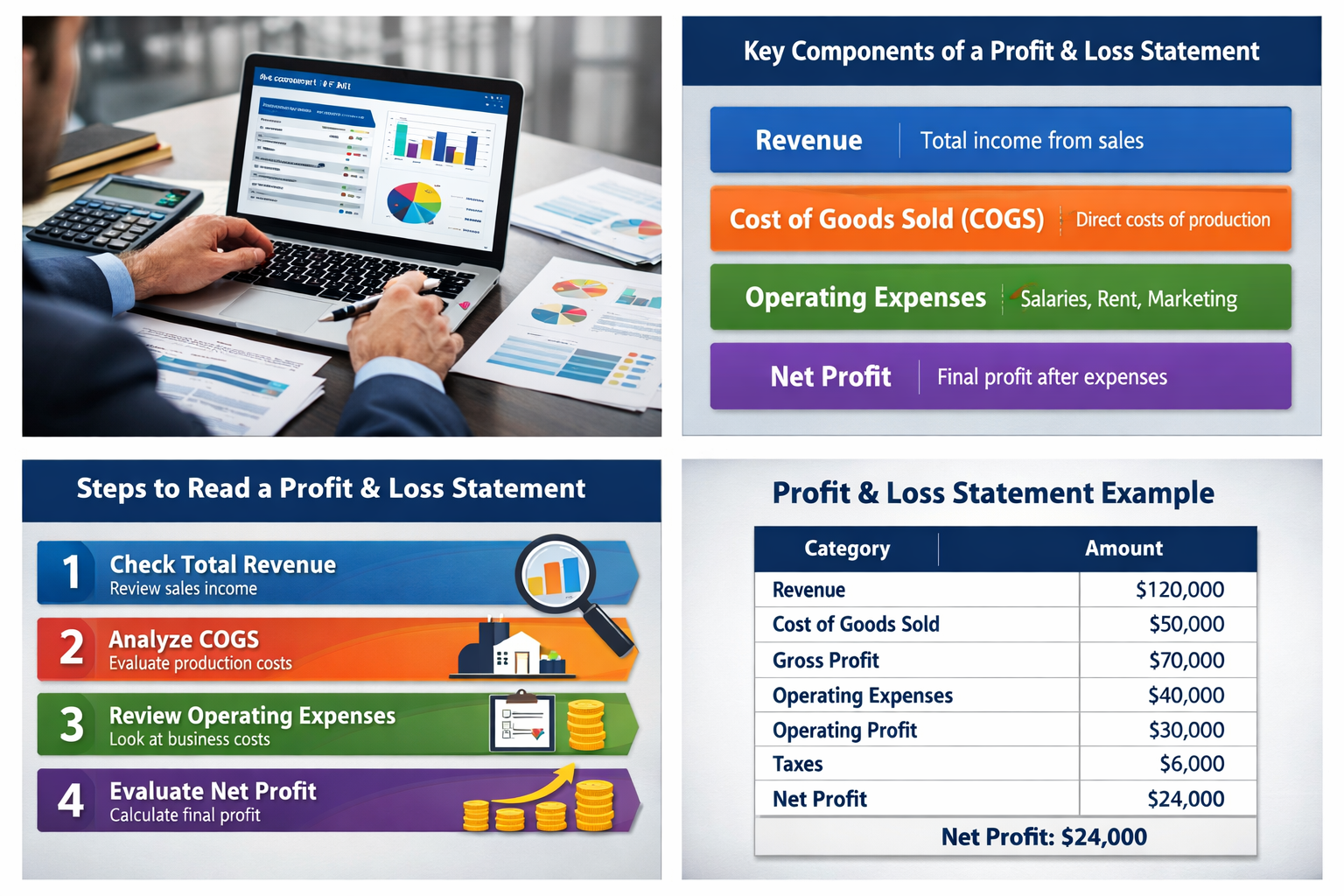
Key Components of a Profit and Loss Statement
To understand how to read a P&L statement, you first need to understand its main components.
Revenue (Sales)
Revenue is the total amount of money earned from selling products or services. It is usually the first item listed on a Profit and Loss Statement and is often called the top line.
Revenue can come from several sources such as:
- Product sales
- Service fees
- Subscription income
- Consulting services
A growing business typically shows increasing revenue over time.
Cost of Goods Sold (COGS)
Cost of Goods Sold refers to the direct costs associated with producing goods or delivering services.
These costs may include:
- Raw materials
- Manufacturing expenses
- Direct labor
- Production supplies
COGS is important because it directly affects how much profit a company earns from its sales.
Gross Profit
Gross profit is calculated by subtracting the Cost of Goods Sold from total revenue.
Gross Profit = Revenue – Cost of Goods Sold
This number shows how efficiently a company produces and sells its products.
A higher gross profit usually indicates better operational performance.
Operating Expenses
Operating expenses are the costs required to run the daily operations of a business.
Common operating expenses include:
- Employee salaries
- Office rent
- Utilities
- Marketing and advertising
- Software subscriptions
- Office supplies
These expenses are necessary for running the business but reduce the overall profit.
Operating Profit
Operating profit, sometimes called Operating Income, represents the profit generated from normal business operations.
It is calculated after subtracting operating expenses from gross profit.
This figure helps businesses understand how profitable their core operations are without considering taxes or interest.
Taxes and Interest
After operating profit, businesses must also account for financial costs such as:
- Interest payments on loans
- Government taxes
These expenses further reduce the company’s earnings.
Net Profit
Net profit is the final amount left after subtracting all expenses, including operating costs, taxes, and interest.
It is commonly referred to as the bottom line because it appears at the bottom of the Profit and Loss Statement.
If the net profit is positive, the business is profitable. If it is negative, the business has incurred a loss.
Step-by-Step Guide to Reading a Profit and Loss Statement
Reading a P&L statement becomes easier when you follow a structured approach.
Step 1: Review Total Revenue
Start by looking at the total revenue generated during the reporting period.
Ask questions such as:
- Is revenue increasing compared to previous months?
- Which products or services generate the most income?
Revenue trends often reveal whether a business is growing or declining.
Step 2: Examine Cost of Goods Sold
Next, analyze the Cost of Goods Sold.
High production costs may indicate:
- Inefficient production processes
- Rising material prices
- Supply chain problems
Reducing COGS can significantly improve profitability.
Step 3: Check Gross Profit
After reviewing revenue and COGS, look at the gross profit.
A healthy business typically maintains a stable or growing gross profit margin.
Gross profit margin is calculated as:
Gross Profit ÷ Revenue × 100
This percentage shows how much profit a company makes from each sale before expenses.
Step 4: Analyze Operating Expenses
Carefully review operating expenses to identify major spending areas.
Common questions to consider include:
- Are marketing expenses generating enough sales?
- Are administrative costs too high?
- Are there unnecessary operational expenses?
Monitoring expenses helps businesses maintain financial efficiency.
Step 5: Evaluate Net Profit
Finally, look at the net profit to determine the company’s overall financial performance.
Net profit reveals whether the business generated actual earnings after covering all costs.
Comparing net profit over multiple months or years helps identify long-term financial trends.
Example of a Profit and Loss Statement
Here is a simplified example to demonstrate how a Profit and Loss Statement works.
| Category | Amount |
|---|---|
| Revenue | $120,000 |
| Cost of Goods Sold | $50,000 |
| Gross Profit | $70,000 |
| Operating Expenses | $40,000 |
| Operating Profit | $30,000 |
| Taxes | $6,000 |
| Net Profit | $24,000 |
In this example, the company generated $24,000 in net profit after paying all expenses and taxes.
Common Mistakes When Reading a P&L Statement
Many beginners misunderstand financial reports because they focus only on a few numbers.
Here are some common mistakes to avoid.
Ignoring Expenses
Some people only look at revenue and ignore expenses. High revenue does not always mean high profit.
Not Comparing Time Periods
Analyzing only one month of data can be misleading. Always compare multiple periods to see trends.
Misunderstanding Profit Margins
Profit margins provide deeper insights into financial performance and should not be overlooked.
Overlooking Hidden Costs
Small recurring expenses can accumulate over time and significantly affect profitability.
Practical Tips for Better Financial Analysis
Improving your financial analysis skills can help you understand your business performance more effectively.
Review Financial Statements Regularly
Checking P&L statements monthly allows businesses to identify financial problems early.
Use Accounting Software
Modern accounting software can automatically generate financial reports and simplify bookkeeping.
Compare with Industry Benchmarks
Understanding industry standards helps businesses evaluate whether their performance is competitive.
Focus on Profit Margins
Profit margins provide a more accurate picture of financial health than revenue alone.
Key Takeaways
- A Profit and Loss Statement summarizes revenue, expenses, and profit for a business.
- It helps determine whether a company is financially successful.
- Key components include revenue, COGS, gross profit, operating expenses, and net profit.
- Analyzing trends over time provides better financial insights.
- Understanding the P&L statement helps business owners make smarter decisions.
Conclusion
The Profit and Loss Statement is one of the most important financial reports used by businesses, accountants, and investors. It provides valuable insights into how much money a company earns, how much it spends, and whether it is profitable.
By learning how to read and analyze this report, business owners can improve financial planning, control expenses, and make better strategic decisions.
Whether you are a beginner learning accounting basics or a professional analyzing financial performance, understanding the Profit and Loss Statement is an essential skill for long-term business success.

