

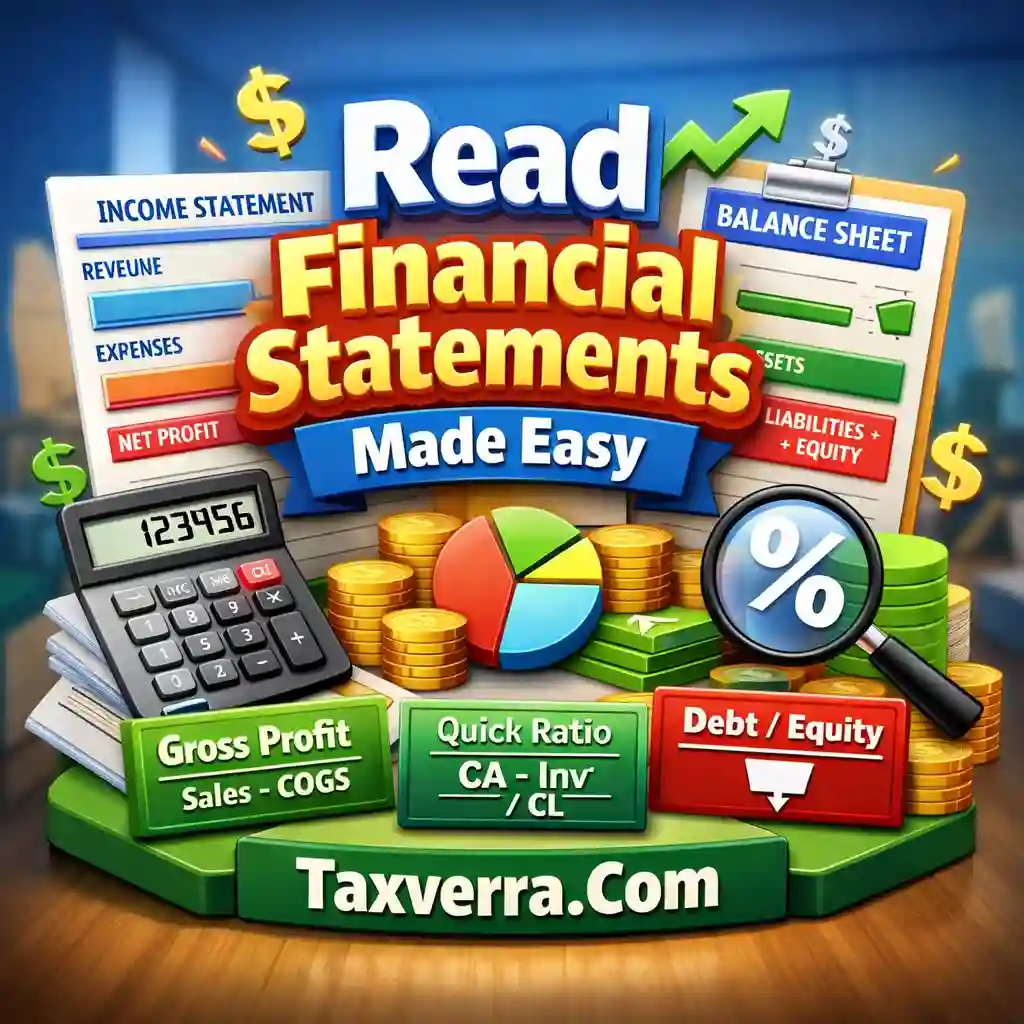
Seeing the Bigger Picture: What Financial Statements Really Tell You
When clients ask me how to read financial statements, I explain that these reports are more than numbers. They represent the financial story of a business. Every figure reflects a decision, whether it relates to pricing, cost management, or investment planning. Once you understand this, financial statements become far less intimidating.
Financial statement analysis revolves around three essential reports: the income statement, balance sheet, and cash flow statement. Each one answers a specific question. The income statement shows profitability, the balance sheet reveals financial position, and the cash flow statement explains how cash is moving.
In my experience, many beginners make the mistake of focusing only on profit. A business can look profitable on paper but still struggle financially. A practical example is a retail client I worked with. Their profit and loss statement showed steady profits, but they constantly faced cash shortages. The issue was excessive inventory tying up their cash.
To properly interpret financial statements, focus on key principles:
- Look for trends instead of isolated figures
- Compare current results with previous periods
- Understand how profit connects with cash flow
One mistake I often see is treating each statement separately. In reality, they are interconnected. Revenue impacts profit, profit impacts equity, and cash flow reflects the real movement of money.
Once you develop this mindset, reading financial reports becomes much easier, especially when supported by simple financial formulas that break down complex data into understandable insights.
Why Financial Literacy Gives You a Real Advantage
Financial literacy is one of the most valuable skills in business, yet it is often overlooked. Understanding financial statements allows you to make informed decisions rather than relying on assumptions. Whether you are a business owner or a professional, this knowledge gives you control over financial outcomes.
In my experience, many businesses struggle not because they lack revenue, but because they do not understand their financial position. Financial analysis for beginners starts with recognizing how money flows through a business.
A practical example is a small service business I advised. Their revenue was growing, but profitability was declining. After reviewing their financial statements, we identified rising operating expenses as the problem. With better cost control, they improved their margins within a few months.
Simple financial formulas make this process easier. Instead of getting overwhelmed by numbers, you can focus on key insights:
- Profit margins help evaluate efficiency
- Liquidity ratios show short-term stability
- Debt ratios highlight financial risk
One mistake I often see is focusing only on sales growth. Revenue alone does not determine success. What matters is how much of that revenue turns into profit and cash.
Another important benefit of financial literacy is better communication. When you understand financial statements, you can confidently explain performance to investors, partners, or stakeholders.
Developing this skill takes time, but the long-term benefits are significant. You begin to identify risks early, make smarter decisions, and build a stronger financial foundation for any business.
Understanding the Three Core Financial Statements
To effectively analyze financial statements, you must first understand the purpose of each report. These three statements work together to provide a complete financial picture.
The income statement focuses on performance over a period. It shows how much revenue the business generated and what expenses were incurred to earn that revenue. The result is either profit or loss.
The balance sheet presents a snapshot of the company’s financial position at a specific point in time. It lists assets, liabilities, and equity. This helps you understand what the business owns and what it owes.
The cash flow statement tracks actual cash movement. It shows how cash is generated and used across operations, investments, and financing activities.
A simple comparison helps clarify their roles:
| Statement | Purpose | Key Insight |
|---|---|---|
| Income Statement | Measures performance | Profitability |
| Balance Sheet | Shows position | Financial strength |
| Cash Flow Statement | Tracks liquidity | Cash availability |
In my experience, many beginners rely heavily on the income statement and ignore the others. This creates an incomplete picture. A company might show strong profits but still struggle with cash shortages.
A practical example is a consulting client who reported high profits but delayed supplier payments. After reviewing their cash flow statement, we found that late customer payments were affecting liquidity.
One mistake I often see is misunderstanding timing differences. Revenue may be recorded before cash is received, which can lead to confusion if you only look at profits.
To build strong financial analysis skills, always review all three statements together. This approach gives you a clearer and more accurate understanding of business performance.
Key Financial Terms Every Beginner Should Know
Before diving deeper into financial statement analysis, understanding basic terminology is essential. Without this foundation, formulas and reports can feel confusing.
Here are the most important terms I explain to clients:
- Revenue refers to total sales generated before any expenses
- Cost of Goods Sold (COGS) is the direct cost of producing goods or services
- Gross Profit is revenue minus COGS
- Operating Expenses include rent, salaries, utilities, and admin costs
- Net Profit is the final profit after all expenses
- Assets are what the business owns
- Liabilities are what the business owes
- Equity represents the owner’s share
In my experience, one mistake I often see is confusing profit with cash. They are not the same. A business can show profit but still struggle financially.
A practical example is a freelancer client who thought they were doing well based on revenue alone. After breaking down expenses, their actual net profit was much lower than expected.
Understanding these terms simplifies everything else. Once you know what each component means, reading financial statements becomes logical rather than technical.
Income Statement Made Simple: Step-by-Step Breakdown with Real Insight
When explaining the income statement to clients, I usually describe it as the performance report of a business. It shows how revenue turns into profit by subtracting different types of expenses. If you want to understand whether a business is actually making money, this is where you start.
The structure is straightforward, but the interpretation is where most people struggle. A simplified flow looks like this:
- Revenue
- Cost of Goods Sold
- Gross Profit
- Operating Expenses
- Net Profit
A key formula that every beginner should understand is the gross profit formula:
Gross Profit = Revenue minus Cost of Goods Sold
From there, you calculate net profit:
Net Profit = Total Revenue minus Total Expenses
In my experience, one mistake I often see is people jumping directly to net profit without analyzing the layers in between. Each stage tells you something different. For example, a declining gross profit might indicate rising production costs, while stable gross profit but falling net profit could point to increasing operating expenses.
A practical example is a trading business I worked with. Their revenue was increasing, but their profits were shrinking. When we analyzed their income statement, we discovered that supplier costs had increased significantly, reducing their margins.
To read an income statement effectively:
- Compare current figures with previous periods
- Look at profit margins, not just absolute profit
- Identify unusual spikes in expenses
This step-by-step approach helps you move beyond basic reading into meaningful financial analysis.
1. Revenue and Sales Analysis
Revenue is the starting point of every financial analysis. It tells you how much a business is earning, but more importantly, it reveals growth patterns.
When analyzing revenue, do not just look at total numbers. Focus on trends:
- Is revenue increasing or declining
- Are there seasonal fluctuations
- Is growth consistent or irregular
In my experience, many beginners assume higher revenue means better performance. That is not always true.
A practical example is a retail business I worked with. Their revenue increased significantly, but profits declined. The reason was heavy discounting, which reduced margins.
Key insights when analyzing revenue:
- Compare revenue across multiple periods
- Identify main revenue sources
- Check if growth is sustainable
One mistake I often see is ignoring revenue quality. Not all sales are equal. Credit sales, for example, may not immediately convert into cash.
A strong revenue analysis helps you understand the foundation of business performance.
2. Cost of Goods Sold and Its Impact
COGS is one of the most critical elements in understanding profitability. It includes direct costs such as raw materials, production, or service delivery expenses.
The relationship between revenue and COGS determines gross profit. If COGS increases without a matching increase in revenue, profitability declines.
In my experience, businesses often overlook rising costs. A small increase in supplier prices can significantly impact margins over time.
A practical example is a manufacturing client who experienced declining profits despite stable sales. After analysis, we found that raw material costs had increased gradually, reducing gross profit.
When analyzing COGS:
- Monitor cost trends regularly
- Compare with industry benchmarks
- Identify inefficiencies in production
One mistake I often see is treating all costs as fixed. Many COGS components can be optimized through better supplier negotiation or operational efficiency.
Understanding COGS helps you control profitability at its core.
3. Gross Profit and Operating Efficiency
Gross profit reflects how efficiently a business produces or delivers its product or service. It is one of the most important indicators in financial analysis.
A strong gross profit means the business has control over its direct costs. A declining gross profit signals potential issues.
In my experience, businesses often ignore gross profit trends and focus only on final profit. This can hide operational inefficiencies.
A practical example is a food business I advised. Their sales were stable, but gross profit margins were declining. After review, we found increased ingredient costs and waste. By improving inventory management, they restored profitability.
Key points to focus on:
- Track gross profit margins over time
- Identify cost increases early
- Improve operational efficiency
One mistake I often see is assuming stable revenue guarantees stable profit. Without controlling costs, profitability can decline even with strong sales.
Gross profit is the first real indicator of business efficiency.
4. Operating Expenses and Cost Control
Operating expenses include all indirect costs required to run the business. These expenses do not directly relate to production but are essential for operations.
Examples include:
- Salaries and wages
- Rent and utilities
- Marketing expenses
- Administrative costs
In my experience, operating expenses are where most businesses lose control. Unlike COGS, these costs are often less monitored.
A practical example is a service company that experienced declining profits. After reviewing their financial statements, we found excessive administrative expenses that were not aligned with revenue growth.
To manage operating expenses effectively:
- Review expenses regularly
- Identify unnecessary costs
- Align spending with business growth
One mistake I often see is allowing expenses to grow faster than revenue. This gradually reduces profitability.
Controlling operating expenses is key to maintaining financial stability.
5. Net Profit and True Business Performance
Net profit is the final result after all expenses are deducted. It shows the true profitability of a business.
However, interpreting net profit requires careful analysis. A single figure does not tell the full story.
In my experience, many business owners focus only on net profit without understanding how it is achieved.
A practical example is a consulting client who showed strong net profit but had unstable revenue. This made their business risky despite profitability.
When analyzing net profit:
- Compare with previous periods
- Evaluate consistency
- Understand contributing factors
One mistake I often see is ignoring profit margins. A business may have high profit but low efficiency if margins are weak.
Net profit provides a clear picture, but only when analyzed in context with other financial data.
Balance Sheet Basics: Understanding Financial Position Clearly
The balance sheet is often misunderstood, yet it is one of the most powerful tools in financial analysis. It provides a snapshot of what a business owns and owes at a specific point in time.
At its core is a simple but critical formula:
Assets = Liabilities plus Equity
Assets include cash, inventory, and receivables. Liabilities include loans, payables, and obligations. Equity represents the owner’s share in the business.
In my experience, beginners tend to focus only on total assets without questioning their quality. Not all assets are equally useful. For example, inventory might look valuable on paper but could be slow-moving or obsolete.
A practical example is a wholesale client who had strong assets on their balance sheet but faced financial stress. Most of their assets were tied up in unsold inventory. Once we identified this, they adjusted their purchasing strategy and improved cash flow.
Here are a few key things to focus on when reading a balance sheet:
- Liquidity of assets, especially cash and receivables
- Level of debt compared to equity
- Changes in financial position over time
One mistake I often see is ignoring liabilities. A company with high assets but even higher liabilities may be financially unstable.
Understanding the balance sheet helps you evaluate long-term stability. It answers whether the business is financially secure or overly dependent on debt.
1. Assets Breakdown: Understanding What the Business Truly Owns
When analyzing a balance sheet, assets are often the first thing people notice. However, in my experience, simply looking at total assets is not enough. You need to understand the quality, liquidity, and usability of those assets.
Assets are generally divided into two categories. Current assets include cash, accounts receivable, and inventory. These are expected to be converted into cash within a year. Non-current assets include property, equipment, and long-term investments, which support long-term operations.
A practical example is a trading business I worked with. Their balance sheet showed strong total assets, but most of it was tied up in inventory. The issue was slow-moving stock, which meant the business had value on paper but lacked usable cash. Once we optimized inventory turnover, their financial position improved significantly.
When reviewing assets, focus on:
- Cash availability and liquidity
- Quality of receivables and collection speed
- Inventory turnover and usability
- Long-term asset productivity
One mistake I often see is assuming all assets are equally valuable. Cash is far more useful than unsold inventory. Similarly, receivables are only valuable if they are actually collected.
In my experience, strong businesses maintain a healthy balance between liquid and non-liquid assets. This ensures they can meet short-term obligations while still investing in long-term growth.
Understanding assets properly helps you assess not just what a business owns, but how effectively it can use those resources.
2. Liabilities Explained: Knowing What the Business Owes
Liabilities represent the financial obligations of a business. While many people see liabilities as negative, that is not always the case. In fact, controlled and well-managed liabilities can support business growth.
Liabilities are also divided into two categories. Current liabilities include short-term obligations such as accounts payable, short-term loans, and accrued expenses. Non-current liabilities include long-term loans and financial commitments.
In my experience, one mistake I often see is ignoring the structure of liabilities. It is not just about how much a business owes, but when those obligations are due.
A practical example is a client who had manageable total debt but faced cash flow issues. The problem was that most liabilities were short-term, creating pressure on cash. By restructuring some of the debt into long-term liabilities, we improved their financial stability.
When analyzing liabilities, focus on:
- Short-term vs long-term obligations
- Interest costs and repayment terms
- Consistency of liability growth
- Ability to meet upcoming payments
Another common mistake is assuming that low liabilities always mean a strong business. Sometimes, businesses avoid debt but miss growth opportunities due to lack of funding.
In my experience, the key is balance. A financially healthy business uses liabilities strategically while maintaining the ability to meet its obligations comfortably.
3. Owner’s Equity Formula: Measuring the True Value of Ownership
Owner’s equity represents the portion of the business that belongs to the owner after all liabilities are deducted. It is one of the most important indicators of long-term financial health.
The basic concept is simple. Equity reflects the net value of the business. It increases with profits and decreases with losses or withdrawals.
A practical example is a small business owner who believed their company was highly valuable due to strong sales. However, after calculating equity, we found that high liabilities had significantly reduced the owner’s actual stake in the business.
Key components of equity include:
- Initial investment by the owner
- Retained earnings from past profits
- Less any withdrawals or losses
In my experience, one mistake I often see is focusing only on revenue growth while ignoring equity. A business can grow in size but not in value if liabilities increase at the same rate.
When analyzing equity, consider:
- Whether equity is increasing over time
- How much profit is retained versus withdrawn
- The relationship between equity and debt
Strong equity growth usually indicates a stable and profitable business. It shows that the company is building value rather than just generating temporary income.
4. Basic Accounting Equation: The Foundation of Financial Statements
At the core of every financial statement lies a simple but powerful principle known as the accounting equation. This equation ensures that the balance sheet remains accurate and consistent.
This equation shows that everything a business owns is financed either through debt or the owner’s investment.
In my experience, many beginners memorize this formula but do not fully understand its importance. It is not just a formula, it is the foundation of all accounting records.
A practical example is a business purchasing equipment using a bank loan. In this case:
- Assets increase due to new equipment
- Liabilities increase due to the loan
- Equity remains unchanged initially
This keeps the equation balanced.
One mistake I often see is misunderstanding how transactions affect different components. Every financial activity impacts at least two elements of this equation.
To apply this effectively:
- Always check whether both sides remain balanced
- Understand how each transaction affects assets, liabilities, or equity
- Use the equation to verify accuracy in financial reports
In my experience, once you truly understand this equation, reading financial statements becomes much easier. It acts as a mental framework that connects all financial data into a clear and logical structure.
Cash Flow Statement: Where Profit Meets Reality
If there is one statement I insist every business owner must understand, it is the cash flow statement. Profit does not guarantee cash, and cash is what keeps a business running.
The cash flow statement is divided into three sections:
- Operating activities
- Investing activities
- Financing activities
Operating activities show cash generated from core business operations. Investing activities reflect purchases or sales of assets. Financing activities include loans, repayments, and owner contributions.
In my experience, many businesses fail because they ignore cash flow. A practical example is a service company that showed consistent profits but struggled to pay salaries on time. The issue was delayed customer payments, which created a cash gap.
One key insight is to compare net profit with operating cash flow. If profit is high but cash flow is low, there may be issues with receivables or inventory.
To analyze cash flow effectively:
- Focus on operating cash flow first
- Identify large cash outflows
- Monitor consistency over time
One mistake I often see is relying solely on profit figures. Profit can be influenced by accounting methods, but cash reflects reality.
Understanding cash flow gives you a clearer picture of business health and helps prevent liquidity crises.
1. Operating Activities: Understanding Core Business Cash Flow
Operating activities represent the cash generated or used by a company’s core operations. This section is the most important part of the cash flow statement because it reflects whether the business can sustain itself without relying on external funding.
In simple terms, operating cash flow shows how efficiently a company converts its profits into actual cash. It includes cash received from customers and cash paid for expenses such as salaries, rent, and suppliers.
In my experience, many businesses focus heavily on profit but ignore operating cash flow. That is a risky approach. A business can report strong profits but still struggle if it cannot convert those profits into cash.
A practical example is a service-based client I worked with. Their income statement showed consistent growth, but they faced regular cash shortages. After reviewing operating activities, we found that delayed customer payments were the main issue. Once we improved receivable collection, their cash flow stabilized.
When analyzing operating activities, focus on:
- Consistency of cash inflows from customers
- Timing differences between revenue and cash
- Growth or decline in operating cash flow over time
One mistake I often see is ignoring negative operating cash flow. If this continues over time, it indicates that the business model itself may not be sustainable.
In my experience, a healthy business should generate positive cash flow from operations consistently. This is the strongest indicator of financial stability and long-term success.
2. Investing Activities: Tracking Long-Term Growth Decisions
Investing activities reflect how a business spends money on long-term assets and growth opportunities. This section shows whether the company is investing in its future or simply maintaining its current position.
Typical investing activities include:
- Purchase of property, equipment, or machinery
- Sale of long-term assets
- Investments in other businesses or securities
In my experience, beginners often misunderstand negative cash flow in this section. They assume it is a bad sign, but that is not always true. Negative investing cash flow can actually indicate growth, especially when funds are used to acquire productive assets.
A practical example is a manufacturing client who invested heavily in new machinery. Their investing cash flow was negative, which initially concerned them. However, this investment increased production efficiency and profitability over time.
When reviewing investing activities, consider:
- Whether investments are aligned with business growth
- Return expected from long-term assets
- Frequency and size of capital expenditures
One mistake I often see is businesses investing without proper planning. Buying assets without clear returns can create financial pressure.
In my experience, strong companies invest strategically. They balance current cash needs with future growth opportunities, ensuring that investments generate value over time.
3. Financing Activities: How Businesses Fund Their Operations
Financing activities show how a business raises capital and manages its financial structure. This section explains whether the company relies on debt, equity, or internal funding.
It includes transactions such as:
- Taking or repaying loans
- Issuing shares or receiving owner investment
- Paying dividends or owner withdrawals
In my experience, this section provides valuable insight into a company’s financial strategy. It reveals how the business funds its operations and growth.
A practical example is a startup client that relied heavily on bank loans during its early stages. While this helped them grow quickly, high repayment obligations later created cash flow pressure. By restructuring their financing mix, they achieved better stability.
When analyzing financing activities, focus on:
- Level of borrowing and repayment trends
- Dependence on external funding
- Changes in owner’s equity
One mistake I often see is excessive reliance on debt. While borrowing can support growth, too much debt increases financial risk and interest burden.
Another important insight is consistency. Frequent changes in financing patterns may indicate instability or lack of planning.
In my experience, a balanced financing structure is key. Businesses should use a mix of debt and equity while ensuring they can comfortably meet their financial obligations.
Simple Financial Ratios That Actually Matter
Financial ratios turn raw data into meaningful insights. They simplify financial statements and help you make comparisons quickly.
Here are some essential ratios every beginner should know:
| Ratio | Formula | Purpose |
|---|---|---|
| Gross Profit Margin | Gross Profit divided by Revenue | Measures profitability |
| Net Profit Margin | Net Profit divided by Revenue | Shows overall efficiency |
| Current Ratio | Current Assets divided by Current Liabilities | Indicates liquidity |
| Quick Ratio | Liquid Assets divided by Current Liabilities | Measures immediate liquidity |
| Debt to Equity Ratio | Total Debt divided by Equity | Shows financial risk |
In my experience, many people calculate ratios but do not interpret them correctly. A ratio by itself means very little without context. You must compare it with industry benchmarks or previous periods.
A practical example is a manufacturing client whose current ratio looked strong. However, most of their current assets were tied up in inventory. When we calculated the quick ratio, their liquidity position was much weaker.
One mistake I often see is relying on a single ratio. Financial analysis should always involve multiple indicators.
To use ratios effectively:
- Compare trends over time
- Benchmark against industry standards
- Combine ratios for a complete view
These simple financial formulas provide powerful insights when used correctly, making financial analysis much more practical and actionable.
1. Profitability Ratios: Measuring How Effectively a Business Earns Money
Profitability ratios are used to evaluate how efficiently a business converts revenue into profit. In simple terms, they show whether the company is actually making money after covering all costs. In my experience, these ratios are the first thing investors and business owners should review when performing financial statement analysis.
The most commonly used profitability ratios include gross profit margin and net profit margin. Gross profit margin focuses on production efficiency, while net profit margin reflects overall business performance after all expenses.
A practical example is a retail client I worked with. Their sales were increasing every quarter, but profitability was declining. When we calculated their profit margins, we discovered rising supplier costs and discount strategies were reducing actual earnings.
Key insights when analyzing profitability ratios:
- Higher margins indicate better cost control
- Declining margins signal inefficiencies
- Compare ratios over multiple periods for accuracy
One mistake I often see is focusing only on net profit without analyzing margins. Profit in absolute terms can be misleading if revenue is growing faster than earnings.
In my experience, strong businesses do not just grow revenue—they maintain stable or improving profit margins over time.
2. Liquidity Ratios: Understanding Short-Term Financial Strength
Liquidity ratios measure a company’s ability to meet its short-term obligations. In simple terms, they answer one critical question: can the business pay its bills on time?
The most important liquidity ratios include the current ratio and quick ratio. The current ratio compares current assets to current liabilities, while the quick ratio removes inventory to focus on more liquid assets.
A practical example is a service company I analyzed. Their current ratio looked healthy, but when we calculated the quick ratio, the situation changed. Most of their assets were tied up in receivables, which were not being collected on time.
Key points when analyzing liquidity ratios:
- A higher current ratio generally indicates better short-term stability
- Quick ratio provides a more realistic view of liquidity
- Excessively high ratios may indicate inefficient asset use
One mistake I often see is assuming a strong current ratio always means financial health. Without checking asset quality, this can be misleading.
In my experience, liquidity is one of the most critical indicators of survival. Even profitable businesses can fail if they cannot manage short-term cash obligations.
3. Efficiency Ratios: How Well a Business Uses Its Resources
Efficiency ratios, also known as activity ratios, measure how effectively a company uses its assets and manages operations. These ratios help determine whether resources are being utilized productively.
Common efficiency ratios include inventory turnover, receivables turnover, and asset utilization ratios.
In my experience, efficiency ratios often reveal hidden problems that profit figures do not show. A business may look profitable but still operate inefficiently.
A practical example is a trading business I advised. Their inventory levels were high, and stock was not moving quickly. When we analyzed inventory turnover, it became clear that capital was stuck in unsold goods, reducing cash availability.
Key insights:
- High turnover usually indicates strong efficiency
- Low turnover may signal operational inefficiencies
- Faster receivable collection improves cash flow
One mistake I often see is ignoring operational delays. Slow collections or excess inventory can silently damage financial performance.
Efficiency ratios help businesses identify where resources are being wasted and where improvements can be made.
4. Solvency Ratios: Evaluating Long-Term Financial Stability
Solvency ratios measure a company’s ability to survive in the long run by evaluating its debt levels compared to equity and assets. These ratios are essential for understanding financial risk.
The most commonly used solvency ratio is the debt-to-equity ratio, which compares total debt to shareholder equity.
In my experience, solvency is often ignored until financial pressure arises. However, it is one of the most important indicators for long-term stability.
A practical example is a manufacturing client who expanded rapidly using borrowed funds. While growth looked strong, their debt-to-equity ratio increased significantly. Eventually, high interest payments started affecting profitability.
Key considerations when analyzing solvency ratios:
- Lower debt-to-equity generally indicates lower risk
- High debt levels can increase financial pressure
- Compare ratios with industry benchmarks
One mistake I often see is confusing growth with stability. A business can grow quickly while becoming financially unstable due to excessive borrowing.
In my experience, healthy companies maintain a balanced capital structure. They use debt strategically but avoid over-leveraging, ensuring long-term sustainability.
5. Gross Profit Margin: Understanding Core Production Efficiency
Gross profit margin is one of the most important indicators in financial statement analysis because it shows how efficiently a business produces and sells its goods or services. It focuses only on direct costs, ignoring overhead expenses.
In my experience, this ratio quickly reveals whether a business has control over its production costs. If margins are stable or improving, it usually indicates strong cost management.
A practical example is a retail client I worked with. Their revenue was growing, but gross profit margin was steadily declining. After investigation, we found supplier price increases and excessive discounting were reducing profitability.
Key insights:
- Higher margin indicates better control over direct costs
- Declining margin signals inefficiencies in production or pricing
- Industry comparison is essential for correct interpretation
One mistake I often see is focusing only on revenue growth while ignoring margin trends. High sales do not guarantee strong profitability.
In practice, gross profit margin is the first checkpoint to evaluate operational efficiency.
6. Net Profit Margin: Measuring True Business Profitability
Net profit margin shows the final profitability of a business after all expenses are deducted. It is one of the most widely used metrics in financial analysis for beginners.
In my experience, this ratio is often misunderstood. It reflects not just production efficiency but also operating expenses, taxes, and financial costs.
A practical example is a service company I analyzed. Their gross margin was strong, but net profit margin was low. The reason was high administrative and marketing expenses.
Key insights:
- Shows overall efficiency of the entire business
- Helps compare performance across time periods
- Sensitive to cost structure changes
One mistake I often see is assuming high revenue automatically means strong net profit. Without controlling expenses, profitability can quickly decline.
Net profit margin is the final reality check of business performance.
7. Current Ratio: Short-Term Financial Stability Indicator
The current ratio measures whether a business can pay its short-term liabilities using its short-term assets. It is a key part of balance sheet analysis.
In my experience, this ratio is widely used but often misinterpreted. A high ratio is not always good, and a low ratio is not always bad.
A practical example is a trading business I worked with. Their current ratio appeared strong, but most assets were tied up in slow-moving inventory. This created liquidity pressure despite a healthy ratio.
Key insights:
- Indicates short-term financial strength
- Should be analyzed with asset quality
- Industry benchmarks are important
One mistake I often see is relying only on the current ratio without reviewing cash flow or receivables.
8. Quick Ratio: A More Strict Liquidity Measure
The quick ratio provides a stricter view of liquidity by excluding inventory from current assets. It focuses only on assets that can be quickly converted into cash.
In my experience, this ratio is more realistic than the current ratio, especially for businesses with large inventory levels.
A practical example is a manufacturing client whose current ratio looked healthy. However, after calculating the quick ratio, we found liquidity issues due to high inventory and slow receivables.
Key insights:
- Provides a more conservative liquidity view
- Useful for inventory-heavy businesses
- Helps identify hidden cash flow risks
One mistake I often see is ignoring inventory quality. Not all inventory can be quickly converted into cash.
The quick ratio gives a clearer picture of immediate financial health.
9. Debt-to-Equity Ratio: Measuring Financial Risk and Leverage
The debt-to-equity ratio shows how much a business relies on debt compared to its own capital. It is one of the most important indicators of long-term financial risk.
In my experience, this ratio plays a critical role in investment and lending decisions. High leverage can boost growth but also increases financial risk.
A practical example is a startup I advised. They used heavy borrowing to expand quickly. While growth was strong initially, high debt repayments later created cash flow pressure.
Key insights:
- Higher ratio means higher financial risk
- Lower ratio indicates conservative financial structure
- Industry comparison is essential
One mistake I often see is assuming debt is always bad. In reality, controlled debt can support expansion if managed properly.
Debt-to-equity ratio helps assess whether a business is financially stable or over-leveraged.
Step-by-Step Method to Read Any Financial Statement with Confidence
When someone asks me how to analyze financial statements without getting overwhelmed, I always recommend a structured approach. Without a method, it’s easy to jump between numbers and miss the bigger picture. A clear process turns complex reports into something practical and actionable.
In my experience, the most effective way is to follow a sequence rather than reviewing everything at once. Start with the income statement, move to the balance sheet, and then confirm your understanding through the cash flow statement.
Here is a step-by-step method I use with clients:
- Start with revenue trends to understand business growth
- Analyze gross and net profit margins
- Move to the balance sheet to assess financial stability
- Review cash flow to confirm actual liquidity
- Use financial ratios to validate your findings
A practical example is a client in the services sector who believed their business was performing well due to rising revenue. However, when we followed this structured approach, we found declining profit margins and weak cash flow. This revealed underlying inefficiencies that were not obvious at first glance.
One mistake I often see is reviewing statements in isolation. For instance, looking only at profit without checking cash flow can lead to misleading conclusions.
Another important tip is consistency. Always compare financial data over multiple periods. Trends reveal far more than single figures.
This step-by-step approach not only simplifies financial statement interpretation but also builds confidence. Over time, you start recognizing patterns quickly and making better financial decisions without second-guessing the numbers.
Common Mistakes That Can Mislead Your Financial Analysis
Even experienced professionals can misinterpret financial data if they overlook key details. In my work with clients, I’ve seen recurring mistakes that significantly impact decision-making.
One of the most common issues is focusing only on profit. Profitability is important, but it does not guarantee financial health. A business can show strong profits while struggling with cash shortages.
Another mistake I often see is ignoring timing differences. Revenue may be recorded before cash is received, and expenses may be delayed. This creates a gap between reported profit and actual cash position.
A practical example is a trading company that showed consistent profits but failed to pay suppliers on time. When we analyzed their financial statements in detail, we discovered that most sales were on credit, causing cash flow problems.
Here are some key mistakes to avoid:
- Relying on a single financial statement
- Ignoring cash flow analysis
- Overlooking changes in expenses
- Misinterpreting ratios without context
- Not comparing data over time
In my experience, another overlooked issue is overconfidence in numbers. Financial statements are only as accurate as the data recorded. Errors in bookkeeping can lead to incorrect analysis.
One lesson I always share is to question unusual figures. If something looks too good or too bad, investigate further.
Avoiding these mistakes will significantly improve your ability to read financial reports accurately and make informed decisions based on real insights rather than assumptions.
Real-World Examples That Bring Financial Statements to Life
Understanding theory is important, but real clarity comes from practical application. Over the years, I’ve worked with businesses across different industries, and financial statements often reveal insights that are not immediately obvious.
A practical example is a small manufacturing business that approached me for financial advice. Their income statement showed steady profits, but they were constantly struggling with cash shortages. When we reviewed their cash flow statement, we found that large amounts of money were tied up in inventory. By reducing excess stock, they improved their cash position significantly.
Another example comes from a service-based company. Their revenue was increasing every quarter, which looked promising. However, their net profit margin was declining. A deeper analysis revealed rising administrative expenses. Once these costs were controlled, profitability improved without increasing revenue.
In my experience, these situations are quite common. Financial statements often highlight issues that business owners are not aware of.
Here’s what these examples teach:
- Profit does not always mean strong cash flow
- Revenue growth does not guarantee profitability
- Expenses need continuous monitoring
- Balance sheet items can impact cash significantly
One mistake I often see is ignoring small changes. Minor increases in expenses or slow-moving inventory can gradually become major problems.
Real-world analysis builds confidence and sharpens your ability to interpret financial data. The more examples you study, the easier it becomes to identify patterns and make better financial decisions.
Tools, Techniques, and Professional Insights for Smarter Analysis
While understanding concepts is essential, using the right tools can make financial analysis faster and more accurate. In my professional work, I rely on a combination of software and structured techniques to interpret financial data effectively.
Modern accounting tools simplify complex calculations and provide real-time insights. However, tools alone are not enough. You need the right approach to extract meaningful information.
Here are some practical techniques I recommend:
- Use ratio analysis consistently
- Track monthly and quarterly trends
- Create simple dashboards for key metrics
- Focus on cash flow alongside profit
In my experience, many beginners rely too heavily on software outputs without understanding the logic behind them. This can lead to poor decision-making.
A practical example is a client who depended entirely on accounting software reports. The system showed positive performance, but a manual review revealed declining cash flow. This highlighted the importance of combining tools with human analysis.
Here are a few useful tools commonly used in financial analysis:
| Tool Type | Purpose |
|---|---|
| Accounting Software | Record and organize transactions |
| Spreadsheet Models | Perform custom analysis |
| Financial Dashboards | Track key performance indicators |
| Ratio Analysis Tools | Simplify calculations |
One mistake I often see is overcomplicating analysis. You do not need advanced tools to understand financial statements. Simple formulas and consistent review are often more effective.
The key is balance. Use tools to save time, but rely on your understanding to interpret results. This combination leads to smarter and more reliable financial decisions.
Frequently Asked Questions About Reading Financial Statements
What is the easiest way to start reading financial statements
The simplest way is to begin with the income statement, as it shows whether a business is making a profit. Once you understand revenue and expenses, move to the balance sheet and then the cash flow statement. In my experience, starting with profit builds confidence before tackling more complex areas like liquidity and financial position.
Why does a profitable business sometimes face cash problems
This is one of the most common questions I receive. Profit is calculated using accounting rules, while cash flow reflects actual money movement. A business can record sales but not receive cash immediately. A practical example is a client who sold products on credit. Their profit looked strong, but delayed payments caused serious cash shortages.
Which financial ratio should beginners focus on first
Start with a few key ratios instead of trying to learn everything at once. Focus on:
- Gross profit margin for profitability
- Current ratio for liquidity
- Debt to equity ratio for financial risk
In my experience, these three provide a solid foundation for financial analysis.
How often should financial statements be reviewed
Ideally, you should review them monthly. This allows you to identify trends early and take corrective action. Waiting until the end of the year often leads to missed opportunities and delayed decisions.
What is the biggest mistake beginners make
One mistake I often see is focusing only on revenue. Revenue growth can look impressive, but without analyzing expenses and cash flow, it does not provide a complete picture of financial health.
Do I need accounting software to analyze financial statements
Not necessarily. While software can make the process faster, you can still perform effective financial analysis using basic spreadsheets and simple financial formulas.
Final Thoughts from a Practical Accounting Perspective
Reading financial statements is not about memorizing formulas. It is about understanding how a business operates financially and making better decisions based on that understanding. Over the years, I’ve seen how this skill transforms the way individuals and businesses approach financial management.
In my experience, the most successful clients are not those with the highest revenue, but those who understand their numbers deeply. They know where their money is coming from, where it is going, and how to control it.
A practical lesson I often share is to focus on consistency. Financial analysis is not a one-time activity. It requires regular review and continuous improvement. Even small adjustments, when made consistently, can lead to significant financial growth.
Here are a few actionable tips to keep in mind:
- Review financial statements regularly, not occasionally
- Focus on trends rather than single data points
- Use simple financial formulas to simplify analysis
- Always connect profit with cash flow
- Question unusual or unexpected figures
One mistake I often see is overcomplicating the process. Financial analysis does not require advanced technical knowledge. With a clear approach and consistent practice, anyone can develop this skill.
Ultimately, understanding financial statements gives you control. It allows you to make informed decisions, avoid financial risks, and identify opportunities for growth. Whether you are running a business or managing personal finances, this knowledge is one of the most valuable tools you can develop.

