

I. What Are Depreciation Methods in Accounting
Depreciation methods refer to the systematic approach used to allocate the cost of a fixed asset over its useful life. In simple terms, instead of recording the full cost of an asset like machinery or vehicles in one year, businesses spread that cost over several years based on usage or time. This process is essential in financial accounting depreciation because it aligns expenses with the revenue generated from the asset.
From a beginner’s perspective, think of depreciation as the gradual “wear and tear” cost of an asset. However, in practice, it is not just about wear and tear. It is about accurate profit measurement, tax efficiency, and compliance with accounting standards.
In my experience working with small businesses, many owners initially believe depreciation is optional or only for large companies. That is incorrect. Even a small retail shop using a POS system or delivery bike must apply proper depreciation methods in accounting to avoid overstating profits.
A practical example is a client who purchased equipment worth 500,000 PKR. Without depreciation, their profit appeared unusually high in the first year, leading to higher tax liability. Once we applied straight line depreciation, their financial statements reflected a more realistic performance.
Key terms you must understand include
Cost which is the purchase price of the asset
Residual value which is the expected value at the end of useful life
Useful life which is the estimated duration the asset will be used
Understanding these concepts builds the foundation for applying different types of depreciation methods correctly.
II. Purpose of Depreciation in Accounting
The primary purpose of depreciation is to ensure that financial statements reflect a true and fair view of a business’s performance. Instead of distorting profits by recording large asset purchases in a single period, depreciation distributes that cost over time.
One of the core accounting principles behind this is the matching principle, where expenses are matched with the revenues they help generate. For example, if a machine is used to produce goods for five years, its cost should be spread across those five years rather than charged entirely in the first year.
In real-world accounting practice, depreciation also plays a critical role in tax planning. Many tax authorities allow depreciation as a deductible expense. This reduces taxable income and helps businesses manage cash flow more effectively.
A practical example is a logistics company I worked with that had multiple delivery vehicles. By applying the reducing balance method, they claimed higher depreciation in early years, which significantly reduced their tax burden during expansion.
Another purpose is asset valuation. Depreciation helps track the book value of assets through accumulated depreciation. This is essential when selling assets, applying for loans, or preparing financial reports for investors.
One mistake I often see is businesses ignoring depreciation until year-end adjustments. This leads to rushed calculations and errors. A better approach is to record depreciation monthly or quarterly to maintain accurate records.
Ultimately, depreciation is not just an accounting requirement. It is a strategic tool that supports better decision-making and financial control.
III. Importance of Depreciation Methods
Choosing the right depreciation method is not just a technical decision. It directly affects profitability, tax liability, and financial reporting. Different asset depreciation methods produce different expense patterns, which can influence how a company’s performance is perceived.
For example, straight line depreciation results in equal expense every year, which is ideal for assets that provide consistent value. On the other hand, the diminishing balance method results in higher expenses in early years, which suits assets that lose value quickly.
In my experience, businesses often underestimate how critical this choice is. A manufacturing client once used the straight line method for high-tech machinery that became obsolete quickly. Their profits appeared inflated in later years, which created unrealistic expectations among investors.
Depreciation also impacts key financial metrics such as
Net profit
Return on assets
Asset turnover ratio
From a compliance perspective, using appropriate accounting depreciation methods ensures adherence to standards like IFRS or local GAAP.
Another important aspect is decision-making. When businesses understand how assets lose value, they can plan replacements, maintenance, and investments more effectively.
Common mistakes include
Using the same method for all assets without considering usage
Ignoring residual value
Failing to review useful life periodically
A practical insight is that accountants should align depreciation methods with the actual usage pattern of assets rather than convenience.
This is why understanding depreciation methods comparison is essential for both accountants and business owners.
IV. 4 Main Depreciation Methods
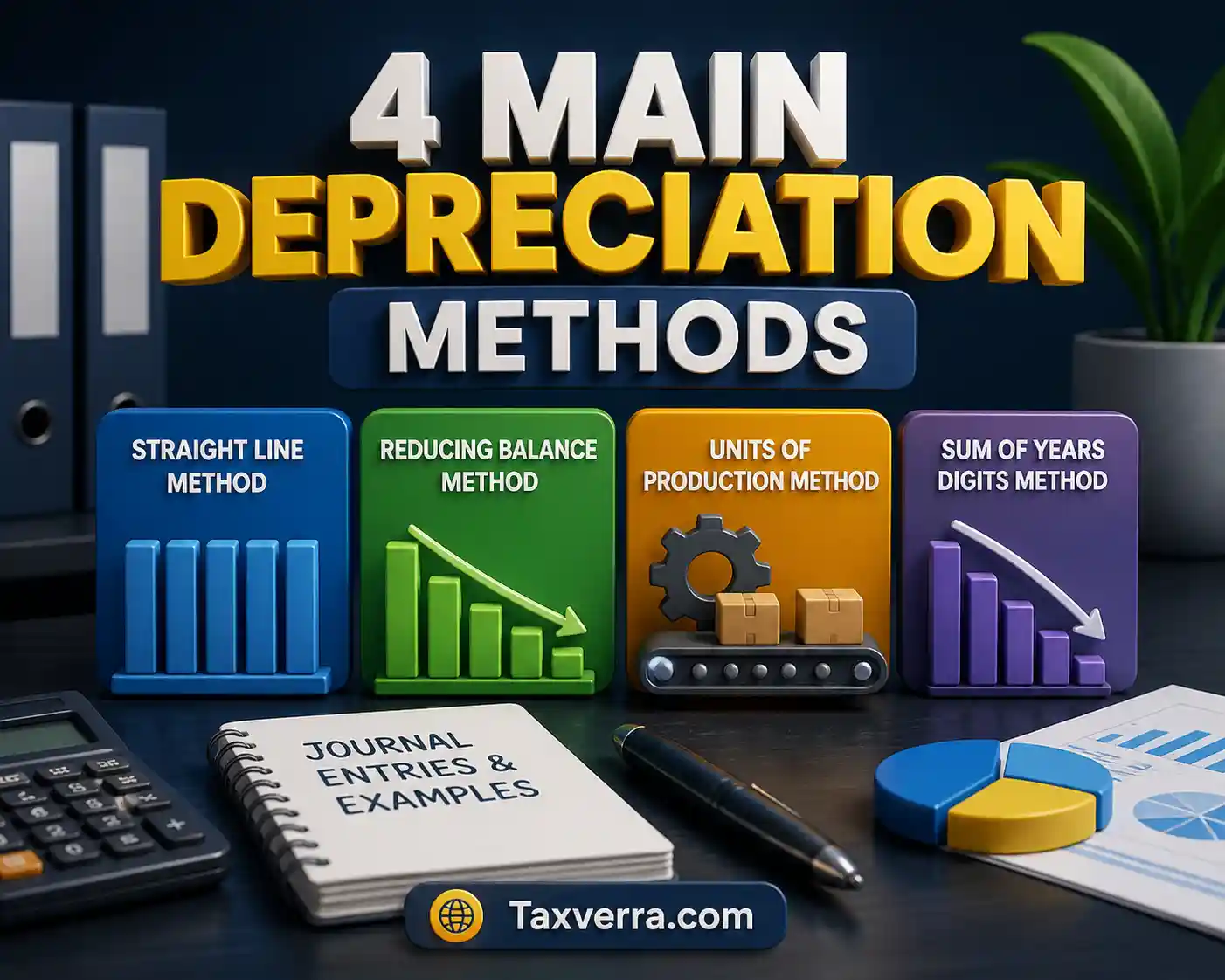
There are four main depreciation methods widely used in accounting, each designed to reflect different patterns of asset usage and value decline.
1. Straight Line Depreciation
Straight line depreciation is one of the simplest and most widely used depreciation methods in accounting. It allocates the cost of a fixed asset evenly over its useful life, meaning the same amount of depreciation expense is recorded each year until the asset’s value reaches its residual value.
From a practical accounting perspective, this method is preferred for assets that provide consistent economic benefits over time, such as buildings, office furniture, and long-term equipment. The main advantage is its simplicity and predictability, which makes financial planning and reporting easier for businesses.
The formula used in straight line depreciation is:
Cost minus Residual Value divided by Useful Life
Each component plays an important role. The cost represents the total purchase price of the asset, including all related expenses to make it operational. Residual value is the expected value of the asset at the end of its useful life. Useful life is the estimated period the asset will be used in the business.
For example, if a machine costs 100,000 with a residual value of 10,000 and a useful life of 5 years, the annual depreciation expense would be 18,000. This amount remains constant every year, making it easy to track in financial statements.
In real-world accounting practice, I often see businesses prefer this method for simplicity, especially small and medium enterprises. However, one limitation is that it does not always reflect actual usage patterns. For assets that lose value faster in early years, other methods like reducing balance may be more appropriate.
Straight line depreciation is best suited for businesses that want stable expense recognition and simple accounting treatment without complex calculations.
2. Reducing Balance (Diminishing Balance) Method
The reducing balance method, also known as the diminishing balance method, is a widely used depreciation method in accounting where depreciation is charged on the book value of an asset each year instead of its original cost. This means the expense is higher in the early years and gradually decreases over time.
From real-world accounting practice, this method is especially useful for assets that lose value quickly in the beginning, such as vehicles, computers, machinery, and other technology-based equipment. It reflects a more realistic pattern of economic benefit because many assets are more productive when they are new and less efficient as they age.
The formula used is:
Book Value × Depreciation Rate
Here, book value refers to the asset’s remaining value after previous depreciation has been deducted. The depreciation rate is usually a fixed percentage determined by accounting policy or tax regulations.
For example, if a vehicle costs 100,000 and the depreciation rate is 20%, the first-year depreciation will be 20,000. In the second year, depreciation is calculated on 80,000, which results in 16,000, and it continues decreasing each year. This creates a declining expense pattern over the asset’s life.
In my experience working with logistics and transport companies, this method is often preferred because vehicle maintenance costs and efficiency changes align more closely with higher early depreciation.
One mistake I often see is applying the same rate without understanding its impact on financial reporting. While profits may appear lower in early years, they become more stable later, which can affect performance analysis.
The reducing balance method is ideal for businesses that want more realistic expense matching and accelerated cost recovery in the early years of asset usage.
3. Units of Production Method
The units of production method is a practical depreciation method in accounting that calculates depreciation based on actual usage of an asset rather than time. This makes it one of the most realistic approaches for assets whose wear and tear depends directly on how much they are used.
In real business environments, this method is commonly applied in manufacturing industries, mining operations, printing businesses, and any setup where output can be measured in units, hours, or production cycles. Instead of assuming equal yearly usage, it aligns expense with actual activity, which improves accuracy in cost calculation.
The formula used is:
(Cost minus Residual Value) ÷ Total Estimated Units × Actual Units Produced
Each part of this formula is important. The depreciable cost is the asset cost after subtracting residual value. Total estimated units represent the expected total output during the asset’s useful life. Actual units produced refer to the usage in a specific period.
For example, if a machine costs 100,000 with a residual value of 10,000 and is expected to produce 90,000 units, the depreciation per unit is 1. If the machine produces 20,000 units in a year, the depreciation expense will be 20,000 for that year.
In my experience working with manufacturing clients, this method provides the most accurate reflection of production cost. One client producing packaging materials was able to improve pricing accuracy significantly after switching from straight line to units of production method because their machine usage varied heavily by season.
A common mistake is underestimating total production capacity, which leads to incorrect depreciation rates. Another issue is poor tracking of actual output, which can distort financial reporting.
The units of production method is ideal for businesses that want precise cost matching based on real operational activity rather than time-based assumptions.
4. Sum of Years Digits Method
The sum of years digits (SYD) method is an accelerated depreciation method in accounting that allocates higher depreciation expense in the earlier years of an asset’s life and gradually reduces it in later years. This approach is based on the logic that many assets are more productive and efficient when they are new, and their performance declines over time.
From a real accounting perspective, this method is less commonly used than straight line or reducing balance, but it is still relevant in situations where businesses want to match higher costs with higher early-year benefits.
The formula is based on a fraction:
Remaining Useful Life ÷ Sum of Years Digits × (Cost − Residual Value)
The “sum of years digits” is calculated by adding all years of the asset’s useful life. For example, if an asset has a useful life of 5 years, the sum is 5 + 4 + 3 + 2 + 1 = 15.
For example, if a machine costs 100,000 with a residual value of 10,000 and a useful life of 5 years, the depreciable amount is 90,000. In the first year, depreciation is calculated as 5/15 × 90,000, which results in 30,000. In the second year, it becomes 4/15 × 90,000, and so on, decreasing each year.
In my experience, this method is useful in industries where assets become less efficient quickly but not in a strictly exponential way. However, it requires careful calculation and is more complex compared to straight line depreciation.
One mistake I often see is miscalculating the sum of years digits, which leads to incorrect depreciation distribution across years. Another issue is applying it without understanding its financial impact, especially on profit trends.
The sum of years digits method is best suited for businesses that want accelerated expense recognition while maintaining a structured and systematic reduction pattern over time.
V. Depreciation Methods Formulas Explained Clearly
Understanding the depreciation formula behind each method is essential for accurate depreciation calculation. Many learners memorize formulas without understanding them, which leads to errors in application.
1. Straight Line Depreciation Formula with Example
The straight line depreciation formula is one of the most fundamental tools in financial accounting depreciation. It is used to calculate a fixed annual depreciation expense that remains constant throughout the useful life of an asset. This makes it simple, predictable, and widely used in both small and large businesses.
The formula is:
Cost minus Residual Value ÷ Useful Life
Each component of this formula has a specific meaning. The cost includes the purchase price of the asset along with any additional expenses required to bring it into working condition, such as installation or transportation. The residual value is the estimated amount the asset will be worth at the end of its useful life. The useful life is the expected duration the asset will generate economic benefits for the business.
For example, if a company purchases equipment for 120,000 with a residual value of 20,000 and a useful life of 5 years, the calculation becomes:
120,000 minus 20,000 = 100,000 depreciable amount
100,000 ÷ 5 = 20,000 annual depreciation
So, the business will record 20,000 depreciation expense every year for five years.
In my experience, this method is especially useful for assets that provide consistent utility over time, such as office furniture, buildings, and long-term installations. It simplifies budgeting because the expense remains stable each year, making financial planning easier.
However, one limitation I often observe is that it does not always reflect real-world usage patterns. Some assets lose value faster in early years, but straight line depreciation spreads the cost evenly, which may distort short-term profitability.
Despite this limitation, the straight line method remains the most widely used because of its simplicity, reliability, and ease of application in financial reporting.
2. Reducing Balance (Diminishing Balance) Method Formula with Example
The reducing balance method formula is a key concept in depreciation methods in accounting, especially when assets lose value faster in the early years of use. Unlike straight line depreciation, this method calculates depreciation on the remaining book value of the asset each year instead of the original cost.
The basic formula is:
Book Value at Beginning of Year × Depreciation Rate
Here, book value is the asset’s value after deducting accumulated depreciation from its original cost. The depreciation rate is a fixed percentage applied each year, usually determined by accounting policy, tax rules, or business estimation.
To understand it clearly, consider a simple example. A machine is purchased for 100,000 with a depreciation rate of 20%. In the first year, depreciation is:
100,000 × 20% = 20,000
The book value becomes 80,000. In the second year, depreciation is:
80,000 × 20% = 16,000
In the third year, it is calculated on 64,000, and the amount continues to decrease each year. This creates a declining expense pattern, which is why it is also called the diminishing balance method.
In real accounting practice, I often recommend this method for assets like vehicles, computers, and machinery. These assets provide higher productivity in early years but lose efficiency over time.
One mistake I often see is using the same rate without understanding its long-term financial impact. While it reduces profit in early years, it improves stability in later years, which can significantly affect financial analysis and investor perception.
This method is widely used because it provides a more realistic reflection of asset consumption and economic benefit over time, especially in fast-moving industries.
3. Units of Production Method Formula with Example
The units of production method formula is a practical approach used in depreciation methods in accounting where depreciation is calculated based on actual usage of an asset instead of time. This makes it highly accurate for businesses where asset wear and tear depends on production levels.
The formula is:
(Cost − Residual Value) ÷ Total Estimated Units × Actual Units Produced
Each element of this formula plays an important role in determining accurate depreciation expense. The cost is the total acquisition cost of the asset, including installation and related expenses. The residual value is the estimated salvage value at the end of its useful life. The total estimated units represent the expected total production capacity of the asset over its life. The actual units produced refer to the output during a specific accounting period.
To understand it practically, consider a machine purchased for 100,000 with a residual value of 10,000 and an expected production capacity of 90,000 units. The depreciable cost is 90,000. So, depreciation per unit becomes:
90,000 ÷ 90,000 = 1 per unit
If the machine produces 20,000 units in a year, depreciation expense will be:
20,000 × 1 = 20,000
This method directly links depreciation expense with operational activity, making it one of the most accurate approaches for manufacturing and production-based businesses.
In my experience working with production companies, this method provides the most realistic cost allocation. One client in the packaging industry improved their pricing strategy significantly after switching to this method because their costs were no longer distorted by fixed annual depreciation.
A common mistake is underestimating total production capacity, which leads to incorrect per-unit depreciation. Another issue is poor tracking of actual output, which can distort financial reporting accuracy.
The units of production method is ideal for businesses that require precise cost measurement based on real operational usage rather than time-based estimates.
4. Sum of Years Digits Method Formula with Example
The sum of years digits (SYD) method formula is used in depreciation methods in accounting to apply an accelerated depreciation pattern, where higher expense is recorded in the early years of an asset’s life and gradually decreases over time. This method is useful when an asset provides more economic benefit in its initial years.
The formula is:
Remaining Useful Life ÷ Sum of Years’ Digits × (Cost − Residual Value)
Each component has a specific meaning. The remaining useful life refers to the number of years left for the asset in a given year. The sum of years’ digits is calculated by adding all digits of the asset’s useful life. For example, if the useful life is 5 years, the sum is:
5 + 4 + 3 + 2 + 1 = 15
The cost minus residual value gives the depreciable amount, which is the total value that will be allocated as expense over the asset’s life.
For example, assume a machine costs 100,000 with a residual value of 10,000 and a useful life of 5 years. The depreciable amount is 90,000. In the first year, depreciation is:
5 ÷ 15 × 90,000 = 30,000
In the second year:
4 ÷ 15 × 90,000 = 24,000
This pattern continues until the last year, where the smallest fraction is applied.
In my experience, this method is useful in industries where asset performance declines gradually but not sharply, such as specialized machinery or high-value equipment. However, it requires careful calculation and is more complex than straight line depreciation.
One common mistake I often see is miscalculating the sum of years digits, which leads to incorrect allocation of depreciation expense across periods. Another issue is applying it without understanding its impact on profit trends, especially in early years where expenses are significantly higher.
The sum of years digits method is best suited for businesses that want accelerated cost recognition with a structured and systematic reduction pattern over time.
In my experience, one common mistake is ignoring residual value in calculations. This overstates depreciation and understates asset value.
Another issue is applying incorrect rates in the diminishing balance method, especially when switching from tax rules to accounting standards.
To avoid errors, always
Identify correct inputs
Double-check formulas
Use Excel templates for consistency
Clear understanding of formulas transforms depreciation from a confusing topic into a practical tool for financial analysis.
VI. Step by Step Process to Calculate Depreciation
When it comes to how to calculate depreciation, most errors happen not in formulas but in the initial steps. A structured approach ensures accuracy and consistency across all depreciation methods in accounting.
The first step is identifying the asset cost, which includes purchase price, delivery charges, installation, and any cost required to bring the asset into working condition. Many beginners only record invoice value, which leads to undervaluation.
The second step is estimating useful life. This is not always fixed. In my experience, businesses often rely on tax rates instead of actual usage patterns, which creates mismatches in financial accounting depreciation.
The third step is determining residual value. This is the expected salvage value at the end of the asset’s life. Ignoring this is one of the most common mistakes I see, especially in small businesses.
The fourth step is selecting the most appropriate depreciation method. This decision should be based on how the asset generates economic benefits. For example, production machinery should ideally follow the units of production method rather than straight line depreciation.
The fifth step is applying the depreciation formula and recording the depreciation expense.
A simple workflow looks like this
- Identify total asset cost
- Estimate useful life and residual value
- Choose method based on usage
- Apply formula
- Record journal entries
A practical example is a client in manufacturing who initially used straight line depreciation. After reviewing operations, we shifted to units of production, which gave a more accurate cost per unit and improved pricing decisions.
Following a structured process reduces errors and improves decision-making.
VII. Depreciation Methods Explained with Examples
Understanding depreciation examples is where theory becomes practical. Each method behaves differently, and real-world application makes the difference clear.
Straight line depreciation example
A company purchases equipment for 120,000 with a residual value of 20,000 and useful life of 5 years. Annual depreciation becomes 20,000. This method is simple and predictable, making it ideal for stable assets.
Reducing balance method example
A vehicle purchased for 100,000 with a 20 percent rate will have depreciation of 20,000 in the first year, then 16,000 in the second year, and so on. This reflects rapid value loss in early years.
Units of production method example
A machine expected to produce 100,000 units with a depreciable cost of 90,000 results in 0.9 per unit depreciation. If 20,000 units are produced in a year, depreciation is 18,000. This method aligns expense with actual usage.
Sum of years digits example
For a 5-year asset, total years sum is 15. In year one, depreciation fraction is 5 over 15 applied to depreciable cost. This creates higher expense in early years.
In my experience, a printing company benefited significantly from switching to units of production because their machine usage fluctuated seasonally.
One mistake I often see is applying the same method across all assets. Each asset behaves differently, and selecting the wrong method leads to distorted financial results.
These examples show how depreciation in accounting with examples helps businesses align cost with actual economic benefit.
VIII. Journal Entries for Depreciation Methods
Depreciation journal entries are essential for recording the periodic expense and updating accumulated depreciation. While the calculation varies across methods, the journal entry structure remains consistent.
The basic journal entry for depreciation is
Debit depreciation expense
Credit accumulated depreciation
Depreciation expense is recorded in the income statement, while accumulated depreciation appears in the balance sheet as a contra asset.
For example, if annual depreciation is 20,000, the entry will be
Debit depreciation expense 20,000
Credit accumulated depreciation 20,000
In practice, businesses may record depreciation monthly, quarterly, or annually depending on reporting requirements.
A practical scenario I encountered involved a company that failed to post monthly depreciation entries. At year-end, they had to record a large adjustment, which distorted monthly profit analysis. After implementing automated entries in accounting software, their reporting became more accurate.
For different methods, the entry remains the same but the amount changes based on calculation.
Common mistakes include
Posting depreciation directly to asset account instead of accumulated depreciation
Forgetting to record depreciation regularly
Using incorrect expense figures due to calculation errors
Another important aspect is asset disposal. When an asset is sold, accumulated depreciation must be adjusted to determine gain or loss.
Understanding journal entries for depreciation ensures that financial statements remain accurate and compliant with accounting standards.
IX. Depreciation Format in Financial Statements
Depreciation plays a critical role in how financial statements are presented. It affects both the income statement and the balance sheet through depreciation expense and accumulated depreciation.
In the income statement, depreciation is shown as an operating expense. It reduces net profit but does not involve cash outflow, which is important for cash flow analysis.
In the balance sheet, assets are presented at their net book value, which is calculated as
Cost minus accumulated depreciation
A simple format looks like this
Asset cost 100,000
Less accumulated depreciation 40,000
Net book value 60,000
Many businesses also maintain a fixed asset schedule, which provides detailed tracking of assets. This includes
- Opening balance
- Additions
- Disposals
- Depreciation expense
- Closing balance
In my experience, companies that maintain proper asset schedules have fewer audit issues and better control over their assets.
A practical example is a retail business that struggled during an audit because they did not track accumulated depreciation properly. Once we implemented a structured format, their reporting became clear and compliant.
One mistake I often see is presenting assets at cost without deducting accumulated depreciation, which overstates financial position.
Proper presentation of depreciation in financial statements ensures transparency and helps stakeholders make informed decisions.
X. Common Errors in Depreciation Accounting
Even experienced professionals make mistakes in depreciation accounting, and these errors can significantly distort financial statements. One mistake I often see is incorrect estimation of useful life. Businesses either rely blindly on tax rules or use unrealistic assumptions, which leads to either overstated or understated depreciation expense.
Another common issue is ignoring residual value. When residual value is not considered, the entire cost of the asset is depreciated, which results in over-depreciation. This directly impacts profit and asset valuation.
Many companies also apply the wrong depreciation method. For example, using straight line depreciation for assets like vehicles or technology that lose value quickly can misrepresent actual performance. In my experience, this often happens because businesses prefer simplicity over accuracy.
Posting errors in depreciation journal entries are also frequent. Some accountants mistakenly credit the asset account instead of accumulated depreciation, which disrupts the asset tracking system.
Other practical mistakes include
- Not updating depreciation after asset improvements
- Failing to record depreciation regularly
- Ignoring partial-year depreciation for newly acquired assets
A real-world case involved a trading company that did not depreciate its warehouse equipment for two years. When corrections were made, profits dropped sharply, affecting investor confidence.
To avoid these issues, always review assumptions annually, maintain proper documentation, and use accounting software for consistency. Accurate depreciation methods in accounting are not just technical compliance, they are essential for reliable financial reporting.
XI. Adjustments in Depreciation
Depreciation is not always static. Adjustments are often required due to changes in estimates, business conditions, or errors. These adjustments ensure that financial accounting depreciation remains accurate and relevant.
One common adjustment is a change in depreciation method. For example, a company may switch from straight line depreciation to diminishing balance method if asset usage changes. This is treated as a change in accounting estimate and applied prospectively.
Another adjustment involves revising useful life or residual value. In my experience, this happens frequently with machinery or technology assets. If an asset lasts longer than expected, depreciation expense should be reduced going forward.
Asset disposal is another key area. When an asset is sold, its cost and accumulated depreciation must be removed from the books. The difference between sale proceeds and net book value results in a gain or loss.
Correction of prior errors is also important. If depreciation was calculated incorrectly in previous years, adjustments must be made carefully to avoid misstating current profits.
A practical example is a manufacturing client who upgraded machinery, increasing its useful life. We adjusted depreciation going forward instead of revising past records, which ensured compliance with accounting standards.
Common mistakes include
- Retrospective changes without proper disclosure
- Ignoring adjustments after asset upgrades
- Miscalculating gain or loss on disposal
Proper handling of adjustments ensures that depreciation calculation remains aligned with actual business conditions.
XII. Comparison of Depreciation Methods
Understanding depreciation methods comparison is critical for selecting the most suitable approach. Each method produces a different expense pattern, which impacts financial statements and decision-making.
Straight line depreciation provides equal expense over time. It is simple and predictable, making it ideal for assets with consistent usage. However, it may not reflect actual wear and tear for rapidly depreciating assets.
Reducing balance method results in higher depreciation in early years and lower in later years. This is suitable for assets like vehicles or electronics that lose value quickly.
Units of production method is based on actual usage. It is highly accurate for manufacturing environments but requires detailed tracking of output.
Sum of years digits method is an accelerated approach that allocates more expense in earlier years. It is less commonly used but can be beneficial for tax planning.
A simple comparison table
| Method | Expense Pattern | Best Use Case |
|---|---|---|
| Straight Line | Equal | Furniture, buildings |
| Reducing Balance | High early | Vehicles, technology |
| Units of Production | Usage-based | Manufacturing equipment |
| Sum of Years Digits | Accelerated | Financial strategy |
In my experience, businesses often default to straight line depreciation without analyzing alternatives. This can lead to inaccurate cost allocation.
A practical insight is to align the method with asset usage pattern, not convenience. This ensures that depreciation expense reflects actual economic benefit.
Choosing the right method improves both financial accuracy and strategic decision-making.
XIII. Practical Tips from Real Accounting Experience
Depreciation is often treated as a routine calculation, but in practice, it plays a strategic role in financial management. In my experience, businesses that actively manage depreciation gain better control over profitability and tax planning.
One key tip is to classify assets properly. Different asset categories should use different depreciation methods. For example, office equipment may use straight line depreciation, while production machinery may use units of production method.
Another important practice is regular review. Useful life and residual value should not remain unchanged for years. Business conditions evolve, and depreciation assumptions must reflect that.
Automation is also critical. Using accounting software like QuickBooks or Xero ensures consistent depreciation calculation and accurate journal entries. Manual calculations often lead to errors, especially in large asset portfolios.
A practical example is a service company that initially handled depreciation manually. After switching to automated systems, they reduced errors and improved reporting efficiency.
Common mistakes I often see include
- Treating depreciation as a year-end activity only
- Using tax rates for financial reporting without adjustment
- Ignoring asset impairment
Accountants use depreciation not just for compliance but for decision-making. It helps in budgeting, pricing, and investment planning.
The key lesson is that depreciation methods in accounting should be actively managed, not passively applied.
XIV. How Accountants Use Depreciation in Real Life
Depreciation is not just a theoretical concept. In real business environments, it directly influences financial decisions, tax planning, and performance evaluation. Accountants use depreciation methods in accounting to ensure that asset costs are allocated accurately and consistently.
In my experience, one of the most practical uses of depreciation is in budgeting and forecasting. When businesses plan future investments, they rely on depreciation schedules to understand when assets will need replacement. This helps avoid sudden cash flow pressure.
Another important application is pricing strategy. For manufacturing companies, depreciation forms part of product cost. If depreciation is underestimated, product pricing may be too low, reducing profitability.
A practical example is a logistics company managing a fleet of vehicles. By applying the reducing balance method, they were able to recognize higher expenses in early years, which matched actual maintenance costs and supported better financial planning.
Depreciation is also critical during audits and compliance checks. Auditors often review depreciation methods, assumptions, and calculations to ensure accuracy. Companies with proper depreciation records face fewer audit issues.
Accountants also use depreciation to analyze asset efficiency. Metrics like return on assets depend heavily on accurate depreciation.
One mistake I often see is treating depreciation as a routine entry without analyzing its impact. In reality, it is a powerful tool for decision-making.
XV. Expert Tip From Real Experience
In my experience, the biggest difference between average and highly effective accountants is how they handle depreciation strategically rather than mechanically.
One key insight is to align depreciation methods with business reality, not just accounting convenience. Many businesses default to straight line depreciation because it is simple, but this does not always reflect actual asset usage.
Another important tip is to review depreciation assumptions annually. Changes in technology, market conditions, or usage patterns can significantly affect useful life and residual value.
A lesson I learned early in my career involved a client who used outdated useful life estimates for machinery. Their financial statements showed inflated profits because depreciation expense was too low. After revising estimates, their reports became more accurate and reliable.
You should also maintain a detailed fixed asset register. This document should include cost, depreciation method, accumulated depreciation, and net book value. It becomes extremely useful during audits and asset disposal.
Avoid relying entirely on tax depreciation rates for financial reporting. Tax rules are designed for compliance, not for accurate performance measurement.
The most practical advice is simple
Understand the asset
Choose the right method
Review regularly
Automate where possible
These steps will significantly improve the quality of financial reporting.
XVI. Practice Section for Depreciation Methods
MCQs
- Which depreciation method results in equal expense each year
A Straight line depreciation
B Reducing balance method
C Units of production method
D Sum of years digits method - Which method is best for assets used based on output
A Straight line
B Units of production
C Reducing balance
D None - What is accumulated depreciation
A Asset cost
B Total depreciation charged over time
C Annual expense
D Residual value - Which method gives higher depreciation in early years
A Straight line
B Units of production
C Reducing balance
D None - Residual value refers to
A Purchase cost
B Expected value at end of useful life
C Annual depreciation
D Market value
Short Questions
- Explain why depreciation is important in accounting
- Differentiate between straight line and reducing balance method
Practical Problem with Solution
A machine costs 100,000 with residual value 10,000 and useful life 5 years
Using straight line depreciation
Depreciation formula
Cost minus residual value divided by useful life
Calculation
100,000 minus 10,000 equals 90,000
90,000 divided by 5 equals 18,000 per year
Journal entry
Debit depreciation expense 18,000
Credit accumulated depreciation 18,000
This simple example shows how depreciation calculation works in real scenarios.
XVII. FAQs on Depreciation Methods in Accounting
What are depreciation methods in accounting?
Depreciation methods are systematic approaches used to allocate the cost of a fixed asset over its useful life. They help businesses record asset expense gradually instead of charging the full cost in one year.
What are the 4 main depreciation methods?
The four main depreciation methods are straight line depreciation, reducing balance (diminishing balance) method, units of production method, and sum of years digits method. Each method calculates depreciation differently based on time or usage.
Which depreciation method is most commonly used?
Straight line depreciation is the most commonly used method because it is simple, consistent, and easy to apply in financial reporting.
How do you calculate depreciation step by step?
First determine asset cost, then subtract residual value, estimate useful life, choose a suitable method, apply the depreciation formula, and finally record the journal entry for depreciation expense.
What is the journal entry for depreciation?
The standard journal entry is:
Debit Depreciation Expense
Credit Accumulated Depreciation
This records the expense in the income statement and reduces asset value in the balance sheet.
What is accumulated depreciation?
Accumulated depreciation is the total depreciation charged on an asset over its life. It is shown as a contra asset in the balance sheet and reduces the asset’s book value.
Can a company change depreciation methods?
Yes, a company can change its depreciation method if it better reflects the asset’s usage pattern. However, it is treated as a change in accounting estimate and applied prospectively.
What is the difference between straight line and reducing balance method?
Straight line depreciation spreads cost evenly each year, while reducing balance method charges higher depreciation in early years and lower in later years.
What are common problems in depreciation accounting?
Common problems include incorrect useful life estimation, ignoring residual value, using wrong method, and errors in journal entries.
Why is depreciation important for businesses?
Depreciation is important because it ensures accurate profit calculation, better tax planning, realistic asset valuation, and improved financial decision-making.
XVIII. Final Thoughts on Depreciation Methods in Accounting
Depreciation is more than just an accounting adjustment; it is a core part of how businesses understand asset value, profitability, and long-term planning. When applied correctly, depreciation methods in accounting help ensure that financial statements reflect a realistic picture of performance rather than inflated or misleading results.
From practical experience, the biggest difference between accurate and weak financial reporting usually comes down to how well depreciation is understood and applied. Businesses that ignore proper depreciation calculation often face distorted profits, incorrect pricing decisions, and tax inefficiencies.
Each method serves a different purpose. Straight line depreciation offers simplicity and consistency, reducing balance method reflects faster value loss in early years, units of production method aligns cost with actual usage, and sum of years digits method supports accelerated expense recognition. The key is not choosing the most popular method, but selecting the one that best matches the asset’s real economic behavior.
One important lesson from real-world accounting practice is that depreciation should never be treated as a one-time year-end task. It requires continuous review, especially when business conditions, asset usage, or technology changes.
For students and professionals, mastering depreciation is not just about memorizing formulas. It is about understanding the logic behind asset consumption and applying it in real financial decisions.
Ultimately, strong knowledge of depreciation methods, journal entries, and financial impact gives any accountant or business owner a significant advantage in financial planning, reporting, and decision-making.

