

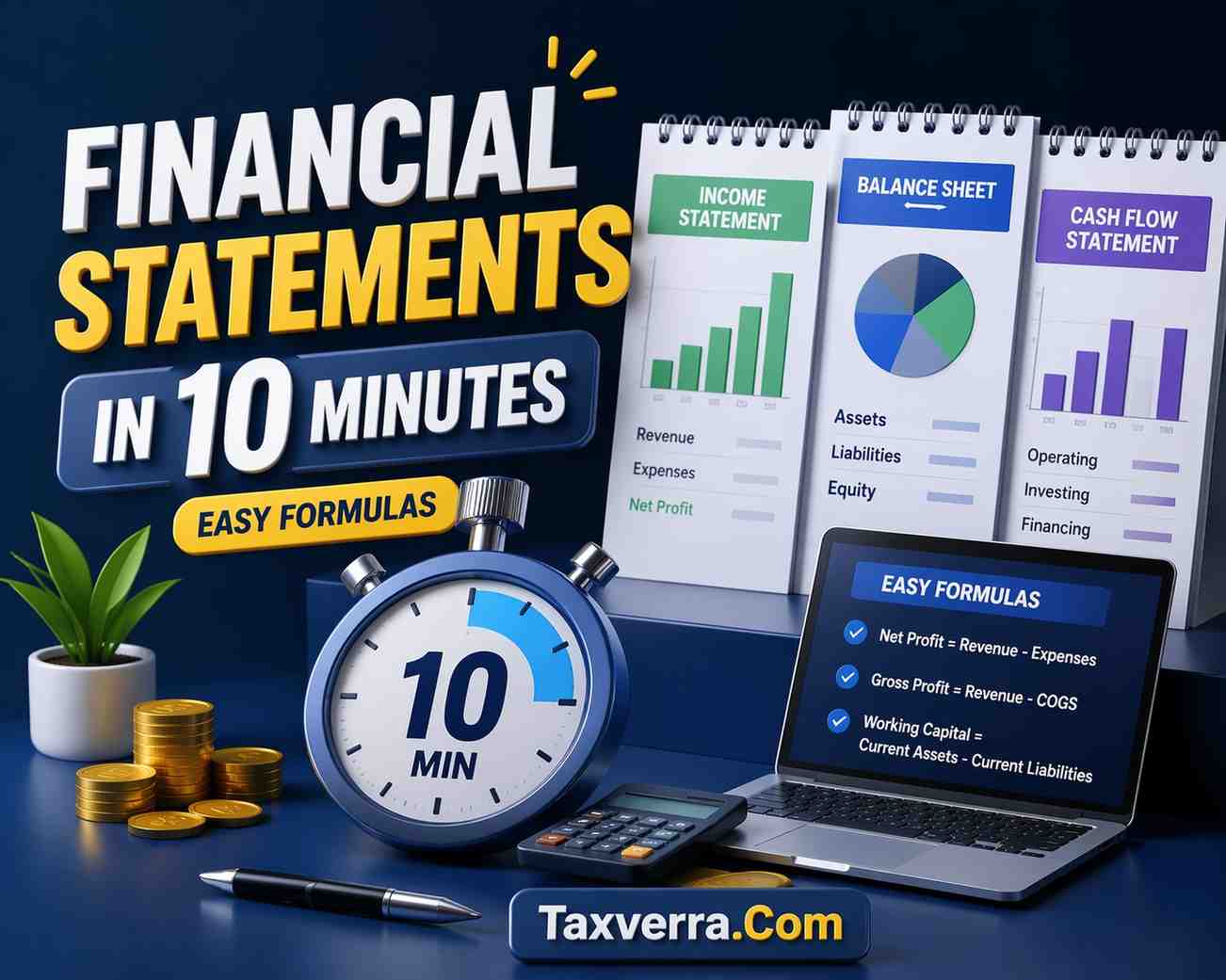
Understanding Financial Statements in the Real World
When I explain financial statements to clients, I avoid textbook definitions and focus on what they actually represent in daily business life. Financial statements are simply structured reports that tell you where your money is coming from, where it is going, and what remains at the end.
At their core, they answer three questions:
- Are you making money
- What do you own vs what you owe
- Do you have enough cash to survive
In my experience, small business owners often track sales but ignore profitability. A practical example is a retail client who had strong monthly sales but was constantly short on cash. The issue was hidden expenses and poor tracking, which only became clear after reviewing proper financial statements.
Here is how I simplify it for beginners:
| Statement Type | Purpose |
|---|---|
| Income Statement | Shows profit or loss |
| Balance Sheet | Shows financial position |
| Cash Flow Statement | Tracks cash movement |
One mistake I often see is treating these statements as compliance documents rather than decision-making tools. They are not just for accountants or tax authorities. They are your financial dashboard.
Another real-world case involved a freelancer who assumed profit equals cash in hand. After preparing proper statements, we identified unpaid invoices and upcoming liabilities that changed the entire financial picture.
The key lesson is simple. If you understand financial statements, you control your business. If you ignore them, you operate blindly.
Quick Breakdown of the Three Core Statements
Instead of overwhelming clients with theory, I break financial statements into three simple components that work together like a system. Each statement serves a different purpose, but they are deeply connected.
The Income Statement focuses on performance over time. It answers whether your business is profitable. The Balance Sheet is a snapshot of your financial position at a specific moment. The Cash Flow Statement tracks actual cash movement, which is often very different from profit.
A practical way to understand this is:
- Income Statement shows profit
- Balance Sheet shows wealth
- Cash Flow shows liquidity
In my experience, confusion usually arises when people rely on only one statement. A client once showed me a profitable income statement but was struggling to pay suppliers. The missing piece was cash flow. Sales were on credit, and cash was not coming in fast enough.
Here is a quick comparison:
| Statement | Time Focus | Key Insight |
|---|---|---|
| Income Statement | Period-based | Profitability |
| Balance Sheet | Point in time | Financial strength |
| Cash Flow | Period-based | Cash health |
One mistake I often see is ignoring how these statements connect. Profit from the income statement flows into equity on the balance sheet. Cash changes affect both assets and operations.
If you can understand how these three reports interact, you can analyze almost any business within minutes.
Breaking Down Profit: Income Statement Made Practical
The Income Statement is where most business owners focus first, and rightly so. It tells you whether your efforts are generating profit or loss.
At its simplest, the formula is:
Net Profit = Revenue – Expenses
But in real life, it is slightly more layered. You typically see:
- Revenue (sales)
- Cost of Goods Sold
- Gross Profit
- Operating Expenses
- Net Profit
In my experience, the biggest misunderstanding is around gross profit vs net profit. A practical example is a food business owner who believed high sales meant success. However, once we calculated costs properly, the margins were extremely thin.
Here is a simplified structure:
| Component | Description |
|---|---|
| Revenue | Total sales |
| Expenses | Costs incurred |
| Net Profit | Final earnings |
One mistake I often see is underestimating expenses. Many small businesses ignore minor costs like subscriptions, delivery charges, or transaction fees. These add up quickly and distort profitability.
Another real-world case involved a service provider who had steady income but no savings. After reviewing the income statement, we found excessive operational expenses that were quietly eating profits.
Actionable tips:
- Always separate fixed and variable costs
- Review expenses monthly, not yearly
- Focus on improving margins, not just sales
Understanding your income statement properly helps you make smarter pricing, cost control, and expansion decisions.
Balance Sheet Without the Confusion
The Balance Sheet is often seen as complex, but it becomes simple when you focus on its core equation:
Assets = Liabilities + Equity
This equation always balances, which is why it is called a balance sheet. It shows what you own, what you owe, and what is left for you.
In practical terms:
- Assets include cash, inventory, receivables
- Liabilities include loans, payables
- Equity is your ownership value
In my experience, business owners ignore this statement until a financial problem arises. A practical example is a client who kept borrowing to expand without reviewing liabilities. Eventually, debt obligations exceeded assets, creating financial stress.
Here is a simplified view:
| Category | Examples |
|---|---|
| Assets | Cash, stock, equipment |
| Liabilities | Loans, unpaid bills |
| Equity | Owner’s capital |
One mistake I often see is confusing profit with financial strength. You can be profitable and still financially weak if liabilities are too high.
Another real-world scenario involved a startup that looked successful on the income statement but had poor asset management. Inventory was overstocked, tying up cash unnecessarily.
Actionable insights:
- Monitor your debt-to-asset ratio
- Keep assets productive, not idle
- Avoid excessive borrowing without planning
The balance sheet gives you a clear picture of stability and long-term sustainability.
Cash Flow: The Reality Check Every Business Needs
Cash flow is where theory meets reality. You can have profits on paper and still run out of cash. This is why I always emphasize the Cash Flow Statement to clients.
The basic formula is:
Net Cash Flow = Cash Inflows – Cash Outflows
Cash flow is divided into:
- Operating activities
- Investing activities
- Financing activities
In my experience, most financial problems arise due to poor cash flow management, not lack of profit. A practical example is a construction business that secured large contracts but faced delays in payments. Despite high profits, cash shortages disrupted operations.
Here is a simple breakdown:
| Activity | Description |
|---|---|
| Operating | Daily business cash |
| Investing | Asset purchases |
| Financing | Loans and capital |
One mistake I often see is relying heavily on credit sales without managing collection cycles. This creates a gap between profit and actual cash.
Another real-world case involved an e-commerce seller who expanded rapidly but ignored cash flow timing. Inventory purchases drained cash before revenue was realized.
Actionable tips:
- Track cash weekly, not monthly
- Maintain a cash reserve buffer
- Speed up receivables and delay payables strategically
Cash flow is not just a statement. It is the lifeline of your business.
Essential Financial Formulas You Should Memorize
Over the years, I have noticed that a few simple formulas can transform how quickly someone understands financial statements. You do not need advanced accounting knowledge, just clarity on key calculations.
Here are the most useful formulas:
- Net Profit = Revenue – Expenses
- Gross Profit = Revenue – Cost of Goods Sold
- Working Capital = Current Assets – Current Liabilities
In my experience, working capital is often overlooked. A practical example is a trading business that had strong profits but struggled to pay suppliers due to poor working capital management.
Here is a quick reference:
| Formula | Purpose |
|---|---|
| Net Profit | Overall earnings |
| Gross Profit | Operational efficiency |
| Working Capital | Short-term liquidity |
One mistake I often see is focusing only on profit and ignoring liquidity. Profit does not guarantee survival, but cash does.
Another real-world case involved a manufacturing client who improved margins significantly but failed to manage inventory turnover. This affected working capital and slowed growth.
Actionable insights:
- Always track profit and cash together
- Use formulas regularly, not occasionally
- Keep calculations simple and consistent
Mastering these formulas allows you to analyze financial statements in minutes, even without deep accounting expertise.
Step-by-Step: Preparing Financial Statements Quickly
Preparing financial statements does not need to be complicated. In my experience, a simple structured approach works best, especially for small businesses and freelancers.
Step-by-step process:
- Gather all financial data (sales, expenses, assets, liabilities)
- Prepare the income statement first
- Create the balance sheet using closing figures
- Finalize the cash flow statement
A practical example is a small service business owner I worked with who had scattered financial records. By organizing transactions monthly and following a simple process, we prepared all statements within a few hours.
One mistake I often see is jumping directly to conclusions without organizing data. Poor data leads to inaccurate statements, which leads to bad decisions.
Here is a simplified workflow:
| Step | Action |
|---|---|
| 1 | Record transactions |
| 2 | Calculate profit |
| 3 | List assets and liabilities |
| 4 | Analyze cash flow |
Another real-world case involved a startup founder who delayed financial reporting. When we finally prepared the statements, we discovered cash shortages that could have been avoided with earlier tracking.
Actionable tips:
- Maintain records daily or weekly
- Use simple tools like spreadsheets
- Review statements regularly, not just annually
Speed comes from consistency, not shortcuts.
A Quick Example to Tie Everything Together
Let me walk you through a simplified example that mirrors real business scenarios.
Assume a small business has:
- Revenue: 10,000
- Expenses: 7,000
- Assets: 15,000
- Liabilities: 5,000
Income Statement:
Net Profit = 10,000 – 7,000 = 3,000
Balance Sheet:
Equity = 15,000 – 5,000 = 10,000
Cash Flow depends on timing, but assume:
Cash Inflows = 9,000
Cash Outflows = 8,000
Net Cash Flow = 1,000
In my experience, this simple breakdown helps clients understand how all three statements connect.
One mistake I often see is analyzing numbers in isolation. Each statement supports the other.
A practical example is a retail client who had profit but negative cash flow due to delayed payments. This highlighted the importance of viewing all statements together.
Key takeaway:
- Profit shows performance
- Balance sheet shows position
- Cash flow shows reality
When combined, they provide a complete financial picture within minutes.
Costly Errors That Can Distort Your Financial Picture
In my experience, even well-performing businesses make basic financial statement mistakes that quietly damage decision-making. These errors are rarely intentional, but they create a misleading picture of profitability and financial health.
One mistake I often see is mixing personal and business expenses. A client running a small consultancy was showing very low profits. After reviewing the records, we discovered personal expenses like travel and dining were booked as business costs. Once corrected, the business was actually quite profitable.
Another common issue is incorrect expense classification. For example:
- Treating capital purchases as expenses
- Ignoring depreciation
- Recording revenue before it is earned
Here is a quick overview:
| Mistake | Impact |
|---|---|
| Misclassified expenses | Incorrect profit |
| Ignored liabilities | Overstated financial position |
| Poor record-keeping | Unreliable statements |
A practical example is an e-commerce seller who did not account for return refunds properly. Revenue looked strong, but actual profits were significantly lower after adjustments.
One mistake I often see repeatedly is ignoring cash flow timing. Businesses assume sales equal cash, which leads to poor planning and liquidity issues.
Actionable tips:
- Review financial statements monthly
- Separate personal and business transactions
- Double-check expense categories
- Track receivables and payables carefully
The key lesson is simple. Small errors in financial statements can lead to big financial consequences, especially when decisions are based on incorrect data.
How to Read Financial Statements Quickly (Like an Expert)
Reading financial statements does not require hours if you know where to focus. In my experience, professionals scan a few key areas to understand a business within minutes.
Start with the Income Statement:
- Look at revenue trends
- Check profit margins
- Identify unusual expenses
Then move to the Balance Sheet:
- Compare assets vs liabilities
- Review debt levels
- Analyze equity growth
Finally, check the Cash Flow Statement:
- Ensure positive operating cash flow
- Identify cash shortages
- Review financing activities
A practical approach I use:
| Step | Focus Area | What to Look For |
|---|---|---|
| 1 | Revenue | Growth or decline |
| 2 | Profit | Sustainability |
| 3 | Cash | Liquidity strength |
In my experience, the fastest insight comes from comparing profit and cash. If profit is high but cash is low, there is usually a collection or expense issue.
One mistake I often see is overanalyzing minor details while ignoring major indicators like cash flow and debt.
A real-world example involved a client who focused heavily on revenue growth but ignored rising liabilities. Over time, this created financial pressure despite increasing sales.
Actionable insights:
- Focus on trends, not just numbers
- Compare current and previous periods
- Identify red flags early
Reading financial statements quickly is about knowing what matters most, not analyzing everything.
Financial Statements vs Reports: Clearing the Confusion
Many people use the terms financial statements and financial reports interchangeably, but they are not exactly the same. Understanding the difference helps avoid confusion, especially in professional settings.
Financial statements are standardized documents:
- Income Statement
- Balance Sheet
- Cash Flow Statement
Financial reports, on the other hand, are broader and may include:
- Management reports
- Budget analysis
- Forecasts
- Ratio analysis
Here is a simple comparison:
| Aspect | Financial Statements | Financial Reports |
|---|---|---|
| Nature | Standardized | Customized |
| Purpose | Historical data | Analysis & insights |
| Users | External & internal | Mostly internal |
In my experience, business owners often rely only on statements and ignore deeper reporting. A practical example is a manufacturing client who had accurate statements but lacked performance analysis. Once we introduced monthly reports, decision-making improved significantly.
One mistake I often see is assuming financial statements alone are enough for planning. They tell you what happened, not what will happen.
Another real-world case involved a startup that focused only on historical data. Without forecasts, they faced unexpected cash shortages during expansion.
Actionable tips:
- Use financial statements for accuracy
- Use reports for strategy and planning
- Combine both for better decision-making
Understanding this difference helps you move from basic accounting to strategic financial management.
Why Financial Statements Drive Smart Business Decisions
Financial statements are not just records. They are tools for making informed decisions. In my experience, businesses that regularly analyze their financials outperform those that rely on intuition.
The Income Statement helps in:
- Pricing decisions
- Cost control
- Profit improvement
The Balance Sheet supports:
- Investment planning
- Debt management
- Financial stability analysis
The Cash Flow Statement guides:
- Liquidity planning
- Expense timing
- Growth strategies
A practical example is a retail client who wanted to expand. Instead of relying on sales trends alone, we reviewed financial statements. The analysis showed weak cash flow, so expansion was delayed, preventing potential financial stress.
One mistake I often see is making decisions based on revenue alone. Revenue does not reflect profitability or financial strength.
Another real-world case involved a service business that reduced costs after analyzing expense trends, leading to a significant increase in net profit without increasing sales.
Actionable insights:
- Base decisions on data, not assumptions
- Review statements before major investments
- Use financial ratios for deeper insights
Financial statements provide clarity. Without them, decisions become guesses rather than strategies.
Tools That Make Financial Statements Faster and Easier
With the right tools, preparing financial statements becomes much faster and more accurate. In my experience, even simple tools can significantly improve efficiency.
Popular options include:
- Spreadsheet software like Excel
- Accounting software like QuickBooks
- Cloud-based tools for real-time tracking
Here is a comparison:
| Tool | Best For |
|---|---|
| Excel | Small businesses, flexibility |
| QuickBooks | Automated accounting |
| Cloud tools | Real-time financial tracking |
A practical example is a freelancer who managed accounts manually. After switching to accounting software, financial statements were generated automatically, saving hours of work each month.
One mistake I often see is relying entirely on manual records. This increases the risk of errors and delays.
Another real-world case involved a growing business that struggled with financial visibility. After implementing cloud accounting, they gained real-time insights into cash flow and profitability.
Actionable tips:
- Choose tools based on business size
- Automate repetitive tasks
- Regularly back up financial data
Technology does not replace financial understanding, but it enhances speed and accuracy, allowing you to focus on decision-making rather than calculations.
Common Questions
Over the years, I have noticed that clients often have similar questions when it comes to financial statements. Addressing these concerns helps build clarity and confidence.
Is profit the same as cash?
No. Profit is calculated on paper, while cash reflects actual money available. Many businesses fail due to cash shortages despite showing profits.
How often should financial statements be prepared?
In my experience, monthly preparation works best. It allows timely decisions and early detection of issues.
Do small businesses really need all three statements?
Yes. Even small businesses benefit from understanding profit, position, and cash flow.
What is the most important statement?
There is no single answer. However, cash flow is often the most critical for survival.
A practical example is a startup founder who believed financial statements were only needed for investors. After implementing monthly reporting, they gained better control over expenses and growth planning.
One mistake I often see is delaying financial review until year-end. By then, it is often too late to correct problems.
Actionable insights:
- Ask questions regularly
- Review financials consistently
- Seek professional guidance when needed
Understanding these basics removes fear and makes financial statements a powerful business tool rather than a complex obligation.
Wrapping It Up: Master Financial Statements in Minutes
After working with businesses across different industries, one thing is clear. Financial statements are not as complicated as they seem when approached correctly.
The key is to focus on:
- Income Statement for profit
- Balance Sheet for position
- Cash Flow for liquidity
In my experience, clarity comes from consistency. Businesses that review their financials regularly make better decisions and avoid major financial issues.
A practical example is a small business owner who started reviewing statements monthly instead of yearly. Within a few months, they identified unnecessary expenses and improved cash flow significantly.
One mistake I often see is overcomplicating financial analysis. You do not need advanced formulas or complex systems to understand your numbers.
Actionable takeaways:
- Keep financial tracking simple
- Focus on key numbers
- Review regularly and act quickly
Financial statements are not just accounting tools. They are decision-making frameworks. Once you understand them, you can evaluate any business within minutes and make confident financial decisions.

