

1. The Month Looks Profitable, but Payroll Still Feels Tight
- Open with a small business owner looking at a decent sales month but still moving money around to cover payroll, rent, sales tax, or supplier bills.
- Make the problem concrete: there is money “on paper,” but too much of it is trapped in unpaid invoices.
- Show the emotional reality: owners do not usually panic because revenue is low. They panic because customers are slow, vague, or hard to pin down.
- Frame receivables as an operations issue, not just an accounting line.
2. What People Think vs What Actually Happens
- What people think: “If we send invoices on time, clients will pay on time.”
- What actually happens: invoices get stuck over missing POs, wrong billing contacts, no approval trail, unclear scope, change-order arguments, or AP departments batching payments on their own calendar.
- What people think: “Late payment is a collections problem.”
- What actually happens: late payment often starts earlier with sloppy onboarding, weak contracts, vague deliverables, and no one owning the handoff from sales to billing.
- What people think: “More sales fix cash flow.”
- What actually happens: more credit sales can make cash flow worse if terms are weak and collection discipline is poor.
3. What Healthy Receivables Really Look Like
- Define “healthy” in practical terms, not textbook terms.
- Healthy receivables means:
- invoices go out fast
- customers know exactly how and when to pay
- issues get resolved before the due date
- no single late client can wreck the month
- staff know when to escalate
- the owner can predict cash, not just hope for it
- Explain the difference between “normal receivables” and “dangerous receivables.”
- Show that a business can survive with some receivables. It gets risky when old balances pile up, clients ignore follow-ups, or one big customer controls too much of incoming cash.
4. The Receivables Chain: Where Cash Flow Actually Breaks
- Break the process into stages:
- before the sale
- at job/project kickoff
- when work is delivered
- when the invoice is issued
- after due date
- Show the cash leak at each stage.
- Before the sale: bad terms, wrong client fit, no deposit.
- During delivery: no written approvals, no scope tracking, no milestone sign-off.
- At invoicing: late invoice, wrong amount, wrong contact, no PO, unclear line items.
- After invoicing: no reminder cadence, no call owner, no escalation path.
- Make this section practical so readers see receivables as a system, not a one-time task.
5. Terms That Protect Cash Instead of Looking “Professional”
- Explain why many small businesses copy net 30 terms without thinking.
- Show when net 30 is fine, and when it is a bad deal.
- Cover smarter structures:
- deposit upfront
- milestone billing
- weekly or biweekly progress billing
- auto-billing for recurring clients
- shorter terms for new or risky clients
- card-on-file for service businesses
- Explain the real tradeoff: strict terms may feel awkward, but weak terms quietly finance the client’s business with your cash.
- Include how to handle large clients that push net 60 or net 90.
6. Real-Life Scenarios With Specifics
- Scenario 1: Marketing agency with one $18,000 monthly client that always pays 20 days late, forcing the owner to float contractor payments.
- Scenario 2: Contractor who finishes work but cannot bill because change orders were approved verbally, not in writing.
- Scenario 3: Product wholesaler giving generous terms to a fast-growing buyer, then discovering that “big customer” does not mean “good payer.”
- Scenario 4: Consultant who switched from one final invoice to 50% upfront, 25% at midpoint, 25% before final delivery and stopped cash crunches almost overnight.
- Use exact numbers, dates, and consequences so the outline feels grounded in how this breaks in real businesses.
7. The Mistakes Section: Common Errors and Why They Keep Happening
- Sending invoices late because billing happens “when there’s time.”
- Letting salespeople promise loose payment terms to close deals.
- Billing the wrong person or not confirming AP contact details.
- Waiting too long to follow up because owners do not want to seem pushy.
- Treating every overdue invoice the same instead of prioritizing by amount, age, and customer history.
- Accepting vague “the check is coming” updates without a specific date.
- Continuing work for chronically late clients with no pause policy.
- Relying on one big customer too heavily.
- Confusing revenue growth with cash strength.
- Explain why these mistakes happen: optimism, weak process, fear of confrontation, and no clear ownership.
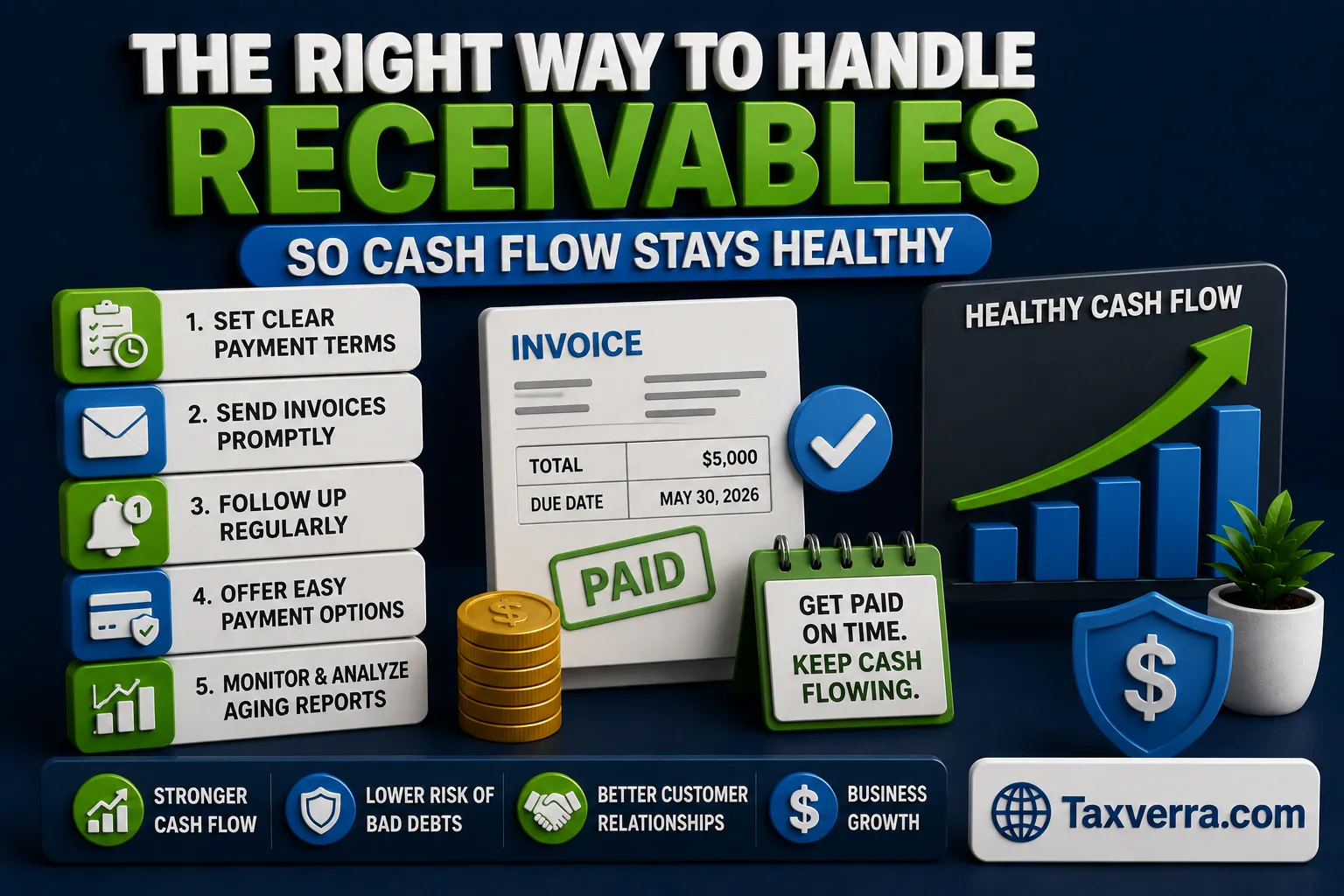
8. The Step-by-Step System: How to Run Receivables Properly
- Build a simple operating system a small business can actually use.
- Step 1: Set payment terms by client type, not by habit.
- Step 2: Confirm billing contact, PO requirement, submission method, and approval chain before work starts.
- Step 3: Require deposits, milestones, or card-on-file where possible.
- Step 4: Invoice immediately when the trigger event happens.
- Step 5: Make invoices easy to approve and easy to pay.
- Step 6: Run a weekly A/R review with aging, promises to pay, disputes, and next actions.
- Step 7: Follow a firm reminder and call schedule before and after due date.
- Step 8: Escalate early when an invoice turns into a dispute, not just a late payment.
- Step 9: Pause work when policy says pause work.
- Step 10: Review which clients are worth keeping if they damage cash flow every month.
- This should feel like a real owner’s system, not generic advice.
9. What to Say and Do at Each Stage of Collection
- This is a practical gap section many articles skip.
- Cover the tone and sequence:
- pre-due-date reminder
- due-date note
- 3 to 7 days late
- 10 to 15 days late
- 30+ days late
- Explain when email is enough and when a phone call is better.
- Include the importance of getting a specific promised payment date.
- Cover what to document after every call.
- Explain the difference between a customer who is organized but slow and one who is avoiding payment.
10. Handling Disputes Before They Turn Into Aged Receivables
- Show that not all overdue invoices are collection failures. Some are unresolved operational issues.
- Cover common dispute triggers:
- unclear scope
- missing approval
- bad invoice detail
- missing paperwork
- surprise charges
- partial delivery complaints
- Recommend a simple dispute log with owner, status, root cause, and deadline.
- Explain how fast dispute resolution protects cash better than sending more reminder emails.
11. Insights Most Articles Miss
- A/R aging is not enough by itself. You also need to know:
- how much of next month’s obligations depend on overdue invoices arriving
- how exposed you are to one or two customers
- how many invoices are delayed by disputes, not inability to pay
- whether billing errors start in sales, operations, or finance
- Emphasize that the best cash flow fix is often upstream:
- tighter proposals
- better client onboarding
- milestone approvals
- cleaner handoffs
- Explain that some clients are profitable on paper but destructive to cash flow in reality.
- Highlight the hidden cost of chasing bad receivables: owner time, staff stress, delayed tax payments, damaged supplier relationships.
12. Contrarian Angle: Sometimes the Right Move Is Less Credit, Not Better Collections
- Push back against the usual “sell more and automate reminders” advice.
- For some small businesses, the better move is:
- fewer open terms
- more deposits
- smaller project chunks
- recurring autopay
- stricter onboarding
- firing repeat offenders
- Include the uncomfortable truth: if a customer always pays late, the issue is not just collections, it is client quality.
- Another overlooked angle: an early-pay discount is not automatically smart if margins are already tight.
13. When Financing Helps and When It Just Hides the Problem
- Briefly cover invoice financing, line of credit, and short-term funding as tools, not solutions.
- Explain when these can help:
- temporary timing gap
- seasonal business
- strong customers, slow cycles
- Explain when they are a red flag:
- chronic invoicing errors
- weak client base
- no collection discipline
- pricing too low to support working capital
- Keep this grounded and skeptical.
14. Simple Action Plan
- End with a short, practical reset plan:
- identify all invoices over 15 days past due
- separate disputes from true slow-pay accounts
- tighten terms for new work starting now
- set one weekly A/R review meeting
- create a follow-up cadence
- require deposits or milestone billing on future jobs
- set a stop-work threshold
- review top 5 customers by receivable exposure
- Finish with a clear takeaway: healthy receivables are not about chasing harder at the end. They come from better rules, faster billing, earlier escalation, and not letting clients train you to wait.

