
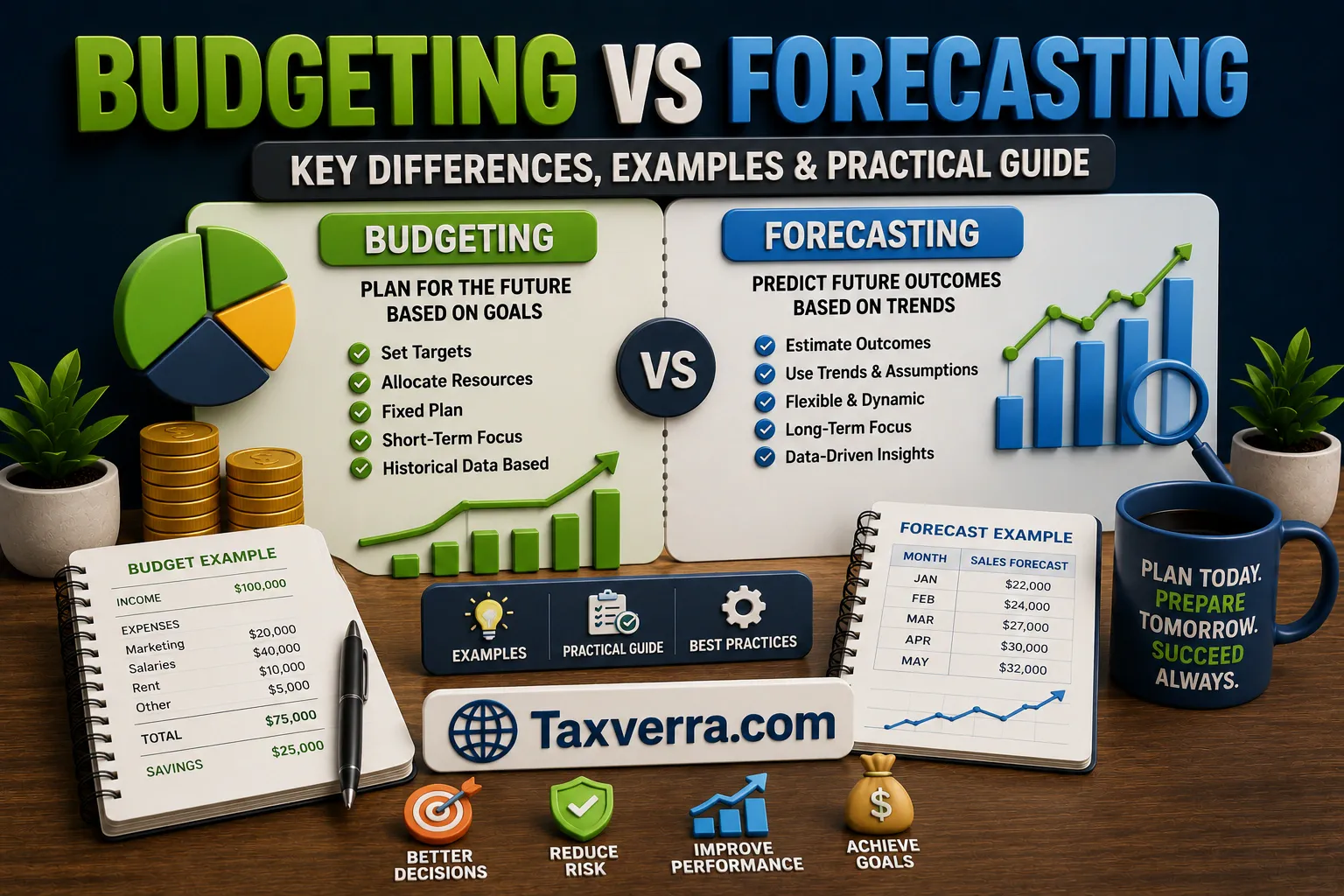
Managing business finances is not just about tracking income and expenses it’s about making smart decisions for the future. That’s where budgeting vs forecasting becomes very important for every business owner. Many people think budgeting and forecasting are same thing, but in reality they serve different purposes and gives different insights. Understanding the key differences between budgeting and forecasting can help businesses plan better, control costs, and improve overall financial performance.
Budgeting is the process of creating a financial plan for a specific period, usually a year. It helps businesses set targets for revenue, expenses, and profit. A proper budget gives direction and helps you stay on track with your financial goals. However, budgeting is often fixed and does not change frequently, which can sometimes create problems when business conditions change. This is where forecasting comes in. Forecasting is more flexible and focuses on predicting future financial outcomes based on real-time data, trends, and market conditions. It helps business owners to adjust strategies quickly when needed.
When we talk about budgeting vs forecasting, it’s important to understand that both tools are not competing, but they actually work together. Budgeting provides a baseline, while forecasting helps you adapt to changes. For example, if your sales are lower than expected, forecasting allows you to update your expectations and take corrective actions before it becomes a bigger issue. Many small businesses ignore forecasting, which is a big mistake because it can lead to poor decision making.
In this practical guide on budgeting vs forecasting, we will break down the concepts in simple terms, explain their differences, and provide real-world examples so you can understand how to use them in your business. Whether you are a small business owner, entrepreneur, or someone learning finance, this guide will help you understand when to use budgeting and when forecasting is more useful. By the end, you will have a clear idea how these two financial tools can improve your planning, reduce risks, and support long-term business growth.
What is Budgeting?
Budgeting is the process of creating a financial plan that estimates a business’s income and expenses over a specific period of time, usually monthly or yearly. It helps business owners decide how much money they expect to earn, how much they will spend, and how much profit they should make. In simple words, budgeting is like a roadmap that guide your business towards its financial goals.
A budget is prepared before the actual period begins, and it is based on assumptions, past data, and business objectives. It allows you to allocate resources properly, control unnecessary spending, and ensure that your business is running efficiently. Without proper budgeting, many businesses struggle to manage cash flow and often end up overspending or facing financial problems.
One important thing to understand is that budgeting is usually fixed or static, meaning once it is created, it does not change frequently. This can sometimes create challenges if market conditions changes or if actual results are different from what was planned. However, it still plays a very important role in setting financial discipline.
Key Features of Budgeting:
- It is a planned financial strategy
- Covers a specific time period (monthly, quarterly, yearly)
- Based on estimated numbers
- Helps in cost control and goal setting
- Provides a benchmark to compare actual performance
Simple Example:
Suppose a business creates a monthly budget where:
- Expected revenue = $10,000
- Expenses = $7,000
- Profit = $3,000
This budget helps the owner understand how much they can spend and what they need to achieve. If actual results are different, they can compare and analyze the gap.
Why Budgeting is Important:
Budgeting is essential because it helps businesses:
- Plan for future growth
- Avoid overspending
- Manage cash flow effectively
- Make better financial decisions
- Stay focused on business goals
In short, budgeting is the foundation of financial planning in any business. It gives clarity, control, and direction but it works best when combined with forecasting to handle real-world changes.
What is Forecasting?
Forecasting is the process of predicting future financial outcomes of a business based on past data, current trends, and market conditions. Unlike budgeting, which is fixed, forecasting is more flexible and changes as new information becomes available. It helps business owners understand what is likely to happen in the future so they can make better decisions.
In simple words, forecasting is about looking ahead and estimating your future revenue, expenses, and cash flow. It uses real data and sometimes updated regularly (monthly or even weekly), which makes it more practical in fast-changing business environment. Many businesses rely on forecasting to stay prepared for uncertainties and avoid financial surprises.
When discussing budgeting vs forecasting, forecasting plays a key role because it allows you to adjust your plans based on actual performance. For example, if your sales are dropping, forecasting can help you predict lower revenue and take action early, instead of waiting until the end of the year. This makes forecasting a powerful tool for business planning and risk management.
Key Features of Forecasting:
- Based on historical data and trends
- Flexible and regularly updated
- Focuses on future predictions
- Helps in decision making and strategy adjustments
- Reflects real-time business conditions
Simple Example:
Suppose your business expected monthly sales of $10,000, but after 3 months you notice sales are averaging only $8,000. Using forecasting, you update your future estimates to reflect this trend. This helps you adjust expenses or plan new strategies to improve performance.
Why Forecasting is Important:
Forecasting helps businesses:
- Prepare for future challenges
- Adapt to market changes quickly
- Improve financial decision making
- Manage risks effectively
- Plan growth strategies with more accuracy
In short, forecasting gives you a forward-looking view of your business. It is not about setting fixed targets, but about staying realistic and responsive to changes. When used together with budgeting, it creates a strong financial planning system that helps businesses grow and stay stable.
Budgeting vs Forecasting: Key Differences
Understanding the difference between budgeting and forecasting is very important for business owners who want better financial control and planning. While both are essential financial tools, they serve different purposes and are used in different ways. Many people confuse them, but once you clearly understand budgeting vs forecasting, it becomes easier to manage your business finances effectively.
Core Difference Explained
The main difference is simple:
- Budgeting is a fixed financial plan created before a period begins
- Forecasting is a flexible prediction that updates based on real data
Budgeting focuses on setting targets, while forecasting focuses on adjusting expectations.
Comparison
| Aspect | Budgeting | Forecasting |
|---|---|---|
| Purpose | Financial planning | Future prediction |
| Nature | Fixed (static) | Flexible (dynamic) |
| Time Frame | Usually yearly | Ongoing / updated regularly |
| Data Used | Estimates & assumptions | Real-time + historical data |
| Focus | Targets & goals | Trends & future outcomes |
| Changes | Rarely updated | Frequently updated |
| Usage | Control spending | Adjust strategies |
Practical Example
Let’s say a business sets a yearly budget expecting revenue of $120,000. This is their financial target.
However, after 6 months, actual performance shows sales are slower than expected. Now forecasting comes into play. The business updates its future estimates to maybe $100,000 based on current trends. This helps them adjust expenses and avoid losses.
Why Both Are Important
When comparing budgeting vs forecasting, it’s important to understand that they are not competitors they actually work together.
- Budgeting gives you a clear financial direction
- Forecasting helps you stay realistic and adaptable
Without budgeting, you have no plan. Without forecasting, your plan may become outdated very quickly.
Key Takeaway
The key difference between budgeting and forecasting is that one is about planning, and the other is about adapting. Smart businesses use both together to improve decision-making, manage risks, and achieve long-term growth.
Why Budgeting is Important for Business Owners
Budgeting is one of the most important financial practices for any business owner. Without a proper budget, it becomes very difficult to control spending, manage cash flow, and achieve long-term goals. A well-planned budget not only gives direction but also helps businesses stay financially stable even in uncertain situations.
1. Helps Control Spending
One of the biggest benefits of budgeting is that it helps you control unnecessary expenses. When you have a clear plan of where your money should go, you are less likely to overspend. Many businesses fail because they don’t track their expenses properly, and budgeting solves this problem.
2. Improves Financial Planning
Budgeting allows business owners to plan their income and expenses in advance. It helps you set realistic financial goals and work towards them step by step. Without planning, businesses often operate blindly, which can lead to financial issues later.
3. Better Decision Making
When you have a proper budget, it becomes easier to make smart business decisions. For example, you can decide whether you can afford to hire new staff, invest in marketing, or expand your business. Budgeting gives you financial clarity, even if sometimes numbers are not 100% accurate.
4. Helps Manage Cash Flow
Cash flow is the lifeline of any business. Budgeting helps you ensure that you have enough money to cover your daily operations. It also helps you prepare for periods when income might be low. Without budgeting, many businesses face cash shortages, which can be risky.
5. Keeps You Focused on Goals
A budget acts like a financial roadmap. It keeps you focused on your business goals and prevents you from making unnecessary financial decisions. Sometimes business owners forget their targets, but budgeting reminds them what they need to achieve.
6. Performance Measurement
Budgeting also helps you compare your planned performance with actual results. If there is a difference, you can analyze what went wrong and improve in the future. This process is very important, but many small businesses ignore it.
Final Thoughts
Budgeting is not just about numbers, it is about control, planning, and growth. Every business owner, whether small or large, should have a proper budgeting system in place. Even if your budget is not perfect, it still gives you a strong foundation to manage your business finances more effectively.
Why Forecasting is Important
Forecasting is a powerful financial tool that helps business owners prepare for the future and make smarter decisions. In today’s fast-changing business environment, relying only on fixed plans is not enough. This is where forecasting becomes very important, because it gives you a clear idea of what might happen next based on real data and trends.
1. Helps Predict Future Performance
Forecasting allows businesses to estimate future revenue, expenses, and profits. Instead of guessing, you use past data and current trends to make informed predictions. This helps you stay prepared, even if things don’t go exactly as expected.
2. Improves Decision Making
With accurate forecasting, business owners can make better decisions. For example, you can decide when to invest more, reduce costs, or expand operations. Without forecasting, decisions are often based on assumptions, which can be risky.
3. Helps Manage Risks
Every business faces uncertainty, whether it’s market changes, economic conditions, or unexpected expenses. Forecasting helps you identify potential risks early so you can take action before problems become serious. Many businesses ignore this, and they face sudden financial issues.
4. Supports Cash Flow Management
Forecasting plays a key role in managing cash flow. It helps you predict when money will come in and when it will go out. This ensures that you have enough funds to run your operations smoothly. Sometimes businesses fail not because they are unprofitable, but because they run out of cash.
5. Allows Quick Adjustments
One of the biggest advantages of forecasting is flexibility. Unlike budgeting, forecasting can be updated regularly based on new data. This means you can quickly adjust your strategies if your business performance changes. It makes your business more adaptable, even in uncertain situations.
6. Helps in Growth Planning
Forecasting is not only about avoiding problems, it also helps you plan for growth. By understanding future trends, you can identify opportunities and take action at the right time. This gives your business a competitive advantage.
Final Thoughts
Forecasting is essential for any business that wants to stay competitive and financially stable. It is not about being 100% accurate, but about being prepared and realistic. When combined with budgeting, forecasting creates a strong financial system that helps businesses grow, adapt, and succeed in the long run.
Types of Budgets
In business, budgeting is not one-size-fits-all. Different types of budgets serve different purposes depending on the goals, size, and nature of your business. Understanding the types of budgets helps business owners plan more effectively and allocate resources wisely.
1. Operating Budget
An operating budget is the most common type of budget for businesses. It focuses on day-to-day expenses and revenue like salaries, rent, utilities, and sales. This budget helps businesses control operational costs and ensure that daily activities stay within financial limits.
Example: A retail store prepares an operating budget that includes expected sales, cost of goods sold, rent, and staff salaries for the year.
2. Cash Flow Budget
A cash flow budget focuses on inflows and outflows of cash over a specific period. Unlike an operating budget, which looks at overall expenses, cash flow budgeting ensures that your business has enough money to pay bills, salaries, and suppliers on time.
Example: A small business forecasts its monthly cash inflows from sales and outflows for rent, salaries, and supplier payments to avoid running out of cash.
3. Capital Budget
A capital budget is used to plan for long-term investments in assets such as machinery, vehicles, buildings, or technology. It helps business owners make informed decisions about large expenditures and calculate return on investment (ROI).
Example: A manufacturing company creates a capital budget to decide whether to purchase new machinery that costs $50,000 and will increase production efficiency.
4. Static Budget
A static budget is fixed and does not change even if actual revenue or expenses vary. It is best for businesses with predictable income and costs, but it can be less flexible in dynamic markets.
Example: A consultancy firm prepares a static annual budget assuming steady client projects throughout the year.
5. Flexible Budget
A flexible budget adjusts based on actual business activity or changes in sales, production, or costs. This type of budget is more adaptable and useful for businesses with fluctuating revenues.
Example: A restaurant prepares a flexible budget that adjusts staff hours and food supplies depending on seasonal customer traffic.
6. Incremental Budget
Incremental budgeting is when the current year’s budget is based on last year’s budget plus or minus adjustments. It’s simple but may not account for changing business conditions.
Example: A company increases its marketing budget by 10% from last year to account for inflation.
7. Zero-Based Budget
In a zero-based budget, every expense must be justified from scratch for each period. This method helps businesses avoid unnecessary spending and allocate resources efficiently.
Example: A startup reviews all departments and justifies every expense for the upcoming year, rather than relying on last year’s numbers.
Key Takeaway
Different types of budgets serve different business needs. Small businesses often start with operating and cash flow budgets, while growing businesses may use capital, flexible, or zero-based budgets for more strategic planning. Choosing the right type of budget ensures better financial control, planning, and growth.
Types of Forecasting
Just like budgeting, forecasting is not a one-size-fits-all tool. Different types of forecasting are used depending on the business’s goals, data availability, and time frame. Understanding the types of forecasting helps business owners make better financial predictions, manage risks, and plan for growth.
1. Qualitative Forecasting
Qualitative forecasting relies on expert opinions, market research, and judgment rather than numerical data. This method is useful when historical data is limited or when launching new products.
Example: A startup surveys potential customers to predict demand for a new product.
Common Techniques:
- Market research
- Expert panels
- Delphi method
2. Quantitative Forecasting
Quantitative forecasting uses historical data and mathematical models to predict future outcomes. This type is ideal for businesses with enough past data to identify trends.
Example: A retail store analyzes last year’s monthly sales data to predict next year’s revenue.
Common Techniques:
- Time series analysis
- Regression analysis
- Econometric models
3. Time Series Forecasting
Time series forecasting looks at patterns over time to predict future performance. It’s effective when data shows trends, seasonal effects, or cyclical patterns.
Example: An ice cream shop uses sales data from the last five summers to forecast sales for the next summer.
Key Patterns Considered:
- Trend (upward or downward)
- Seasonality (repeating seasonal patterns)
- Cyclical (long-term economic cycles)
4. Causal Forecasting
Causal forecasting assumes that future outcomes are influenced by one or more independent variables. It tries to establish cause-and-effect relationships between variables.
Example: A company predicts sales based on advertising spend, economic conditions, and competitor pricing.
Common Technique:
- Regression analysis
5. Short-Term Forecasting
Short-term forecasting predicts financial outcomes for a few days, weeks, or months. It’s mostly used for day-to-day operations and cash flow management.
Example: A café forecasts weekly sales to order enough coffee and supplies without overstocking.
6. Medium-Term Forecasting
Medium-term forecasting covers 6 months to 2 years. It’s useful for budgeting, staffing, and operational planning.
Example: A software company forecasts employee hiring needs and expenses for the next year based on projected project loads.
7. Long-Term Forecasting
Long-term forecasting predicts outcomes for 2–5 years or more. It helps in strategic planning, capital investment, and growth decisions.
Example: A manufacturing company forecasts future demand for its products over the next 5 years to plan for new factories and machinery.
Key Takeaway
Each type of forecasting has its own purpose and benefits. Small businesses often rely on short-term and qualitative forecasting, while larger businesses use quantitative, causal, and long-term forecasting to make strategic decisions. Using the right type of forecasting ensures businesses can adapt, grow, and stay competitive.
Budgeting vs Forecasting: Practical Business Scenario
To really understand budgeting vs forecasting, it’s helpful to look at a real-world business example. While both are essential financial tools, they serve different purposes and are often used together to make smarter decisions.
Scenario: A Small Retail Business
Imagine a small retail store that sells clothing. The owner wants to plan for the next year and ensure the business stays profitable. Here’s how budgeting vs forecasting would work in practice:
1. Budgeting in Action
At the beginning of the year, the store owner prepares a budget:
- Expected Revenue: $120,000
- Cost of Goods Sold (COGS): $50,000
- Rent & Utilities: $12,000
- Salaries: $30,000
- Marketing Expenses: $10,000
- Expected Profit: $18,000
This budget acts as a financial roadmap. It helps the owner decide how much can be spent in each area and sets clear targets for revenue and profit. The budget is relatively fixed and does not change unless there’s a major business event.
2. Forecasting in Action
Six months into the year, actual sales data shows revenue is only $50,000 instead of the expected $60,000. Using forecasting, the owner adjusts future projections:
- Updated Revenue Forecast: $100,000
- Adjusted COGS: $42,000
- Salaries & Rent remain the same
- Adjusted Marketing: $8,000
- Predicted Profit: $10,000
This forecast helps the business adapt. The owner can now reduce discretionary spending, run targeted promotions, or prepare for a slower sales period. Forecasting is flexible and changes as real data comes in.
Key Takeaways from This Scenario
- Budgeting sets the target – it gives a clear plan of where money should go and what the business aims to achieve.
- Forecasting adjusts the target – it reflects real-world conditions and helps the business respond to changes quickly.
- Both work together – budgeting provides structure, while forecasting provides flexibility. Using only one without the other can lead to poor financial decisions.
- Better Decision Making – With forecasting, the store owner can make timely decisions to improve cash flow and profitability.
Practical Tip for Business Owners
Always start with a budget to define your financial goals, then use forecasting regularly (monthly or quarterly) to track performance and make adjustments. This combination ensures your business stays profitable, adaptable, and prepared for any unexpected changes in the market.
Budgeting vs Forecasting: Key Rules & Principles for Businesses
To use budgeting and forecasting effectively, business owners need to follow certain rules and principles. These guidelines help ensure that financial planning is accurate, realistic, and actionable. Even experienced entrepreneurs sometimes make mistakes by ignoring these fundamentals, which can lead to poor financial decisions.
1. Start with Clear Objectives
Before creating a budget or forecast, it’s important to define your goals. Are you trying to reduce costs, grow revenue, or prepare for expansion? Clear objectives ensure that your budgeting and forecasting efforts align with your business strategy.
Example: A startup may focus on cash flow management, while a growing company may prioritize profitability or market expansion.
2. Use Accurate and Relevant Data
Budgeting and forecasting are only as good as the data you use. For budgeting, historical performance, previous expenses, and market trends are important. For forecasting, updated real-time data is critical. Using outdated or incomplete data can lead to unrealistic targets and poor planning.
Tip: Track every expense and revenue source accurately to improve both budgets and forecasts.
3. Separate Fixed and Variable Costs
Understanding which costs are fixed and which are variable is crucial. Fixed costs like rent or salaries stay the same regardless of revenue, while variable costs like materials or shipping change with sales. This distinction helps create more accurate budgets and forecasts.
4. Keep Forecasts Flexible
Unlike budgets, which are usually static, forecasts should be updated regularly. Markets, sales trends, and external factors can change quickly, so your forecasts should reflect these changes to remain useful.
Rule: Review forecasts monthly or quarterly, and adjust your projections based on new data.
5. Align Budgeting and Forecasting
While budgeting sets the targets, forecasting shows whether you are likely to meet them. Both should work together, not in isolation. A forecast can highlight gaps in your budget, and a budget provides context for your forecast.
Example: If your forecast shows lower revenue than your budget, you may need to reduce costs or adjust your strategy.
6. Include Contingency Planning
Unexpected events happen in every business. Incorporate a contingency buffer in your budget and forecasting to handle emergencies or unforeseen expenses.
Tip: Allocate at least 5–10% of your budget for unexpected costs.
7. Focus on Key Performance Indicators (KPIs)
When budgeting and forecasting, track the KPIs that matter most to your business. This could include:
- Revenue growth
- Gross profit margin
- Operating expenses
- Cash flow
- Customer acquisition cost
KPIs help you measure performance and make informed adjustments.
8. Communicate and Involve Your Team
Budgeting and forecasting should not be done in isolation. Involve department heads and key stakeholders to get realistic numbers and ensure everyone understands the goals. This creates accountability and improves execution.
Final Thoughts
The key principles for budgeting and forecasting revolve around accuracy, flexibility, alignment, and clear objectives. By following these rules, business owners can make smarter financial decisions, stay prepared for challenges, and ensure sustainable growth.
How Budgeting and Forecasting Work Together
Many business owners wonder whether they should focus on budgeting or forecasting, but the truth is that these two tools work best when used together. While budgeting provides a plan, forecasting gives real-time insights that allow businesses to adapt to changes. Understanding how they complement each other is key to financial success.
1. Budgeting Sets the Foundation
Budgeting is like creating a roadmap for your business. It defines targets for revenue, expenses, and profits for a specific period. Without a budget, forecasting loses context because there is no baseline to measure performance against.
Example: A small e-commerce store sets a yearly budget expecting $200,000 in revenue and $150,000 in expenses. This budget provides a clear target for the year.
2. Forecasting Adjusts the Plan
Forecasting takes the budget and compares it to actual performance and trends. It helps business owners understand whether they are on track to meet their targets and what adjustments are needed.
Example: After 6 months, the e-commerce store realizes that revenue is only $90,000. Using forecasting, they update expected revenue to $180,000 and adjust marketing and inventory spending accordingly.
3. Highlighting Gaps and Opportunities
By using both tools together, businesses can identify gaps between their planned budget and forecasted results. This helps uncover opportunities for improvement or areas where corrective action is needed.
Example: If expenses are higher than expected, forecasting can highlight this gap early, allowing the business to cut non-essential costs and avoid losses.
4. Enhancing Decision Making
Budgeting alone provides targets but lacks flexibility. Forecasting alone predicts outcomes but lacks structure. Together, they allow business owners to make informed, timely decisions:
- Adjust operations based on changing trends
- Allocate resources effectively
- Plan for growth or emergencies
5. Creating a Continuous Financial Cycle
The best businesses treat budgeting and forecasting as part of a continuous financial cycle:
- Create a budget at the start of the period
- Monitor performance and collect real-time data
- Forecast future outcomes based on trends
- Adjust budgets and operations as needed
This cycle ensures that the business remains both strategically focused and operationally flexible.
Key Takeaway
Budgeting and forecasting are not alternatives they are complementary. Budgeting sets the financial goals, while forecasting shows the path toward achieving them in a changing business environment. Businesses that use both effectively gain better control over cash flow, reduce risks, and are better prepared to seize opportunities for growth.
Budgeting vs Forecasting: Common Mistakes to Avoid
Even experienced business owners can make mistakes when it comes to budgeting and forecasting. These errors can lead to poor financial decisions, cash flow problems, or missed opportunities. Understanding common pitfalls helps you avoid them and use these tools effectively.
1. Confusing Budgeting with Forecasting
A very common mistake is treating budgeting and forecasting as the same thing. Budgeting is about setting targets, while forecasting is about predicting outcomes based on real data. Using one in place of the other can lead to unrealistic plans or missed financial insights.
Tip: Always create a budget first, then use forecasting to monitor and adjust it.
2. Using Outdated or Inaccurate Data
Budgets and forecasts are only as good as the data behind them. Relying on old sales figures, inaccurate expense reports, or assumptions without validation can result in wrong predictions.
Tip: Keep records updated and review data regularly before preparing budgets and forecasts.
3. Ignoring Cash Flow
Many business owners focus only on revenue and profit but ignore cash flow. A profitable business can still face cash shortages if inflows and outflows are not monitored. Forecasting helps prevent this, but ignoring it is a costly mistake.
Tip: Always include cash flow projections in both budgeting and forecasting.
4. Being Too Rigid
Budgets are often treated as fixed rules, and some business owners stick to them even when conditions change. This rigidity can prevent your business from adapting to market changes, seasonal trends, or unexpected expenses.
Tip: Use forecasting to adjust your budget when necessary, and remain flexible without losing control.
5. Failing to Track Performance
Setting a budget or forecast is only half the job. Many businesses fail to compare actual results with their plans, missing the opportunity to learn and improve.
Tip: Monitor KPIs regularly and analyze gaps between planned and actual performance.
6. Overcomplicating the Process
Some business owners make budgets and forecasts overly complex, including unnecessary details. This can make them difficult to manage and reduce their usefulness.
Tip: Keep budgeting and forecasting simple, realistic, and actionable. Focus on the numbers that matter most.
7. Not Involving Key Stakeholders
Budgeting and forecasting done in isolation often fail because department heads or managers are not involved. This can lead to unrealistic assumptions or lack of accountability.
Tip: Involve relevant team members to ensure accuracy and alignment across your business.
Key Takeaway
Avoiding these common mistakes ensures that budgeting and forecasting become powerful tools rather than just paperwork. Remember:
- Budgeting = planning your goals
- Forecasting = adapting to reality
- Track, review, and adjust regularly to make smarter financial decisions
Advanced Budgeting & Forecasting Strategies for Business Owners
Once you understand the basics of budgeting and forecasting, the next step is to implement advanced strategies that can take your business planning to the next level. These strategies help business owners make smarter decisions, reduce risks, and maximize growth opportunities.
1. Rolling Forecasts
Instead of creating a fixed yearly forecast, use rolling forecasts that update regularly (monthly or quarterly). This allows your business to adapt quickly to changes in sales, expenses, or market conditions.
Example: If your sales trend changes unexpectedly, a rolling forecast helps adjust revenue projections and resource allocation in real-time.
Benefit: Keeps your financial planning flexible and aligned with actual performance.
2. Scenario Planning
Scenario planning involves creating multiple budgets or forecasts based on different assumptions, such as best-case, worst-case, and most likely scenarios. This strategy prepares your business for uncertainty and helps in risk management.
Example: A restaurant may prepare forecasts for normal sales, low season, and a new marketing campaign to see how each scenario affects cash flow.
Benefit: Helps business owners make informed decisions even in unpredictable situations.
3. Driver-Based Forecasting
Driver-based forecasting focuses on the key variables that impact your business, such as number of customers, average order value, or production costs. Instead of forecasting every line item, you focus on the drivers that matter most.
Example: An online store uses website traffic and conversion rate as drivers to forecast revenue, rather than trying to forecast each product individually.
Benefit: Provides more accurate forecasts and reduces unnecessary complexity.
4. Zero-Based Budgeting (ZBB)
Zero-based budgeting starts from zero every period and requires justification for all expenses. This prevents unnecessary spending and ensures resources are allocated efficiently.
Example: A marketing team justifies every campaign and expense for the new year, rather than simply adding a percentage increase to last year’s budget.
Benefit: Reduces waste and encourages accountability.
5. Integrated Financial Planning
Integrate budgeting and forecasting with other business systems like ERP, CRM, or accounting software. This ensures that data flows seamlessly across departments, improving accuracy and reducing manual work.
Example: Linking your sales data directly to your forecast helps you update projections automatically as orders come in.
Benefit: Saves time, reduces errors, and enables real-time insights.
6. Use Key Performance Indicators (KPIs) for Forecasting
Advanced forecasting relies on KPIs to measure performance and guide adjustments. Track metrics such as:
- Revenue growth
- Gross profit margin
- Customer acquisition cost
- Inventory turnover
- Cash flow
Benefit: Allows business owners to identify issues early and take corrective action.
7. Combine Historical and Predictive Analytics
Leverage both historical data and predictive analytics to improve forecasts. Using machine learning or statistical tools can help you identify trends, seasonality, and patterns that human analysis might miss.
Example: An e-commerce store predicts demand for each product category based on previous years’ sales and website traffic patterns.
Benefit: Increases accuracy and reduces surprises.
Key Takeaway
Advanced budgeting and forecasting strategies are about flexibility, accuracy, and insight. Rolling forecasts, scenario planning, driver-based forecasting, and zero-based budgeting all provide actionable intelligence for decision-making. Businesses that adopt these strategies are better prepared for growth, market changes, and financial stability.
Tools, Systems, and Practical Resources for Budgeting & Forecasting
Using the right tools and systems can make budgeting and forecasting much easier, faster, and more accurate. Manual spreadsheets can work for small businesses, but as your business grows, leveraging modern tools and software is essential for better financial planning.
1. Accounting Software
Accounting software is the foundation for both budgeting and forecasting. It collects financial data, tracks expenses, and generates reports that feed into your budget and forecast.
Popular Options:
- QuickBooks – Ideal for small to medium businesses for accounting and budgeting
- Xero – Cloud-based accounting with strong reporting features
- Zoho Books – Affordable solution for startups and small businesses
Benefit: Automates data collection, reduces errors, and provides real-time insights.
2. Spreadsheet Tools
Spreadsheets like Microsoft Excel or Google Sheets are still widely used for budgeting and forecasting, especially for small businesses or custom models. Advanced formulas, pivot tables, and charts allow you to create detailed financial plans and forecasts.
Tips for Spreadsheets:
- Use templates for budgeting and forecasting
- Link historical data for trend analysis
- Incorporate charts for visual insights
3. Business Intelligence (BI) Tools
BI tools help analyze large datasets and create visual dashboards. They are particularly useful for driver-based forecasting and scenario planning.
Popular BI Tools:
- Power BI – Integrates with Excel and accounting software for advanced reporting
- Tableau – Great for interactive dashboards and predictive analytics
- Looker – Useful for integrating financial and operational data
Benefit: Provides real-time visual insights and helps identify trends quickly.
4. ERP (Enterprise Resource Planning) Systems
For medium to large businesses, ERP systems like SAP, NetSuite, or Odoo integrate accounting, inventory, sales, and HR data. This allows for integrated financial planning and accurate forecasting across departments.
Benefit: Eliminates silos, ensures consistency, and improves planning accuracy.
5. Forecasting-Specific Software
Some software is designed specifically for forecasting and advanced budgeting:
- Adaptive Insights – Cloud-based for rolling forecasts and scenario planning
- Planful – Provides integrated financial planning and analytics
- Jirav – Combines budgeting, forecasting, and KPI tracking
Benefit: Offers specialized tools like driver-based forecasting, rolling forecasts, and scenario modeling.
6. Templates and Practical Resources
Even without software, you can start with practical templates and resources:
- Budget templates for small businesses (Excel/Google Sheets)
- Cash flow forecasting templates
- Scenario planning worksheets
These are available online for free or paid, and they save time while giving a structured approach.
7. Training and Courses
Investing in knowledge improves how you use these tools:
- Online courses on budgeting and forecasting
- YouTube tutorials for Excel financial models
- Webinars from accounting software providers
Benefit: Helps business owners understand best practices and implement advanced strategies effectively.
Key Takeaway
Using the right combination of accounting software, BI tools, ERP systems, and practical templates makes budgeting and forecasting easier, faster, and more accurate. For business owners, investing in tools and resources is as important as understanding the concepts themselves.
Budgeting vs Forecasting for Small Businesses
For small business owners, understanding the difference between budgeting and forecasting is crucial. While both tools are used for financial planning, they serve different purposes and, when used together, can significantly improve decision-making, cash flow management, and business growth.
1. Why Small Businesses Need Budgeting
Small businesses often operate with limited resources, so having a budget is essential to control expenses and allocate resources effectively. A budget sets clear targets for revenue, expenses, and profit, helping owners plan for operational costs and future growth.
Example: A small café prepares a yearly budget that outlines projected sales, monthly rent, salaries, and supply costs. This helps the owner avoid overspending and ensures that the café remains profitable.
Key Benefits for Small Businesses:
- Keeps expenses under control
- Helps set realistic revenue and profit goals
- Provides a financial roadmap for the year
- Assists in loan applications or investor presentations
2. Why Small Businesses Need Forecasting
Forecasting is about predicting future financial outcomes based on actual performance and market trends. For small businesses, forecasting is vital because it allows owners to adapt to changing conditions such as seasonal demand, supply shortages, or market fluctuations.
Example: The café notices that weekday sales are lower than expected, but weekend sales are higher. Using forecasting, the owner updates revenue expectations and adjusts staffing schedules accordingly.
Key Benefits for Small Businesses:
- Helps anticipate cash flow shortages
- Enables quick decision-making in response to market changes
- Reduces risk by planning for multiple scenarios
- Improves resource allocation for marketing, staffing, and inventory
3. Key Differences for Small Businesses
| Aspect | Budgeting | Forecasting |
|---|---|---|
| Purpose | Set financial targets | Predict future performance |
| Flexibility | Fixed, rarely changed | Flexible, updated regularly |
| Data Source | Estimates & assumptions | Historical data + trends |
| Usage | Planning & control | Adaptation & decision-making |
| Time Horizon | Usually annual | Short-term, medium-term, long-term |
4. Using Both Together in Small Businesses
For small businesses, the best results come from using budgeting and forecasting together:
- Budgeting sets the annual goals and expected expenses.
- Forecasting tracks performance in real-time and updates future expectations.
- Together, they allow business owners to manage cash flow, plan for growth, and make smarter operational decisions.
Example: If the café’s forecast predicts lower sales in the upcoming month, the owner can adjust the budget by reducing non-essential expenses or launching targeted promotions.
Key Takeaway
For small businesses, budgeting provides structure, and forecasting provides flexibility. Using both tools effectively ensures that even with limited resources, owners can maintain profitability, plan for growth, and respond quickly to market changes.
Budget vs Forecast in Financial Reporting
In financial reporting, both budgets and forecasts play important but distinct roles. While they are often used together, understanding the difference between a budget vs forecast helps business owners, investors, and managers make better decisions.
1. Budget in Financial Reporting
A budget is a financial plan created before the start of a period, usually a year. It sets expectations for revenue, expenses, and profits. In financial reporting, budgets are used as benchmarks to measure actual performance.
Example:
A company’s annual budget may plan for:
- Revenue: $1,000,000
- Operating Expenses: $700,000
- Net Profit: $300,000
When preparing financial reports, management compares actual results to the budget to see whether the business is on track or overspending.
Key Roles of Budget in Financial Reporting:
- Provides a reference for performance evaluation
- Highlights variances between planned and actual results
- Supports decision-making for cost control and resource allocation
2. Forecast in Financial Reporting
A forecast predicts future financial outcomes based on current and historical data. Unlike a budget, it is dynamic and updated regularly to reflect real-time business conditions. Forecasts are included in financial reporting to inform stakeholders about expected future performance.
Example:
Halfway through the year, the company realizes revenue is only $450,000 instead of $500,000. The updated forecast might predict:
- Revenue: $950,000
- Expenses: $680,000
- Net Profit: $270,000
This forecast helps management adjust strategies and plan for potential shortfalls before the year ends.
Key Roles of Forecast in Financial Reporting:
- Provides updated projections for the future
- Helps identify trends and anticipate cash flow issues
- Assists in strategic planning and risk management
3. Budget vs Forecast: Side-by-Side in Reporting
| Aspect | Budget | Forecast |
|---|---|---|
| Nature | Fixed plan | Dynamic prediction |
| Purpose | Set targets & measure performance | Predict future outcomes |
| Timing | Prepared before the period begins | Updated continuously or periodically |
| Usage in Reporting | Benchmark for variance analysis | Provides actionable insights for decisions |
| Focus | Planning & control | Adaptation & strategy |
4. How They Work Together in Financial Reporting
- Budgets serve as the baseline for comparison, helping businesses see if they are meeting their goals.
- Forecasts provide updated expectations, allowing adjustments before financial problems arise.
- Together, they give a complete picture of financial health and performance.
Example: A company may report that actual profits are below budget, but the forecast predicts recovery in the next quarter. This insight helps management make informed decisions rather than panic over short-term variances.
Key Takeaway
In financial reporting, budgets and forecasts complement each other. The budget shows what was planned, while the forecast shows what is expected based on real performance. Businesses that use both effectively can monitor performance, anticipate challenges, and make proactive decisions for sustainable growth.
Actionable Step-by-Step Guide for Implementing Budgeting & Forecasting in Your Business
Implementing budgeting and forecasting effectively can seem overwhelming, especially for small business owners. But by following a structured approach, you can create a system that improves financial control, reduces risks, and drives growth. Here’s a step-by-step guide to help you implement both in your business.
Step 1: Define Your Goals and Objectives
Start by clarifying what you want to achieve with budgeting and forecasting. Goals can be short-term (monthly cash flow), medium-term (annual revenue targets), or long-term (expansion or investment planning).
Tips:
- Identify key revenue and expense drivers
- Prioritize financial goals for the upcoming year
- Align goals with your business strategy
Step 2: Collect Accurate Financial Data
Your budget and forecast are only as good as the data you use. Gather historical financial data, including revenue, expenses, cash flow, and key performance indicators (KPIs).
Tips:
- Use accounting software or spreadsheets to track all transactions
- Categorize expenses as fixed or variable
- Include historical trends to improve forecasting accuracy
Step 3: Create Your Budget
Develop a detailed budget that outlines expected revenue, costs, and profits. Allocate resources to each department, project, or expense category.
Tips:
- Consider operating, cash flow, and capital budgets
- Include contingency for unexpected expenses (5–10% buffer)
- Set realistic targets to avoid over-optimistic projections
Step 4: Develop Your Forecast
Create a forecast based on your budget, historical data, and current business trends. Update your forecast regularly (monthly, quarterly, or rolling forecasts) to reflect actual performance.
Tips:
- Use driver-based forecasting for key variables (sales volume, conversion rates, production costs)
- Include multiple scenarios (best-case, worst-case, most-likely)
- Adjust forecasts based on seasonality or market conditions
Step 5: Integrate Tools and Systems
Leverage software tools to streamline budgeting and forecasting. Tools reduce errors, save time, and provide real-time insights.
Recommended Tools:
- Accounting Software: QuickBooks, Xero, Zoho Books
- BI Tools: Power BI, Tableau, Looker
- Forecasting Software: Adaptive Insights, Planful, Jirav
- Spreadsheets: Microsoft Excel, Google Sheets (for small businesses)
Step 6: Monitor and Compare Performance
Regularly compare actual performance vs budget and forecast. Identify variances, analyze reasons, and adjust your plan if necessary.
Tips:
- Track KPIs such as revenue growth, gross margin, and cash flow
- Use variance analysis to spot trends and inefficiencies
- Share insights with your team for accountability
Step 7: Adjust and Improve
Use your forecasts to adjust the budget or operations. Forecasting allows you to adapt to market changes, reduce risks, and optimize resource allocation.
Example:
If actual revenue is lower than expected, you might reduce discretionary expenses, delay hiring, or launch targeted promotions.
Step 8: Review and Update Regularly
Both budgets and forecasts should be living documents, updated regularly to reflect changing conditions. Review monthly or quarterly and refine your models based on lessons learned.
Tips:
- Conduct quarterly reviews for strategic adjustments
- Update rolling forecasts continuously for dynamic planning
- Encourage feedback from departments to improve accuracy
Key Takeaways
- Budgeting sets the plan and allocates resources.
- Forecasting adapts the plan to real-time performance.
- Regular monitoring ensures you stay on track and can make informed decisions.
- Use the right tools to automate and simplify the process.
- Continuous improvement is essential for accurate planning and sustainable growth.
By following this step-by-step guide, business owners can create a robust financial planning system that helps achieve goals, manage risks, and drive long-term success.
Real-Life Use Case
Imagine you run an eCommerce business:
- Budget predicts steady monthly sales
- Suddenly, demand spikes during holidays
Forecasting allows you to:
- Increase inventory
- Boost marketing
- Maximize profits
Without forecasting, you might miss opportunities.
FAQs About Budgeting vs Forecasting
Here are the most common questions business owners have about budgeting and forecasting, along with clear, SEO-friendly answers:
1. What is the difference between budgeting and forecasting?
Budgeting is a financial plan that sets targets for revenue, expenses, and profit for a specific period. Forecasting predicts future financial outcomes based on actual performance and trends. Simply put, budgets set the plan, and forecasts adjust the plan to reality.
2. Why are both budgeting and forecasting important for businesses?
Using both tools together ensures that a business has clear financial goals while remaining flexible to market changes. Budgeting provides structure and targets, while forecasting helps anticipate risks, optimize cash flow, and make timely decisions.
3. How often should I update my forecast?
Forecasts should be updated regularly, depending on your business size and market volatility. Small businesses often update forecasts monthly or quarterly, while larger companies might use rolling forecasts that are updated continuously.
4. Can small businesses benefit from forecasting?
Yes! Even small businesses benefit greatly from forecasting. It helps predict cash flow shortages, manage expenses, and make better decisions for growth. Forecasting is especially useful for businesses with seasonal revenue fluctuations.
5. What are common mistakes in budgeting and forecasting?
Some common mistakes include:
- Confusing budgeting with forecasting
- Using outdated or inaccurate data
- Ignoring cash flow
- Being too rigid with budgets
- Overcomplicating the process
- Not involving key stakeholders
Avoiding these mistakes improves accuracy and helps achieve business goals.
6. What tools can help with budgeting and forecasting?
- Accounting Software: QuickBooks, Xero, Zoho Books
- BI Tools: Power BI, Tableau, Looker
- Forecasting Tools: Adaptive Insights, Planful, Jirav
- Spreadsheets: Microsoft Excel, Google Sheets
Using the right tools improves accuracy, saves time, and provides real-time insights.
7. Should I use zero-based budgeting or incremental budgeting?
It depends on your business needs:
- Zero-Based Budgeting (ZBB): Start from zero each period and justify all expenses; best for optimizing resource allocation.
- Incremental Budgeting: Use last year’s budget as a base and adjust; simpler but may include unnecessary expenses.
Small businesses may start with incremental budgeting, while growing businesses often benefit from zero-based budgeting for efficiency.
8. How do I integrate budgeting and forecasting in financial reporting?
Budgets act as a benchmark for measuring performance, while forecasts show expected future outcomes. By comparing actual results with budgets and forecasts, businesses can identify variances, adjust strategies, and plan for risks or opportunities.
9. What’s the best approach for small business owners starting with budgeting and forecasting?
- Start with a simple operating and cash flow budget
- Use historical data and realistic assumptions
- Update forecasts regularly
- Track key performance indicators (KPIs)
- Gradually adopt advanced strategies like rolling forecasts, scenario planning, and driver-based forecasting
Key Takeaway
Budgeting and forecasting are essential financial tools for businesses of all sizes. By understanding the differences, avoiding common mistakes, and using the right tools, business owners can plan effectively, adapt to changes, and achieve long-term growth.
Final Thoughts: Budgeting vs Forecasting
Understanding budgeting vs forecasting is crucial for any business owner who wants to achieve financial stability and growth. While both tools are related, they serve distinct but complementary purposes:
- Budgeting provides a structured financial plan, setting targets for revenue, expenses, and profits. It acts as a roadmap for your business.
- Forecasting is dynamic, allowing you to adapt your plan based on actual performance, market trends, and unexpected changes.
By combining both:
- You can monitor performance against your goals
- Make data-driven decisions quickly
- Adjust strategies to optimize cash flow and profitability
- Plan effectively for growth, investments, and risk management
For small businesses, startups, and even larger organizations, the key to success lies in:
- Collecting accurate financial data
- Setting realistic budgets
- Using regular, rolling forecasts
- Leveraging tools and software to streamline the process
- Continuously reviewing, analyzing, and adjusting
Remember, budgeting and forecasting are not just accounting tasks they are strategic tools that empower business owners to stay ahead of challenges, seize opportunities, and make smarter financial decisions.
Takeaway: Businesses that master both budgeting and forecasting gain clarity, control, and confidence in managing their finances and achieving sustainable growth.

