

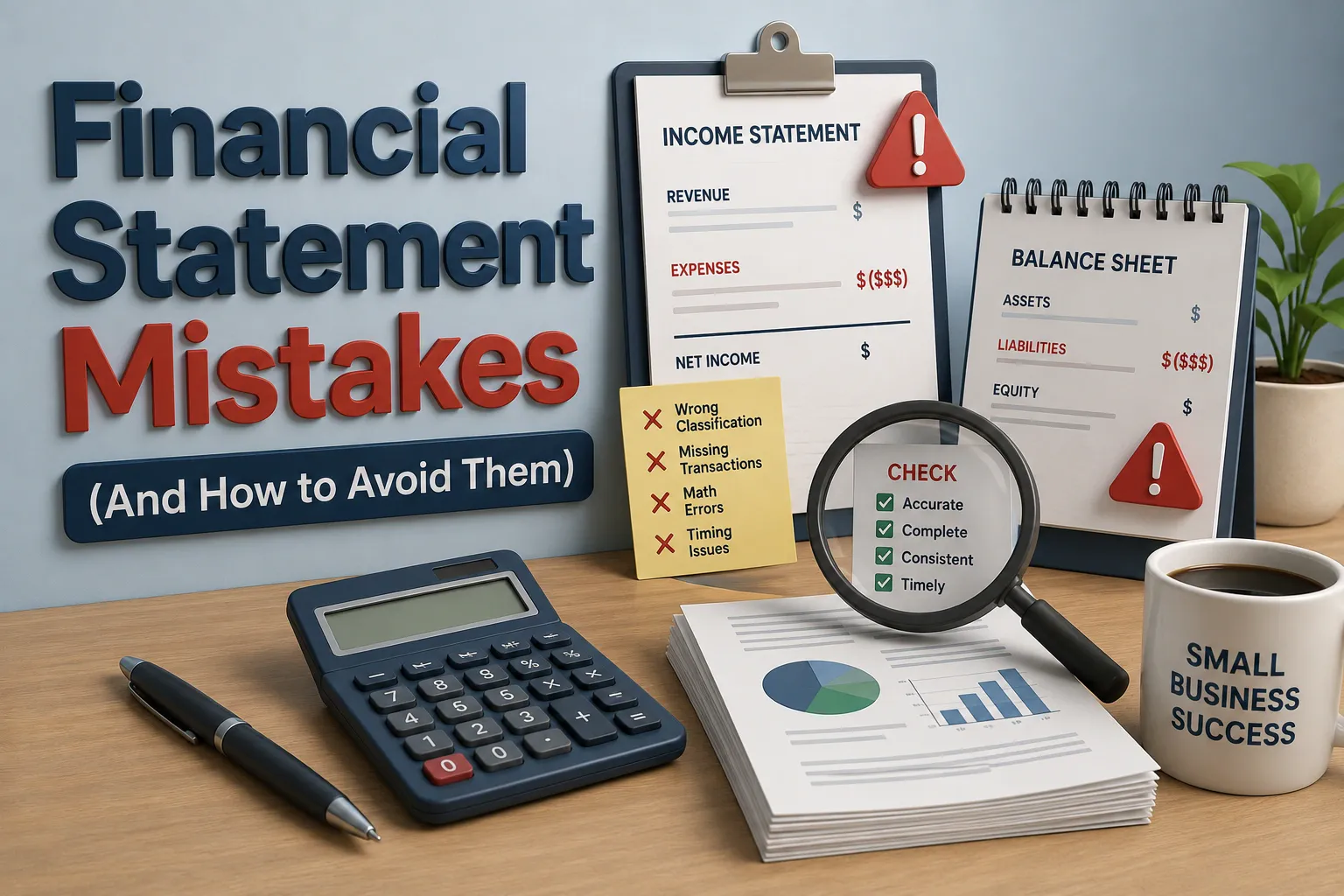
Financial statements are essential tools for understanding a business’s financial health. They help business owners monitor revenue, expenses, profitability, and cash flow. However, many small businesses make mistakes when preparing or interpreting financial statements.
These mistakes can lead to poor decision-making, inaccurate reporting, tax problems, and even financial losses. Understanding the most common financial statement mistakes can help small business owners improve their accounting practices and maintain accurate financial records.
In this guide, we will explore the most common financial statement mistakes small businesses make and how to avoid them.
Why Accurate Financial Statements Matter
Financial statements provide a clear picture of a company’s financial position and performance. Investors, lenders, and business owners rely on these reports to make informed decisions.
The three main financial statements include:
- Income Statement
- Balance Sheet
- Cash Flow Statement
Together, these reports provide insight into profitability, financial stability, and cash management.
When financial statements contain errors, businesses may misjudge their financial performance or make incorrect strategic decisions.
1. Mixing Personal and Business Expenses
One of the most common mistakes small business owners make is mixing personal expenses with business expenses.
For example, using a business bank account to pay for personal groceries or entertainment makes it difficult to track actual business costs.
Why This Is a Problem
- Financial statements become inaccurate
- Tax deductions may be disallowed
- Business profitability becomes unclear
How to Avoid It
- Open a separate business bank account
- Use a dedicated business credit card
- Maintain proper bookkeeping records
eparating personal and business transactions ensures financial reports reflect the true performance of the business.
2. Failing to Reconcile Bank Statements
Bank reconciliation is the process of matching accounting records with bank transactions.
Many small businesses neglect this step, leading to discrepancies between their financial records and bank balances.
Common Problems
- Missing transactions
- Duplicate entries
- Recording errors
Without reconciliation, financial statements may show incorrect cash balances.
Solution
Perform monthly bank reconciliations to ensure that accounting records match bank statements.
3. Incorrect Revenue Recognition
Another major mistake is recording revenue incorrectly.
Some businesses record revenue before it is earned or fail to record it when it should be recognized.
Example
If a company receives payment in advance for services not yet delivered, the amount should be recorded as unearned revenue, not income.
Impact
Incorrect revenue recognition can distort profitability and mislead business owners about their financial performance.
4. Ignoring Accrual Accounting Adjustments
Many small businesses record transactions only when cash is received or paid.
However, financial statements often require accrual accounting, which records revenue when earned and expenses when incurred.
Examples of Adjustments
- Accrued expenses
- Prepaid expenses
- Depreciation
- Accrued revenue
Ignoring these adjustments can lead to inaccurate profit calculations.
5. Not Tracking Accounts Receivable and Payable
Accounts receivable represents money customers owe to the business, while accounts payable represents money the business owes to suppliers.
Some small businesses fail to track these properly.
Consequences
- Overstated revenue
- Missed payments to suppliers
- Poor cash flow management
Maintaining accurate records of receivables and payables helps businesses understand their financial obligations.
6. Misclassifying Expenses
Another frequent accounting mistake is classifying expenses incorrectly.
For example:
- Recording equipment purchases as regular expenses
- Misclassifying capital expenditures
- Incorrect expense categories
This affects both the income statement and balance sheet.
Example
Buying a machine worth $10,000 should be recorded as a capital asset, not an operating expense.
Correct classification ensures accurate financial reporting.
7. Not Recording Depreciation
Many small businesses purchase equipment, vehicles, or computers but forget to record depreciation.
Depreciation spreads the cost of an asset over its useful life.
Example
If a company purchases machinery for $20,000 with a 10-year life, depreciation expense should be recorded annually.
Ignoring depreciation overstates profit and assets.
8. Ignoring Inventory Management
Inventory errors are common among retail and product-based businesses.
Mistakes include:
- Incorrect inventory valuation
- Not recording inventory purchases
- Failing to track inventory changes
These errors directly affect Cost of Goods Sold (COGS) and gross profit.
Proper inventory tracking ensures accurate financial reporting.
9. Relying Only on Bank Balance
Some small business owners think their business is profitable simply because there is money in the bank.
However, the bank balance does not show:
- Outstanding invoices
- Future expenses
- Unpaid bills
Financial statements provide a more accurate view of business performance than bank balances alone.
10. Not Reviewing Financial Statements Regularly
Another major mistake is preparing financial statements but not reviewing them.
Financial statements should be reviewed regularly to identify trends and financial issues.
Recommended Review Schedule
- Monthly profit and loss review
- Quarterly financial analysis
- Annual financial planning
Regular reviews help business owners detect problems early.
Real Example of a Financial Statement Mistake
Consider a small restaurant.
Revenue recorded: $120,000
Expenses recorded: $70,000
Reported profit: $50,000
However, the owner forgot to include:
- Rent: $15,000
- Equipment depreciation: $5,000
Actual profit:
$120,000 – $90,000 = $30,000
This example shows how missing expenses can significantly distort financial statements.
Best Practices for Accurate Financial Statements
Small businesses can avoid financial statement mistakes by following these best practices:
Maintain Proper Bookkeeping
Use reliable accounting software and maintain accurate records.
Separate Personal and Business Finances
Always keep business transactions separate.
Reconcile Accounts Regularly
Monthly reconciliations ensure accurate financial data.
Use Accounting Software
Tools such as QuickBooks, Xero, or Wave can automate many accounting tasks.
Seek Professional Advice
Consulting an accountant or bookkeeper can help ensure compliance and accuracy.
Final Thoughts
Financial statements play a critical role in managing a successful business. Unfortunately, many small businesses make mistakes that affect the accuracy of these reports.
Common errors such as mixing personal expenses, failing to reconcile accounts, misclassifying expenses, and ignoring depreciation can lead to misleading financial information.
By understanding these mistakes and implementing proper accounting practices, small businesses can maintain accurate financial records, make better decisions, and achieve long-term financial success.
Accurate financial reporting is not just about compliance—it is a powerful tool for business growth and financial stability.

